
Walk into a busy garage or workshop on a hot afternoon and the problem is obvious: heat builds up quickly, air barely moves, and working conditions become uncomfortable long before the job is finished.
This is especially common in auto repair shops, commercial garages, detailing centers, workshops, and other large spaces with high ceilings and limited natural airflow.
Opening a door may help temporarily. Portable fans can cool one workstation. Air conditioning can work, but cooling a large garage—especially one with doors opening throughout the day—can become expensive.
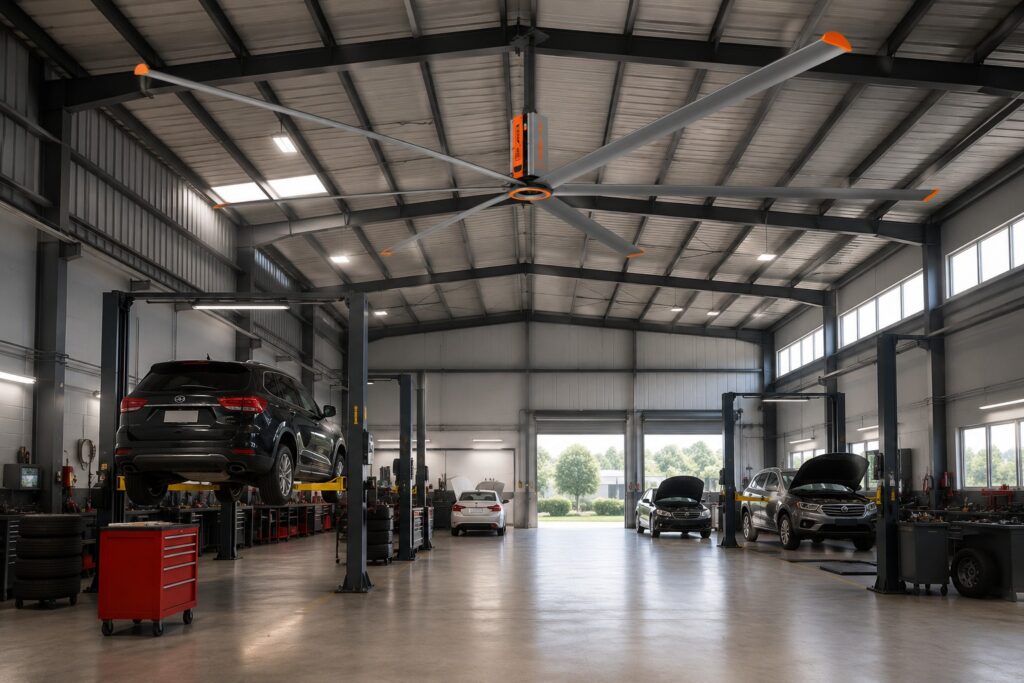
For larger spaces, HVLS fans offer a more practical way to keep large volumes of air moving across the garage without relying on multiple high-speed fans.
HVLS (High Volume, Low Speed) ceiling fans are designed to move large volumes of air across wide areas at relatively low speeds. Instead of creating a strong blast in one direction, they generate broad, consistent airflow throughout the workspace.
That means fewer hot spots, better air distribution, and a more comfortable environment for people working below.
For garages where heat and poor circulation are an everyday problem, the right fan is not simply another piece of equipment—it becomes part of the building’s overall ventilation and cooling strategy.
Why Large Garages Struggle With Airflow
Commercial garages present a difficult cooling environment.
High ceilings allow warm air to collect overhead. Large doors repeatedly introduce outdoor heat. Vehicles, machinery, lighting, and people add even more heat during the working day.
At the same time, many garages have areas where very little air moves.
The result is often an uneven environment: one part of the shop may feel tolerable while another becomes noticeably hotter and more stagnant.
This is where an HVLS fan can make a significant difference.
Rather than cooling only one workstation, a properly selected industrial ceiling fan circulates air across a much larger area, helping create more consistent conditions throughout the garage.
How HVLS Fans Improve Garage Airflow
HVLS stands for High Volume, Low Speed. If you’re comparing fan sizes, motor types, airflow requirements, and installation conditions, our industrial ceiling fan buying guide explains what to consider before selecting a fan for a large workspace.
The principle is simple: use a large fan diameter to move a substantial volume of air without needing extremely high rotational speed.
The fan pushes air downward and outward across the floor. That air then travels through the occupied area before circulating back upward, creating broad air movement throughout the building.
For technicians working underneath vehicles, employees moving between service bays, or teams spending an entire shift inside a workshop, that wider airflow coverage can be far more useful than several small fans pointed in different directions.
Reduce Hot and Stagnant Areas
In buildings with high ceilings, warm air naturally rises.
Without sufficient circulation, temperatures can vary significantly between the floor and ceiling. HVLS fans help mix these air layers, reducing temperature stratification and distributing air more evenly.
Improve Perceived Comfort
A ceiling fan does not refrigerate the air.
Instead, moving air increases the cooling effect people feel on their skin. This can make a warm garage considerably more comfortable without requiring the entire building to be mechanically cooled to a much lower temperature.
Cover More Space With Fewer Fans
Portable and wall-mounted fans can be useful for localized cooling, but large garages often require multiple units to cover individual workstations.
An HVLS ceiling fan is designed for broad-area circulation, making it particularly suitable for open workshops and commercial garages.
Where Industrial Garage Fans Make the Most Sense
Large ceiling fans are particularly suitable for:
- Auto repair workshops
- Vehicle maintenance facilities
- Commercial garages
- Car detailing centers
- Fleet maintenance buildings
- Industrial workshops
- Equipment maintenance facilities
- Large hobby or fabrication workshops
- Warehouses with vehicle service areas
For a small residential garage with a low ceiling, a large HVLS fan may not be the right choice. Fan diameter, ceiling height, structural conditions, and available clearance all need to be considered before selecting a system.
The right solution starts with the building—not simply the largest available fan.
Garage Cooling Without Relying Entirely on Air Conditioning
Cooling a large garage with conventional air conditioning can be challenging.
Garage doors may open dozens of times per day. Large volumes of conditioned air can escape, while outdoor heat enters almost immediately.
HVLS fans take a different approach by focusing on air movement and comfort.
They can operate independently or form part of a wider cooling strategy. In particularly hot environments, HVLS fans can also work alongside an evaporative air cooler for garages, adding actual cooling while the ceiling fan distributes that cooler air across a wider working area.
This type of integrated approach is particularly useful for facilities that are too large, too open, or too frequently accessed for conventional air conditioning to be the only practical option.
Air Circulation Is Not the Same as Exhaust Ventilation
This distinction is important in a garage.
An industrial ceiling fan circulates indoor air. It does not remove carbon monoxide, welding fumes, paint vapors, fuel vapors, or other hazardous contaminants from the building.
Facilities where vehicles run indoors or processes generate fumes still require appropriate mechanical ventilation. An industrial exhaust fan can help remove hot or contaminated indoor air, while an HVLS fan focuses on circulating air throughout the workspace.
For many commercial garages, the best solution therefore combines:
- HVLS fans for general air circulation
- Exhaust fans or mechanical ventilation for contaminated air
- Local extraction where fumes or dust are produced
- Evaporative cooling where additional temperature reduction is required
The objective is not simply to create more wind. It is to design airflow that suits the actual working environment.
Choosing the Right Ceiling Fan for a Garage
There is no single fan size that works for every garage.
Before choosing a system, consider several factors.
Ceiling Height
Ceiling height is one of the first things to check before choosing a large-diameter fan. Fan diameter, roof clearance, blade height, lighting, sprinkler systems, vehicle lifts, and other obstructions all affect installation. See our guide to HVLS fan mounting height for recommended clearances for different fan types.
Large HVLS ceiling fans require adequate installation clearance. Ceiling structure, mounting position, lights, cranes, sprinkler systems, doors, and other equipment all need to be considered.
Floor Area
A small workshop and a multi-bay service center require very different airflow coverage.
Larger spaces may benefit from a large-diameter HVLS fan, while lower or more compact garages may require commercial ceiling fans or another configuration.
Building Layout
Vehicle lifts, storage racks, partitions, machinery, and mezzanines can affect the way air moves.
Fan placement should therefore be based on the actual floor plan rather than simply locating the fan in the center of the room.
Working Conditions
A detailing center, auto repair shop, fabrication workshop, and warehouse garage may all require different airflow strategies.
Understanding where employees spend most of their time helps determine where airflow will provide the greatest benefit.
Why Work With RTFANS?
Selecting an industrial fan involves more than choosing a diameter from a catalog.
RTFANS provides HVLS fans and integrated ventilation and cooling solutions for large commercial and industrial spaces.
Depending on the application, a solution can include:
- HVLS ceiling fans
- Commercial ceiling fans
- Evaporative air coolers
- Industrial exhaust fans
- Cooling pad systems
- Combined ventilation and cooling design
Instead of treating the fan as a standalone product, the objective is to match airflow to the size, height, layout, and working conditions of the facility.
FAQ
Get the Right Airflow for Your Garage
A hot, stagnant garage does more than make people uncomfortable. It can make long shifts harder, create uneven working conditions, and force businesses to depend on inefficient spot-cooling solutions.
The answer is not simply to install more small fans.
For the right building, an HVLS ceiling fan can move air across a much larger working area and become the foundation of a more effective garage cooling and ventilation strategy.
Not sure which fan, air cooler, or ventilation setup is right for your garage?
Send RTFANS your floor area, ceiling height, building layout, location, and working conditions. Our team can recommend a cooling and airflow solution based on the actual space.
Contact RTFANS for a Free Cooling Solution →