
Plain talk about store heat, refrigeration load, and how a fan makes your existing air conditioning go further.
One thing up front: HVLS fans do not replace your air conditioning. They work with it. Put air movement across the sales floor and shoppers feel cooler at the same thermostat setting — so you can recover setpoints, cut the cooling capacity you need, and install fewer or smaller air-conditioning units. Same comfort, less equipment to buy and to run.
Start here: the problem isn’t the frozen aisle
Walk into a big supermarket on a hot afternoon and you will find a small crowd in the frozen food section. They are not shopping. They are standing. A few are on their phones.
They are not there for the peas. They are there because it is the only cool spot in the building.
So the frozen aisle isn’t popular. It’s just the coolest place to stand. And once you notice that, you start asking a better question: why is only one part of a 8,000 m² store comfortable?
Here are six reasons large supermarkets are putting big, slow HVLS fans on their ceilings — as a partner to the AC system they already have, not as a replacement for it. Every reason comes with a number.
1. It fixes the “two climates in one building” problem
Hot air rises. That’s not a theory, it’s a rule. Under a 5–6 metre ceiling, warm air parks up top and never comes back down on its own. Meanwhile the cold air spilling out of open display cases is heavy, so it sinks and pools near the floor.
The result: your store doesn’t have one climate. It has two. A cold strip along the fresh aisles, and warm everywhere else.
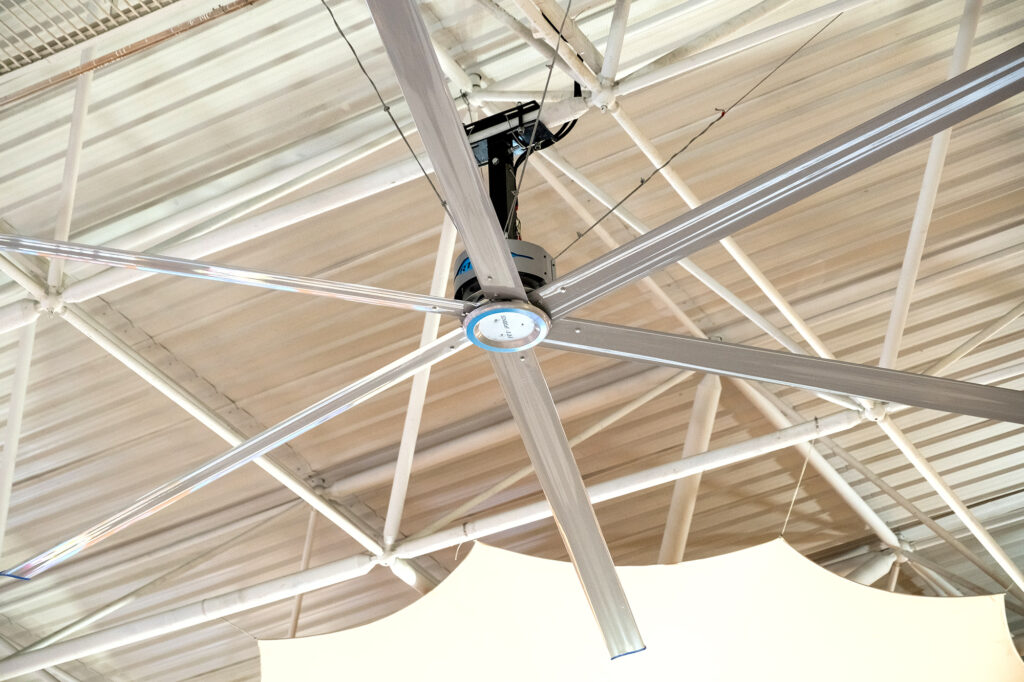
A large, slow-turning HVLS fan mixes that air back together — top to bottom, aisle to aisle. It doesn’t make the air colder. It makes the whole store feel like one temperature instead of three.
The number: shoppers give off about 120 W of body heat each. Put 1,200 of them in your store at peak and you have added roughly 144 kW of heat — close to your entire lighting load.
2. It attacks the single biggest load in the building
Here’s the part that shows up on your energy bill.
An open vertical display case pulls in warm, moist air from the sales floor. Industry analysis puts that infiltration at roughly 70–80% of the case’s total cooling load. That isn’t a small inefficiency. It’s the dominant cost of keeping food cold.
And it scales up fast: refrigeration plus air conditioning can account for up to 75% of a supermarket’s electricity use, with refrigeration usually the largest single load in the building. Published benchmarks put a typical store at 700–1,000 kWh per square metre per year.
Every degree you take off the sales floor — and every bit of air you keep moving — is load your compressors don’t have to carry.
3. It lets you install less air conditioning — not none
This is the argument that usually ends the meeting, and it is the one most people get wrong.
HVLS fans are not an alternative to your AC system. Air conditioning does two jobs a fan cannot: it takes heat out of the air, and it takes moisture out of it. A fan does neither. What a fan changes is how much cooling people need before they are comfortable.
The mechanism is simple. Moving air breaks up the still, warm layer sitting against your skin, so you feel cooler at the same air temperature. Energy bodies put that at a perceived 6–7 degrees cooler, with the thermostat untouched. Recover those setpoints and the cooling load your AC has to meet comes down — and cooling capacity is exactly what you are buying when you buy AC units.
The number: one RTF-CF unit — 1.5 kW — covers up to around 1,500 m². An 8,000 m² sales floor runs about six of them: roughly 9 kW of fan power in total. Air conditioning for the same floor moves in the hundreds of kilowatts.
That gap is the whole point. Nine kilowatts of air movement is not there to compete with those hundreds of kilowatts — it is there to reduce them: fewer units, smaller plant, lower peak demand, less equipment to service.
The honest caveat: how much you can take out depends on your space, your setpoint strategy and your comfort standard — and in hot, humid climates your AC still carries the dehumidification load, which air movement cannot do. We would rather scope that with you than quote a number.
4. Comfortable shoppers stay longer — and spend more
This is the advantage you feel in the till, not the meter.
Peer-reviewed retail research has linked extreme in-store temperatures to measurably weaker sales. Retail analytics point the same way: the longer shoppers stay, the more they buy. A store where the only comfortable spot is the frozen aisle is quietly telling customers to wrap up and leave.
Worth knowing: the effect lands on people, not on the air. So you get a more comfortable store without paying to cool more air — which is the difference between adding capacity and getting more out of the capacity you already own.
Same thermostat setting. Very different store.
5. It protects your cold chain instead of fighting it
Fair question: won’t a big fan disturb the open display cases?
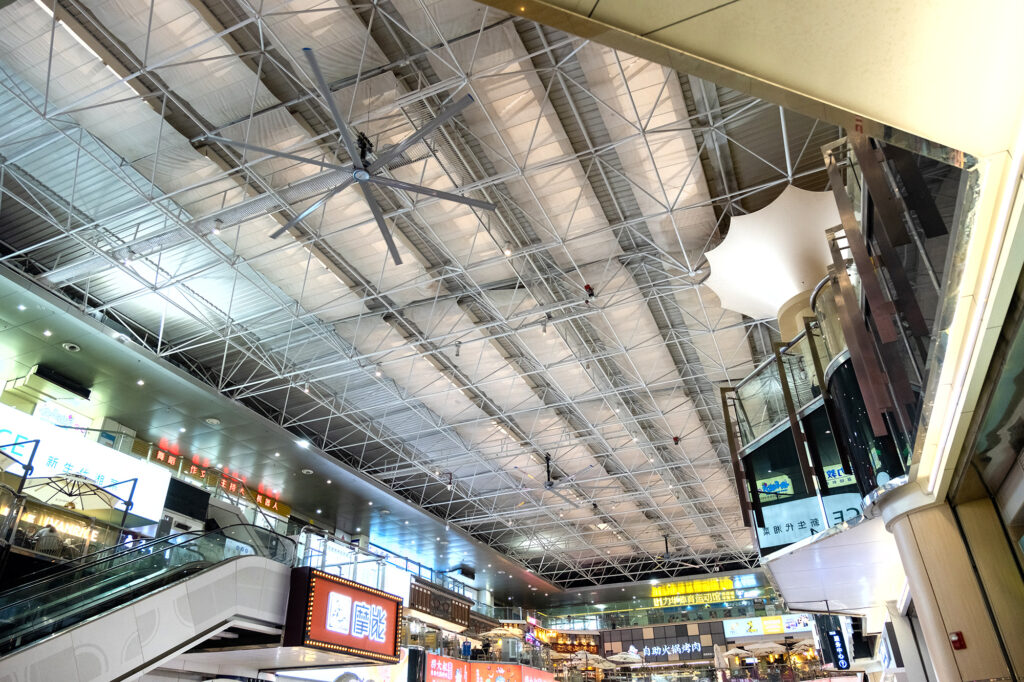
Not if it’s specified properly. Large diameter, low speed, air moving along the aisles and over shoppers’ heads — never blasted into the case faces. That air curtain is what keeps your food safe, and it stays exactly where it belongs.
Stable case temperatures are the point. Unstable ones mean longer defrost cycles, more compressor wear, and a food safety process working harder than it should.
There’s a food-safety bonus too: our HVLS motors use oil-free PMSM direct drive. No gearbox, no gear oil, nothing to leak above open food — and no oil-change schedule to chase.
6. It can push your refrigeration replacement bill to the right
This is the argument most supermarkets haven’t heard yet, and it’s the biggest one.
Refrigerant rules are tightening. In the EU, the revised F-gas Regulation is phasing down HFCs and refrigerant prices are climbing fast — and a supermarket typically carries 400–700 kg of HFC refrigerant on site. In the US, the EPA has pushed its low-GWP deadline out to 2032, which buys time but doesn’t cancel the bill: bringing a store’s refrigeration into compliance can cost $1 million or more per store, which is why major chains are spreading it across a decade.
So the cheapest refrigeration project is the one you don’t have to do yet.
Reduce the load your refrigeration system is sized against and you change the capital number. Airflow doesn’t replace your refrigeration system — it changes what that system has to carry.
How many fans does a supermarket need?
Start with these two:
| Model | Power | Coverage per unit |
| RTF-CF/DF series | 1.5 kW | up to ~1,500 m² |
| RTF-SF series | 0.55 kW | up to ~550 m² |
Those are maximum coverage figures. The real number depends on your ceiling height, aisle layout and where the cases sit — a 4 m ceiling and a 9 m ceiling are two completely different designs. We would rather run your actual numbers than hand you a rule of thumb.
Two rules we never break
Never aim air at the open case faces. That air curtain is your cold chain. Air movement belongs over the aisles.
In hot, humid climates, ventilation comes first. Evaporative cooling that adds humidity will only increase your refrigeration load. The order of operations matters more than the equipment list.
Quick answers
So does this mean we can drop the air conditioning? No — and we would not sell it that way. Your AC still handles the heat load and the humidity. The fan changes how much cooling your shoppers need before they feel comfortable, which lets you reduce the capacity you install and run. It is a supplement, sized against your existing system rather than instead of it.
Does a ceiling fan actually lower the temperature? It lowers what you feel, and it mixes down the trapped hot air overhead. On its own it doesn’t change air temperature — which is exactly why we pair it with your existing cooling rather than positioning it as a standalone fix.
Will it be noisy? Direct-drive units have no gearbox, so there’s no gear-mesh noise. That’s usually the reason supermarkets choose them over gear-driven fans in the first place.
We have 40 stores. Can this be rolled out? Yes, and phasing is normal. Start with two stores, measure the energy and the case stability, then use real numbers to justify the rest. Nobody argues with a meter reading.
If you’re planning a store
Send me three things — sales-floor area, ceiling height, and case layout — and I will put together an airflow layout with indicative fan counts and power draw. If you are already working through a refrigeration capital plan, tell me that too. That is the conversation where airflow usually earns its place.
RTFANS has been building ventilation and cooling for large spaces since 2003 — 23 years, and 90+ countries. Supermarket cooling is one of the areas we know best.
info@koolairint.com Whatsapp: +8613926828226
#SupermarketCooling #HVLSFans #RetailCooling #EvaporativeCooling #DisplayCaseInfiltration #CaseTemperatureStability #FoodSafety #EnergyEfficiency #HFCPhasedown #LowGWP #NaturalRefrigerants #StoreRetrofit #DwellTime #DemandCharges #FacilityManagement #TCO #RTFANS #KoolAir