
A cooler of this kind uses water because that is how it cools. The water is not a fault; it is the fuel.
If nobody manages that water, the unit keeps running while its cooling quietly collapses — and the money shows up on two other bills instead.
Three checks and one control setting are enough to keep it performing into its fifth summer.
The service call came in on a Thursday afternoon in August, and it was short: “The cooler is running, but the floor is hot.”
The technician found the unit humming along exactly as designed, drawing full power, moving air. He also found the pads coated in a hard white crust, thick enough that the surface felt like sandpaper. The cooler was doing very little of what it had been bought to do.
Nobody had done anything wrong. Nobody had ignored a warning light, because there was no warning light. The water bill had been a slightly odd line item all summer, and the pads had simply done what wet surfaces do when the water going into them is left unmanaged.
Why a cooler uses water at all
Think about stepping out of a swimming pool on a breezy day. The wind feels cold on your skin — not because the air is cold, but because water is evaporating off you and taking heat with it.
An evaporative cooler does the same thing at industrial scale. It wets a large surface and moves air across it. Water evaporates into that air, the energy for the change is pulled out of the air, and the air arrives at the floor measurably cooler.
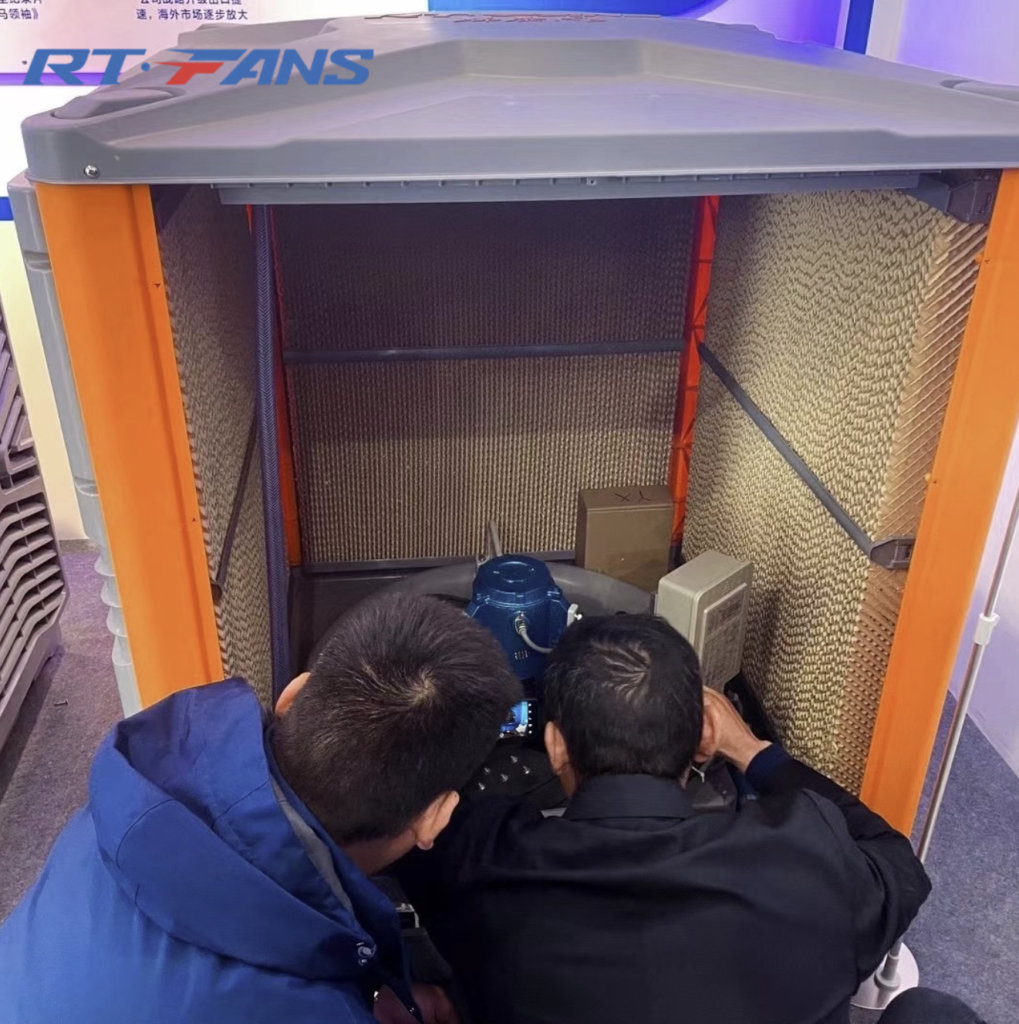
This is why the electrical bill is a fraction of conventional cooling. And it is also why there is a second bill: the water leaves with the heat. It does not recirculate forever. It has to be replaced.
Where the water actually goes
Three streams, and only one of them is the one doing the work.
The water that evaporates. The productive stream. Its volume is set by how much heat you are rejecting — more heat, more water. There is no trick that avoids this. It is the price of the effect, and it is what you are paying for the low electricity bill.
The water deliberately drained. This is the one that surprises people. A portion of the water is intentionally sent to waste to keep dissolved minerals from concentrating. It looks like a leak, or like waste. It is neither — it is what keeps the rest of the water able to do its job.
The water used for cleaning. Hosing out the unit between seasons, washing dust off the pads. Small, ordinary, and larger when maintenance is postponed.
Why the crust matters more than the price of water
Your supply water is not pure. It carries calcium, magnesium, silica, and other dissolved minerals. When water evaporates, those minerals stay behind. Every litre that evaporates leaves its mineral content in the remaining water, and the concentration climbs.
Eventually it forms a hard deposit on the pads. This is the part worth understanding, because it does not look like a failure. The unit still spins. The pump still runs. But the deposit blocks the wet surface, so less water evaporates, so less cooling happens — and the fan has to work harder to push air through a clogged pad.
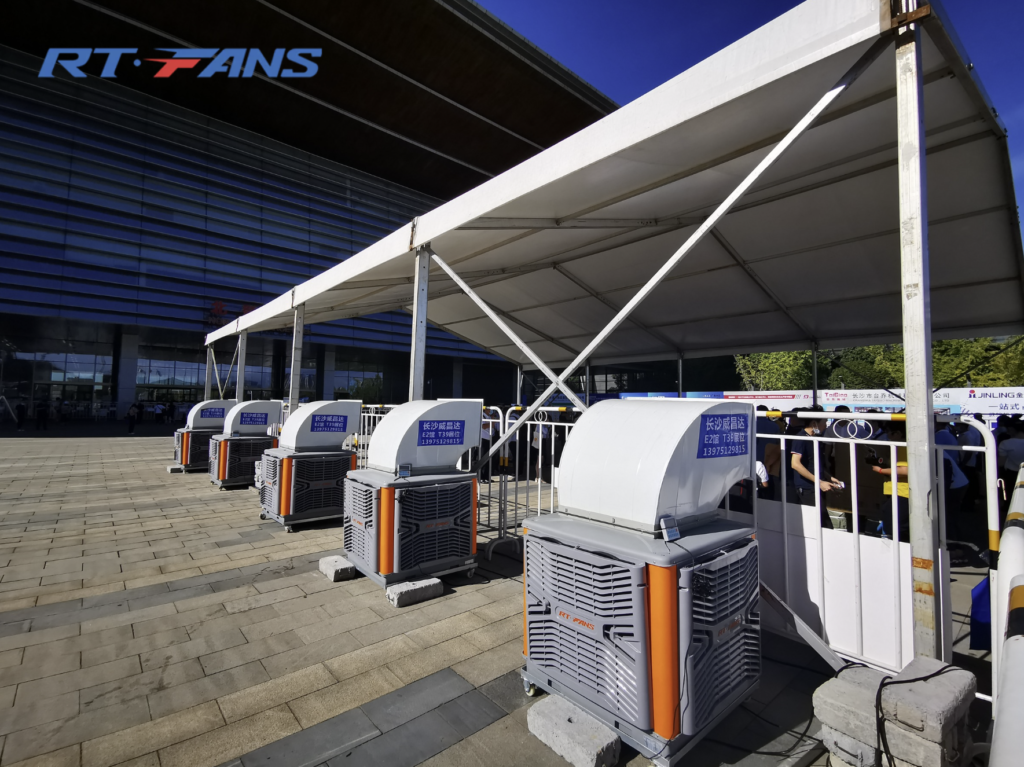
The counterintuitive result: saving water can cost more than using it. Cut the drain water to shave the water bill and you raise the electricity bill, then pay again when the pads have to be replaced early. The right target is not the smallest water bill. It is the smallest total of water plus electricity plus pad life.
Five things you can check without an engineer
- Look at the pads at the end of the season. If they are white, chalky, or stiff, minerals are winning. If they are soft, evenly coloured, and still springy, the water is being managed well. This single look tells you more than any monthly report.
- Ask for the drain rate in writing. Every unit sends some water to waste on purpose. Ask how much per hour, and why that number. An answer of “it’s preset” is not an answer.
- Ask how that drain is controlled. There are two ways: a simple timer that drains on a schedule, or a control that measures the water and drains only when needed. The measuring type uses less water on soft-water sites and protects better on hard-water sites.
- Test the water once — then again if the source changes. Water quality is a property of your location, not of the cooler. A plant that uses municipal supply in the wet season and a borehole in the dry season has two different waters feeding one machine.
- Put pad replacement in the maintenance budget now. Pads are a consumable, like filters on any other machine. Budgeting for them as a scheduled line item costs less than discovering them as an emergency, usually in the middle of your hottest week.
For engineers
The section above is deliberately non-technical. What follows is for specifiers and maintenance engineers.
Control the purge by measured conductivity, not by fixed timer. A timed drain purges the same volume regardless of incoming water quality, which is simultaneously wasteful on soft water and inadequate on hard water. Conductivity tracks dissolved solids directly, so a control loop can purge approaching the concentration limit and hold back below it. On sites with variable supply chemistry, this is the difference between a self-adjusting system and one that depends on somebody remembering to test.
The test panel worth running: hardness, conductivity or TDS, pH, chlorides, silica, alkalinity, and iron. Chlorides drive corrosion of wetted metal components; silica forms hard deposits that resist routine cleaning; iron can indicate corrosion upstream in the loop.
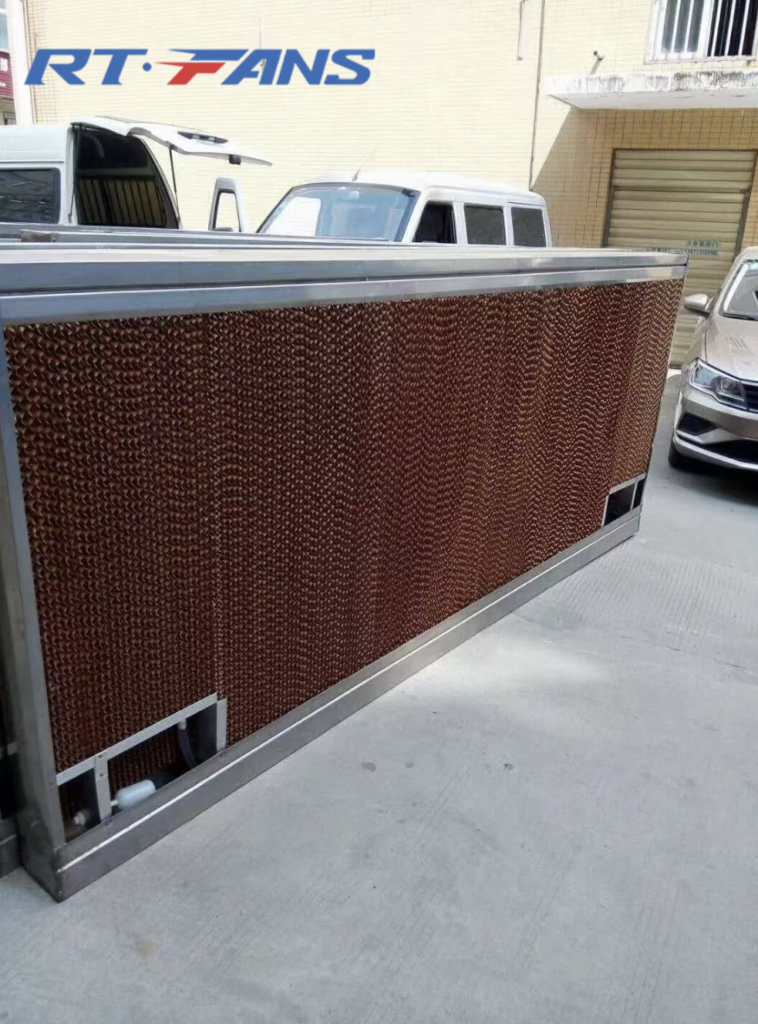
Media selection and wet–dry cycling. Corrugated cellulose media deliver strong evaporation efficiency per unit of face area and are the common choice, but they are a consumable whose life shortens with every wet–dry cycle. On drying, dissolved salts migrate to the surface and crystallise there, stiffening the media and accelerating deposit build-up. Rigid media tolerate cycling better at higher capital cost. Intermittent operation of an evaporative system is therefore often harder on the media than steady running.
Hygiene. Wetted media with continuous airborne dust loading is a growth surface. Biofilm, algae, and mould are controlled by sump cleaning, draining and drying during idle periods, avoiding standing water between seasons, and water treatment where site conditions warrant it. A continuously running system is generally lower risk than one switched on and off irregularly and left damp in between.
Reuse, modelled rather than assumed. Rainwater harvesting and condensate recovery from adjacent refrigeration or air handling plant can offset part of the make-up demand, and payback is short in water-constrained markets. Recycling washdown water is possible with adequate filtration but adds a quality-control obligation. In a market with cheap, soft, abundant water, the engineering effort may not repay itself.
Specify the water balance. Expected evaporation, purge rate and its control method, expected media service life, assumed water chemistry, and supply and drainage requirements. A supplier who can produce this has designed a system. One who cannot has sold an appliance.
What to do before next summer
If you run a facility: find out what your cooler’s drain rate is and what controls it. If the answer is vague, you have found your weakest link, and it is a cheap one to fix.
If you are specifying a new system: ask for the water balance in writing, alongside the cooling capacity. Treat it as part of the specification, not a footnote.
If you are budgeting: add pad replacement to the maintenance plan as a scheduled consumable, and price the water into the operating cost. A cooling system with an unplanned water cost is a cooling system that will be judged unfairly when it underperforms.
Twenty-three years of building and supporting these systems, with installations in more than 90 countries and regions, has produced one consistent finding: the installations still performing in their fifth summer are almost never the ones that spent the most. They are the ones where somebody planned the water.
For further information please contact: Email: info@koolairint.com Whatsapp: +8613926828226