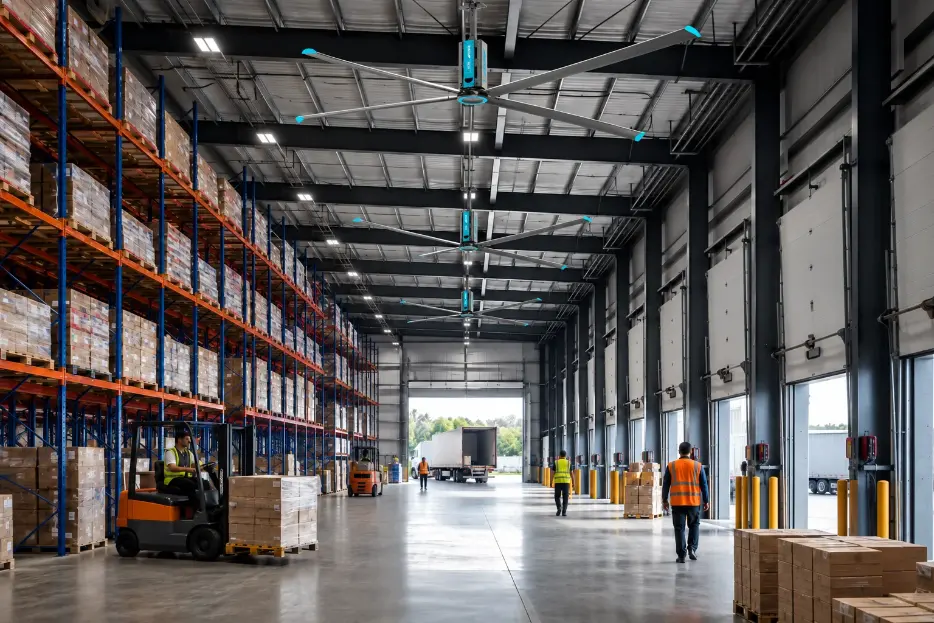
Combine circulation, fresh-air cooling and controls into a system engineered for your building.
Warehouse Airflow Planning
Warehouse Cooling & Ventilation Solutions
A warehouse cooling system should be planned around the building and the work inside it. We help coordinate HVLS fans, evaporative air coolers, and exhaust ventilation for storage aisles, picking areas, packing stations, and loading docks.
Start With the Warehouse Conditions
High-bay warehouses are not uniform boxes. Roof heat, open dock doors, dense storage, shift patterns, and internal equipment can create very different conditions within the same building. The first design step is to map where heat builds up, where people work, and where air can safely enter and leave.
Hot air collecting below the roof and above occupied work areas
Racking, mezzanines, and partitions interrupting natural air movement
Loading doors introducing outdoor heat, humidity, and dust during busy shifts
Packing, picking, and dispatch teams needing more consistent airflow than portable fans can provide
Build the System Around Each Zone
HVLS fans for broad air movement
Large-diameter, low-speed fans circulate air from the upper structure down through the occupied zone and back across the floor. Placement is reviewed against racking aisles, clearances, lighting, sprinklers, and vehicle routes.
Evaporative cooling for warmer zones
Where the climate and operating conditions are suitable, evaporative air coolers can supply fresh, water-cooled air to loading bays, packing stations, or other high-heat areas. Their suitability depends on outdoor humidity, water quality, drainage, and the required indoor conditions.
Exhaust and make-up air
Exhaust fans or roof ventilation can remove accumulated hot air and support air exchange. They do not replace local extraction for vehicle exhaust, welding fumes, dust, or other process contaminants.
What We Review Before Recommending Equipment
Floor area, clear height, roof structure, and available mounting points
Racking geometry, aisle widths, mezzanines, lighting, sprinklers, and crane paths
Dock-door operation, outdoor climate, humidity, and prevailing air movement
Heat sources, worker locations, storage requirements, and any process emissions
Electrical supply, water and drainage availability, access for maintenance, and control preferences
Warehouse Cooling FAQ
What is the best cooling solution for a warehouse?
There is no single best system for every warehouse. HVLS fans are often used for broad air circulation, while evaporative coolers add fresh-air cooling in suitable climates and exhaust equipment removes hot or contaminated air. The right combination depends on floor area, ceiling height, rack layout, heat sources, humidity, and the required indoor conditions.
How many HVLS fans does a warehouse need?
The quantity and diameter should be selected from the actual floor plan and clear ceiling height. Racking, columns, sprinklers, lights, mezzanines, and dock doors can all change fan placement, so a project layout is more reliable than a fixed fan-per-area rule.
Can HVLS fans replace air conditioning in a warehouse?
HVLS fans primarily move and mix air to improve perceived comfort and reduce temperature stratification; they do not refrigerate air. They may supplement an existing HVAC system, but whether they can reduce mechanical cooling depends on the climate, building envelope, process requirements, and comfort or storage limits.
Are evaporative air coolers suitable for warehouses?
They can be effective in hot, relatively dry conditions where introducing fresh air and moisture is acceptable. In humid climates or spaces with strict humidity control, another cooling approach may be more appropriate. A site review should confirm climate, water, drainage, filtration, and maintenance requirements before selection.
Do warehouse fans improve air quality?
HVLS fans improve circulation and can reduce stagnant zones, but circulation is not the same as contaminant removal. Warehouses with forklifts, fuels, welding, dust, or other emissions need properly designed exhaust and local extraction in addition to general air movement.