
Ceiling Fan Direction in Winter: A Practical Guide for Industrial Spaces
Learn how to choose and verify a winter ceiling fan setting in warehouses and factories, with practical guidance on airflow and temperature measurements.

For many conventional ceiling fans, the winter setting is clockwise when viewed from below, creating an upward airflow at low speed. Industrial and HVLS fan designs differ, however, so use the direction and speed recommended by the manufacturer for your specific fan. The goal is to mix warmer air near the ceiling with cooler air in the occupied zone without creating an uncomfortable draft.
In a heated warehouse or factory, this process is called destratification. A fan does not create heat; it moves air that the heating system has already warmed. Whether it improves conditions or reduces heating demand depends on the building, the fan layout, the heating controls and how the space is used.
Why Warm Air Collects Near the Ceiling
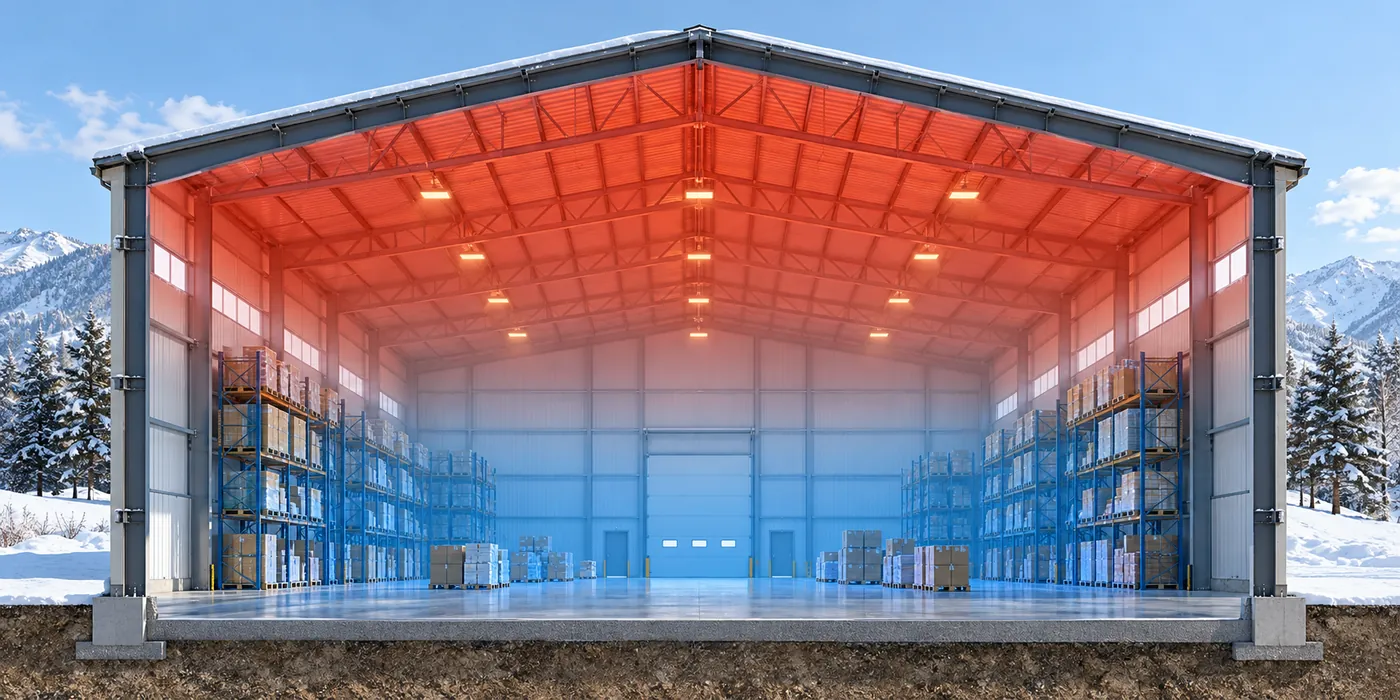
Warm air is generally less dense than cooler air and tends to rise. In a high-ceiling building, heating equipment can therefore produce a temperature difference between the roof area and the work floor. This is called thermal stratification.
The size of that difference varies with outdoor conditions, insulation, heat sources, air leakage, door activity and the building's ventilation system. A warm roof area alone does not reveal how much energy a facility could save. Measure temperatures at several heights before deciding whether destratification is needed.
Clockwise vs Counterclockwise: Start With Airflow

On many conventional fans, clockwise rotation viewed from below produces an updraft, while counterclockwise rotation produces a downdraft. An updraft can help circulate ceiling-level air while limiting the direct breeze on people below.
Rotation alone is not a reliable universal indicator. Blade pitch, fan design and the way a controller labels direction can change the resulting airflow. Some industrial fans may use a different direction or operating strategy for destratification. Check the fan's manual and observe its airflow; do not assume that a direction label copied from a residential guide applies to every HVLS fan.
Start at the manufacturer's recommended winter setting and adjust within its permitted operating range. A higher speed may improve mixing in one building but cause an unwanted draft in another. The useful setting is the one that achieves acceptable temperatures and comfort under the facility's actual conditions.
How HVLS Fans Fit Into a Winter Airflow Plan

High-volume, low-speed (HVLS) fans are designed to circulate air in large spaces. A suitable layout depends on more than floor area: ceiling height, racks, partitions, equipment and available mounting points all affect air movement. The HVLS fan range is a starting point for reviewing equipment options; the correct configuration still requires a site-specific assessment.
Consider how the fan interacts with heaters, supply outlets, return paths, loading doors and occupied workstations. In a warehouse airflow plan, tall racks and frequently opened doors can create conditions that differ from one bay to another. A factory may also need to account for process heat, dust or local exhaust.
Follow the equipment manufacturer's installation and clearance instructions. Have qualified professionals assess the structure, electrical connection, fire protection equipment and interaction with heating and ventilation systems. Do not use a circulation fan as a replacement for required ventilation or exhaust.
How to Check Winter Performance

- Record a baseline. With the heating system operating normally, measure air temperature at representative occupied locations and at accessible upper-level positions. Record the time, outdoor conditions, heating settings and door activity.
- Use the recommended setting. Run the fan according to its manufacturer’s winter instructions. Allow the building conditions to stabilize before comparing readings; the time required depends on the space and heating system.
- Repeat the measurements. Use the same locations and instruments, and compare conditions under similar operating circumstances. An infrared thermometer measures surface temperature, so use an air-temperature sensor when comparing air at different heights.
- Check occupied areas. Ask occupants whether they feel an uncomfortable draft, and look for areas where mixing remains uneven.
- Review the whole system. If conditions do not improve, consider fan direction, speed and placement alongside thermostat location, heater operation, insulation, air leakage and open doors.
A short spot check can reveal a problem, but it cannot establish annual energy savings. To assess energy use, compare metered consumption over suitable periods and account for weather, occupancy, production schedules and changes to heating controls.
When a Direction Change Is Not Enough
Changing direction will not add heat to an unheated building or correct an undersized or poorly controlled heating system. It also cannot seal loading doors or compensate for inadequate insulation. If a facility has several temperature zones, one setting may not work equally well throughout the building.
Fan selection matters too. An obstructed airflow path, an unsuitable mounting location or insufficient airflow may limit mixing. Avoid diagnosing the cause from a single temperature reading. Review the layout and operating data with the fan supplier and the heating or ventilation professional responsible for the site.
Frequently Asked Questions
Should every ceiling fan run clockwise in winter?
No. Clockwise rotation viewed from below is a common winter recommendation for conventional fans, but blade design and controls vary. Follow the specific manufacturer's instructions and verify the airflow.
Will an HVLS fan heat a warehouse?
No. It moves and mixes air; the building's heating system supplies the heat. A fan may help distribute that heat more evenly when the layout and operating conditions are suitable.
What speed should an industrial fan use in winter?
Use the manufacturer’s recommended starting point for the installed model. Adjust within its permitted range while checking temperatures and occupant comfort. There is no universal percentage that fits every installation.
Can destratification reduce heating costs?
It may reduce heating demand in some buildings, but the outcome depends on the heating system, building envelope, controls, weather and operation. Use measured energy data to evaluate a particular facility; do not assume a fixed saving.
What information should I provide when asking for help?
Provide building dimensions, ceiling and mounting heights, a floor plan showing racks and obstructions, heating equipment and thermostat locations, existing fan details, door activity and temperature readings at several heights. Photographs and operating schedules can also help a supplier understand the conditions.
Plan the Right Winter Setting

Begin with the fan manufacturer's instructions, then measure the temperature distribution and check comfort in occupied areas. If the current setup does not meet the facility's needs, a review of the fan layout and heating system can help identify practical next steps.
For a project-specific assessment, request a quote from RTFANS and include your layout, existing equipment and temperature readings.
Related insights
Recommended Engineering & Ventilation Guides

Big Ass Fans vs. RTFANS: Comparing HVLS Fan Performance, Cost, and OEM Options
Compare HVLS fan performance, installed costs, maintenance, and OEM questions when evaluating Big Ass Fans and RTFANS.
View article
How to Choose and Measure HVLS Ceiling Fans for Industrial Spaces
A practical guide to choosing HVLS ceiling fans by coverage, motor type, noise, IP rating, structural support and facility measurements.
View article
Why Industrial Garages Need HVLS Ceiling Fans for Better Airflow
Walk into a busy garage or workshop on a hot afternoon and the problem is obvious: heat builds up quickly, [...]
View article