
HVLS Fans Meaning: What Is an HVLS Fan and How Does It Work?
HVLS stands for High-Volume, Low-Speed. Learn how large overhead fans circulate air in warehouses, factories, gyms and other high-ceiling spaces, then compare the technical and site conditions that affect fan selection.

HVLS fans meaning is straightforward: HVLS stands for High-Volume, Low-Speed. An HVLS fan is a large overhead ceiling fan that moves a broad volume of air at a relatively low rotational speed. Its airfoil blades push air downward and outward, helping circulate air through open warehouses, factories, workshops, gyms, commercial halls and suitable agricultural buildings.
An HVLS fan is an air-circulation device. It can improve perceived comfort and mix warm and cool air, but it does not refrigerate a room and it does not replace exhaust ventilation for fumes, dust, mist or combustion products.
What does HVLS stand for?
The abbreviation has four words:
- High volume: the fan is designed to move a large mass of air through an open area.
- Low speed: the blades rotate more slowly than a small, high-velocity fan.
A large blade span and aerodynamic profile make this combination possible. A small fan can create an intense breeze in one local zone. An HVLS fan creates a deeper and wider airflow pattern that is more appropriate for a high-bay floor.
How does an HVLS fan work?
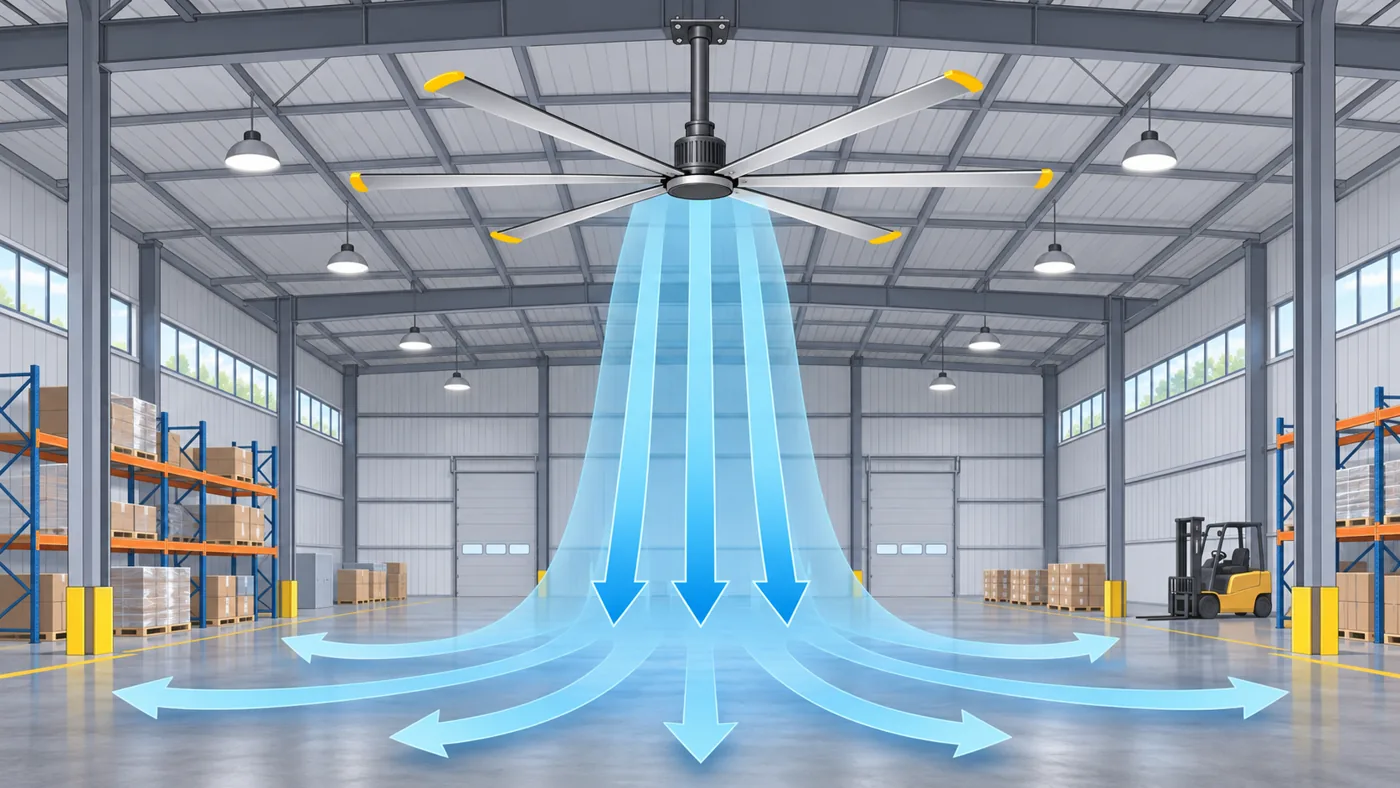
The fan pushes a column of air toward the occupied zone. When the air reaches the floor, it spreads outward and then returns upward around the room. The actual airflow pattern depends on the model, speed, mounting height, ceiling geometry, obstructions and other mechanical systems.
In warm conditions, moving air over the skin can increase evaporation and improve perceived comfort. The actual air temperature does not automatically fall. The RTFANS wind-chill reference explains that perceived temperature depends on air temperature, air velocity, relative humidity, clothing and activity. It also notes that wind chill is not a universally standardized measurement.
In cool conditions, controlled low-speed operation may support destratification by mixing warmer air near the roof with the occupied zone. The selected model's controller and manual must define the permitted operating direction and limits. Do not assume that one seasonal direction applies to every series.
What is an HVLS fan used for?
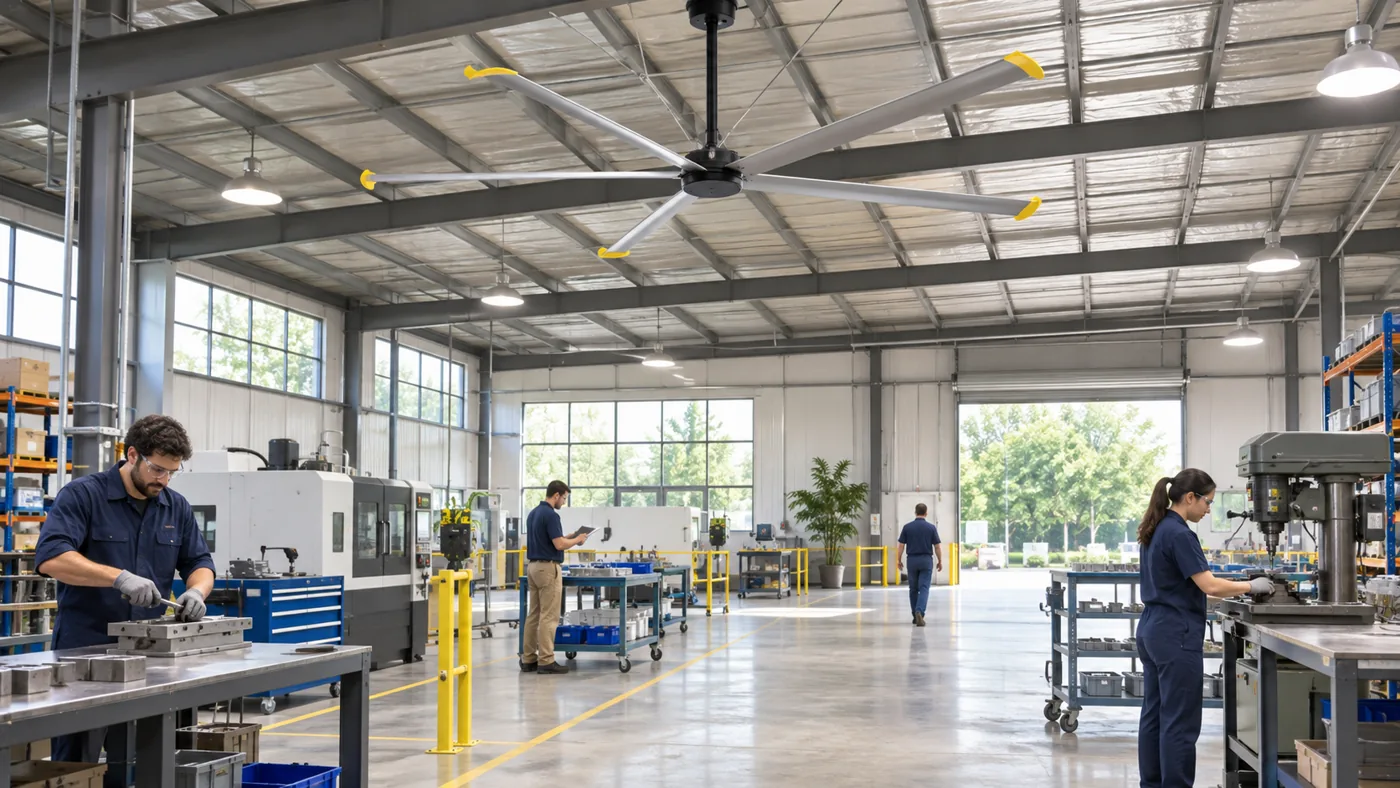
HVLS fans are considered for open areas where stagnant zones, heat stratification or uneven comfort are persistent problems. Common applications include:
- warehouses and distribution centers;
- factories and production halls;
- workshops and vehicle service facilities;
- gyms and sports spaces;
- retail, event and commercial halls; and
- suitable agricultural buildings.
For sports facilities, the gym fan guide provides additional application context.
HVLS circulation should remain separate from contaminant control. Vehicle exhaust, welding fumes, solvents, dust, mist and combustion products require an application-specific exhaust or source-capture design. General circulation can move contaminants around a building if it is used without the required ventilation system.
Current RTFANS configuration ranges
The 2026 overseas configuration table lists the following model-level ranges. These are product configuration values, not a promise that every model serves the same floor area.
| Series | Diameter | Listed airflow | RPM | Blades | Maximum application range* | Noise |
|---|---|---|---|---|---|---|
| King | 5.5–7.3 m | 12,800–15,500 m³/min | 20–63 | 6 | 1,300–1,800 m³ | 43 dB(A) |
| Paragon | 5.5–7.3 m | 10,500–13,800 m³/min | 20–63 | 5 | 1,000–1,600 m³ | 42 dB(A) |
| Charm I | 5.5–7.3 m | 12,800–15,500 m³/min | 20–63 | 6 | 1,300–1,800 m³ | 39 dB(A) |
| Charm II | 5.5–7.3 m | 10,500–13,800 m³/min | 20–63 | 5 | 1,000–1,600 m³ | 39 dB(A) |
| Virtue | 3.3–4.7 m | 6,500–9,000 m³/min | 40–102 | 5 | 350–550 m³ | 39–40 dB(A) |
| Grace | 2.7–4.7 m | 5,580–8,200 m³/min | 30–100 | 5 | 200–500 m³ | 36–38 dB(A) |
| Gallop | 4.0–4.7 m | 7,500–8,200 m³/min | 30–80 | 5 | 300–400 m³ | 38 dB(A) |
*The configuration table labels this field in cubic metres. It should not be rewritten as a universal floor-area coverage claim in square metres.
The table shows why HVLS specifications should be checked by model. The listed diameter range is 2.7–7.3 m, airflow is 5,580–15,500 m³/min, and rotational speed ranges from 20 to 102 RPM across the listed configurations. Blade count is six for the listed King and Charm I configurations, and five for Paragon, Charm II, Virtue, Grace and Gallop.
The listed electrical supply also varies. King, Paragon, Charm I, Charm II and Virtue use 220/380 V configurations in the table, while Grace and Gallop use 220/110 V configurations. Confirm the exact model, power, current, controller and local electrical requirements before quotation or installation.
HVLS fans vs. regular ceiling fans
| Decision point | HVLS fan | Regular ceiling fan |
|---|---|---|
| Air pattern | Broad downward and radial circulation | More localized breeze |
| Typical setting | Open, high-ceiling commercial or industrial space | Smaller rooms or defined zones |
| Selection work | Requires coordination with structure, clearance and building services | Usually simpler for a small room |
| Comfort mechanism | Air movement and mixing across a large zone | Local air movement near the fan |
Neither category is automatically right for every building. Low ceilings, dense racking, mezzanines, cranes, sprinklers, lighting and process equipment can change the suitable arrangement.
What should you check before choosing an HVLS fan?
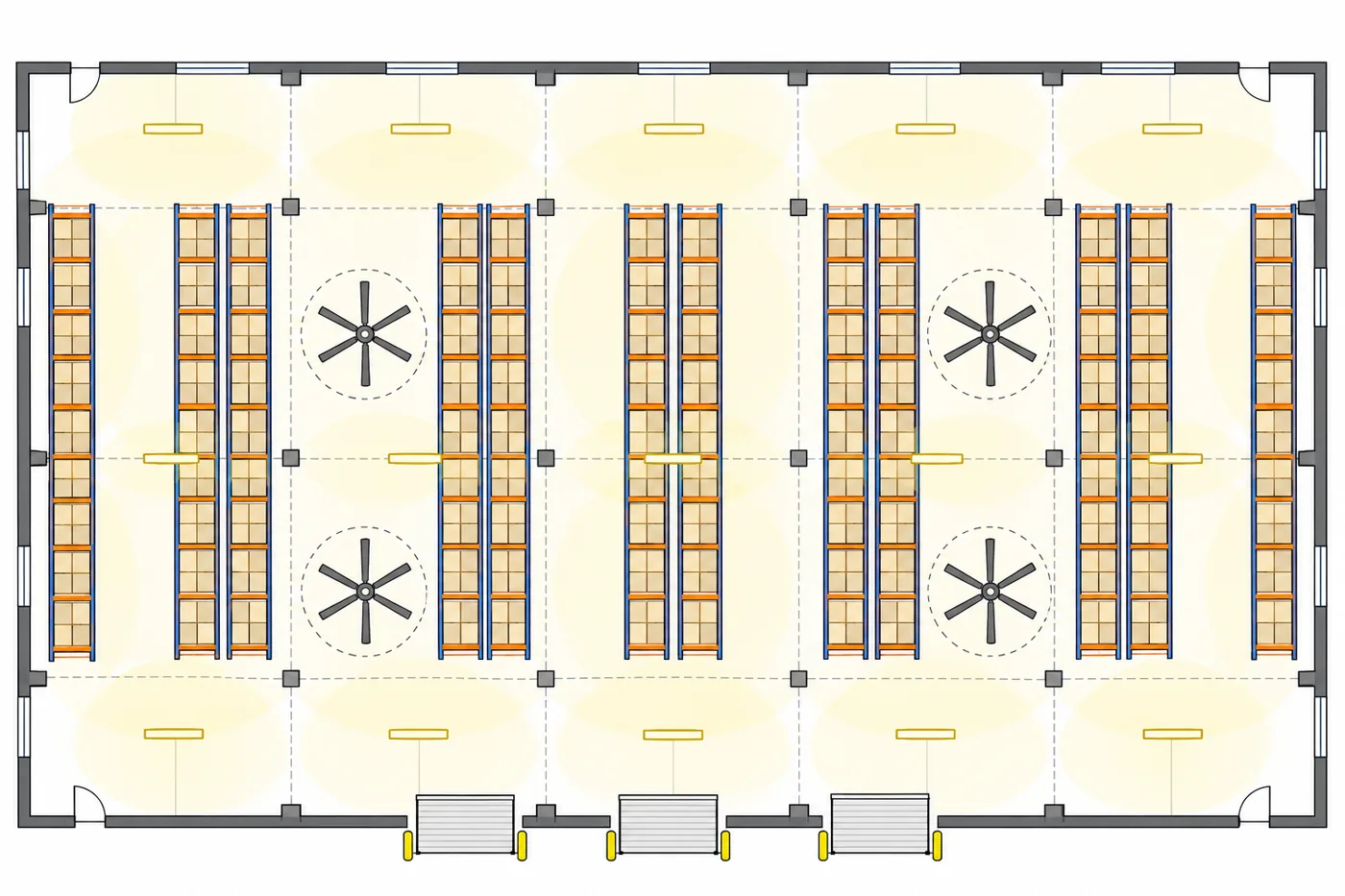
Start with the facility rather than the largest available diameter.
- Floor area and clear ceiling height: establish the air volume and mounting envelope.
- Roof structure and mounting point: confirm the supporting structure, bracket arrangement and safety clearances.
- Obstructions: map racks, cranes, lights, sprinklers, ducts, doors, mezzanines and process equipment.
- Occupied zones: identify where people work, exercise, queue or spend time.
- Existing systems: record HVAC supply and return locations, exhaust, make-up air and evaporative equipment.
- Operating conditions: consider humidity, dust, washdown, corrosive exposure, schedules, controls and maintenance access.
Review the King fans, Paragon Series, Charm Series, Charm II Series, Grace fan and Virtue Series, then confirm the exact model data against the current configuration sheet.
For combined circulation and evaporative cooling, see the fan and cooler solution. The ventilation and cooling calculator can structure an early project discussion, but it does not replace a site-specific layout, structural review or safety assessment.
What do airflow and coverage tests tell you?
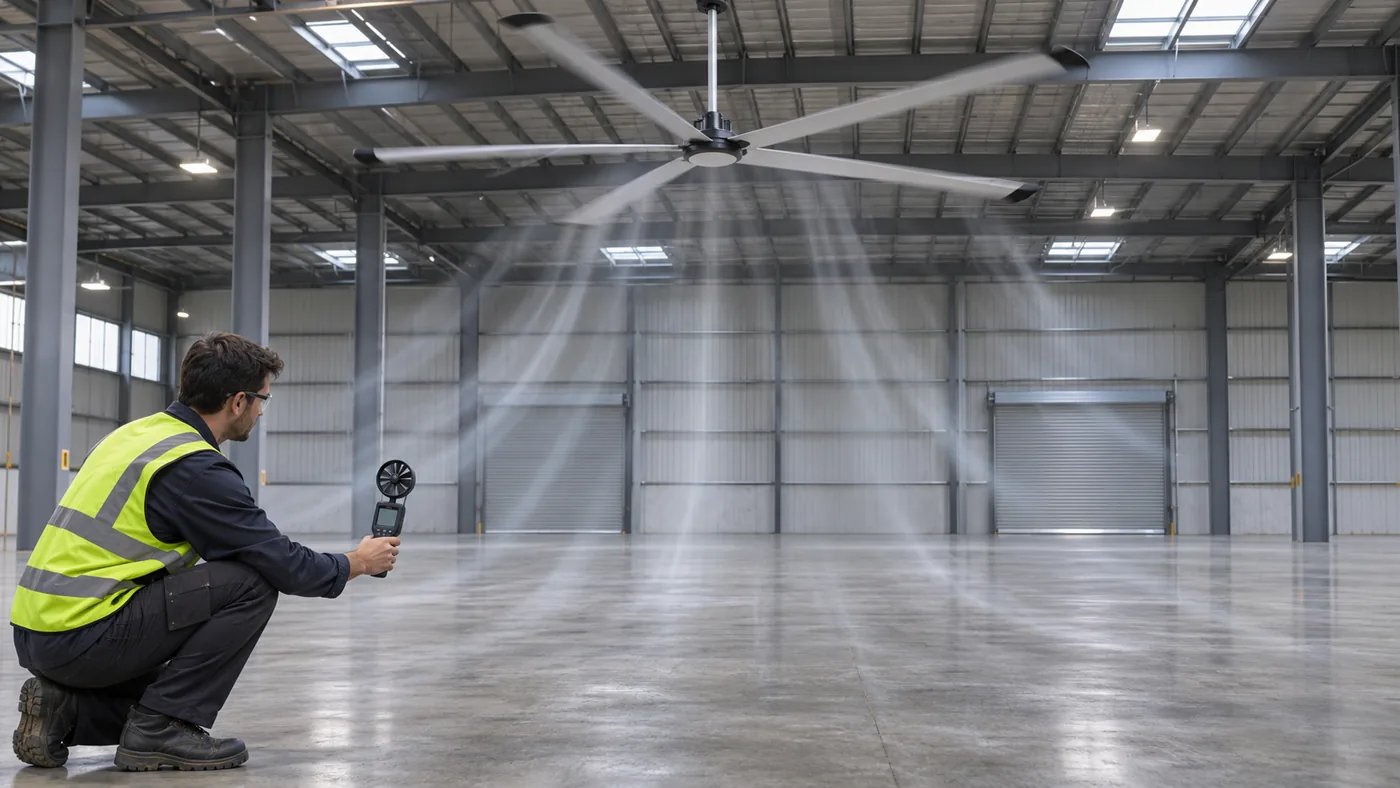
RTFANS technical materials include controlled reference tests for selected models. An industrial test used an RTF-CF-7E 7.3 m fan at a height of 8 m, with at least 1.3 m between the blade top and the ceiling. The calculated airflow was 13,837.98 m³/min. The reference coverage test reached a 24 m radius at 0.5 m/s under an unobstructed test setup.
A commercial test used an RTF-SF-4E 4.0 m fan at a height of 6 m, with at least 0.8 m to the ceiling. The calculated airflow was 8,807.28 m³/min, and the reference coverage test reached a 15 m radius at 0.7 m/s.
These are selected-model tests under stated conditions. They are useful engineering references, not universal coverage guarantees. Final fan quantity and layout depend on the model, required air velocity, ceiling height, obstructions, structural conditions and occupied zones.
Installation, safety and maintenance
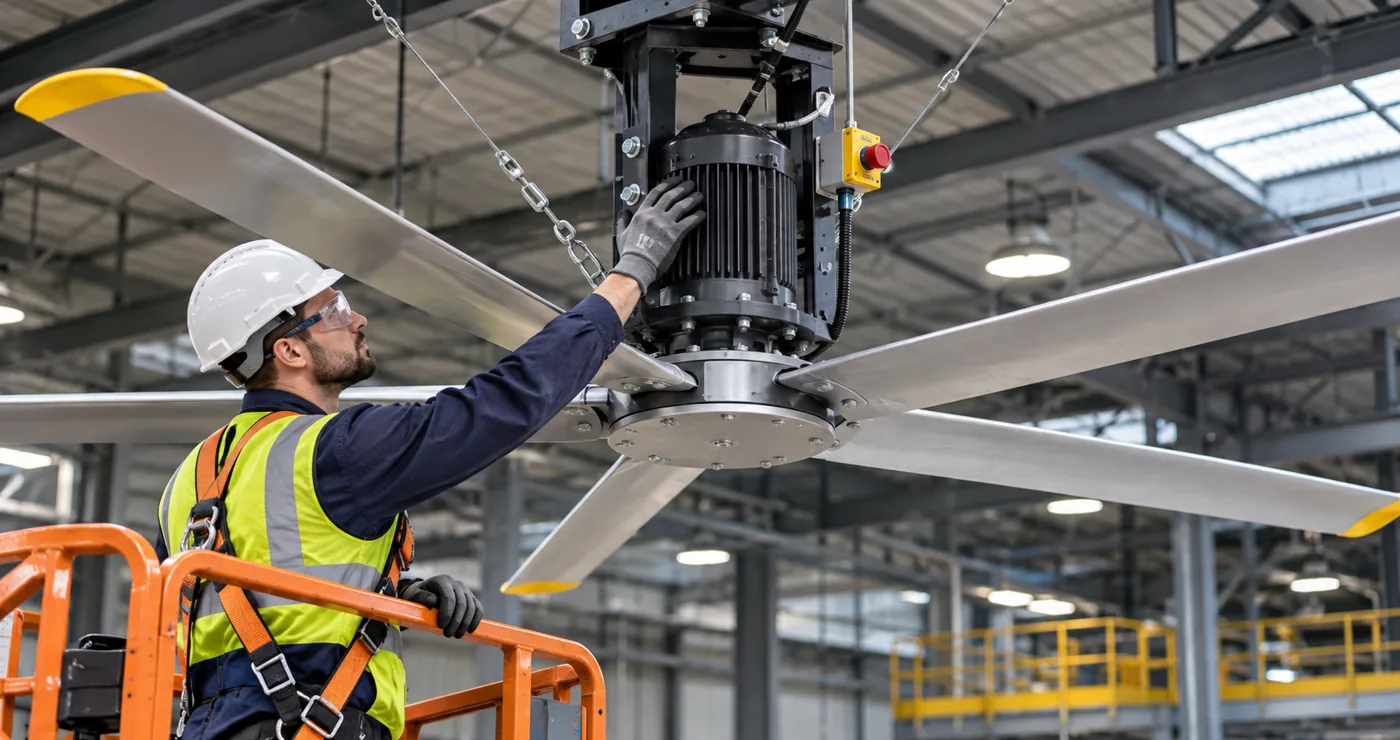
Installation must coordinate the fan with the roof structure, mounting arrangement, lighting, sprinklers, cranes and other overhead equipment. RTFANS technical materials describe series-specific mounting arrangements for H-beams and concrete beams, together with anti-drop protection, safety rings, galvanized safety cables and blade connection hardware. The selected model's drawings and manual control the final installation.
The 2026 after-sales material recommends the following operating practice:
- Before maintenance, isolate the main and control power and use lockout/tagout procedures.
- Electrical work, high-level work and core-component removal should be performed by trained professionals.
- Inspect for unusual noise, vibration, loose connections, blade damage, corrosion and control faults.
- Clean blades, motor housings, control boxes and cooling paths as the environment requires.
- Carry out professional deep maintenance once or twice a year.
- Shorten inspection intervals in dusty, corrosive or intensive-use environments.
- Do not attempt to correct dynamic balance yourself if persistent vibration appears.
Keep the distinction between circulation and ventilation visible in the operating plan. A fan can mix air without supplying outdoor air or removing a contaminant.
Frequently asked questions about HVLS fan meaning
What does HVLS stand for?
HVLS stands for High-Volume, Low-Speed. It describes a large overhead fan that moves a broad volume of air at a relatively low rotational speed.
What is an HVLS fan?
An HVLS fan is a large ceiling fan for open spaces such as warehouses, factories, gyms and workshops. It pushes air downward and outward to support wide-area circulation. The selected model and layout must match the building.
Does an HVLS fan lower the actual air temperature?
Not by itself. An HVLS fan moves air, which can improve perceived comfort by increasing heat loss from the skin. Actual perceived conditions depend on air velocity, humidity, air temperature, clothing and activity.
How many blades does an HVLS fan have?
It depends on the series. The 2026 overseas configuration table lists six blades for King and Charm I, and five blades for Paragon, Charm II, Virtue, Grace and Gallop.
Can an HVLS fan replace an exhaust fan?
No. An HVLS fan circulates indoor air. Exhaust, make-up air, filtration or local capture may still be required for vehicle exhaust, welding fumes, dust, solvents, mist or other process contaminants.
Plan airflow around the facility
The practical answer to “what is an HVLS fan?” is that it is one part of a large-space airflow strategy. Model, diameter, airflow, control range, mounting arrangement and quantity should follow the building, occupied zones and process conditions.
Share the floor area, clear height, layout, location and operating conditions through the RTFANS project quote request. The team can review whether HVLS circulation, commercial fans, exhaust, evaporative cooling or a combined arrangement fits the facility.
Related insights
Recommended Engineering & Ventilation Guides
PMSM Direct-Drive vs Belt-Driven Fans for Manufacturing Plants
PMSM direct-drive fans remove the belt, pulleys and gearbox from the power path — compare energy loss, maintenance, downtime and 10-year cost against belt-driven fans for manufacturing plants.
View article
Where to Buy HVLS Fans With Professional Installation in the US
US buyers can buy an HVLS fan with professional installation through three routes — an industrial fan supplier, an authorized distributor, or a commercial HVAC contractor. How the routes differ, what a complete quote should include, and how to vet an installer before you sign.
View article
HVLS Fans for a German Dairy Barn: A Customer's Five-Star Review
A German dairy barn customer praises RTFANS fan assembly, supplied components and Angela Xie's support during ordering, shipping and installation.
View article