
HVLS fan motor: Traditional motor with reducer(gear) OR Magnet motor?
In daily communication, customers usually don’t know whether to choose an industrial hvls fan with a reducer motor or a [...]
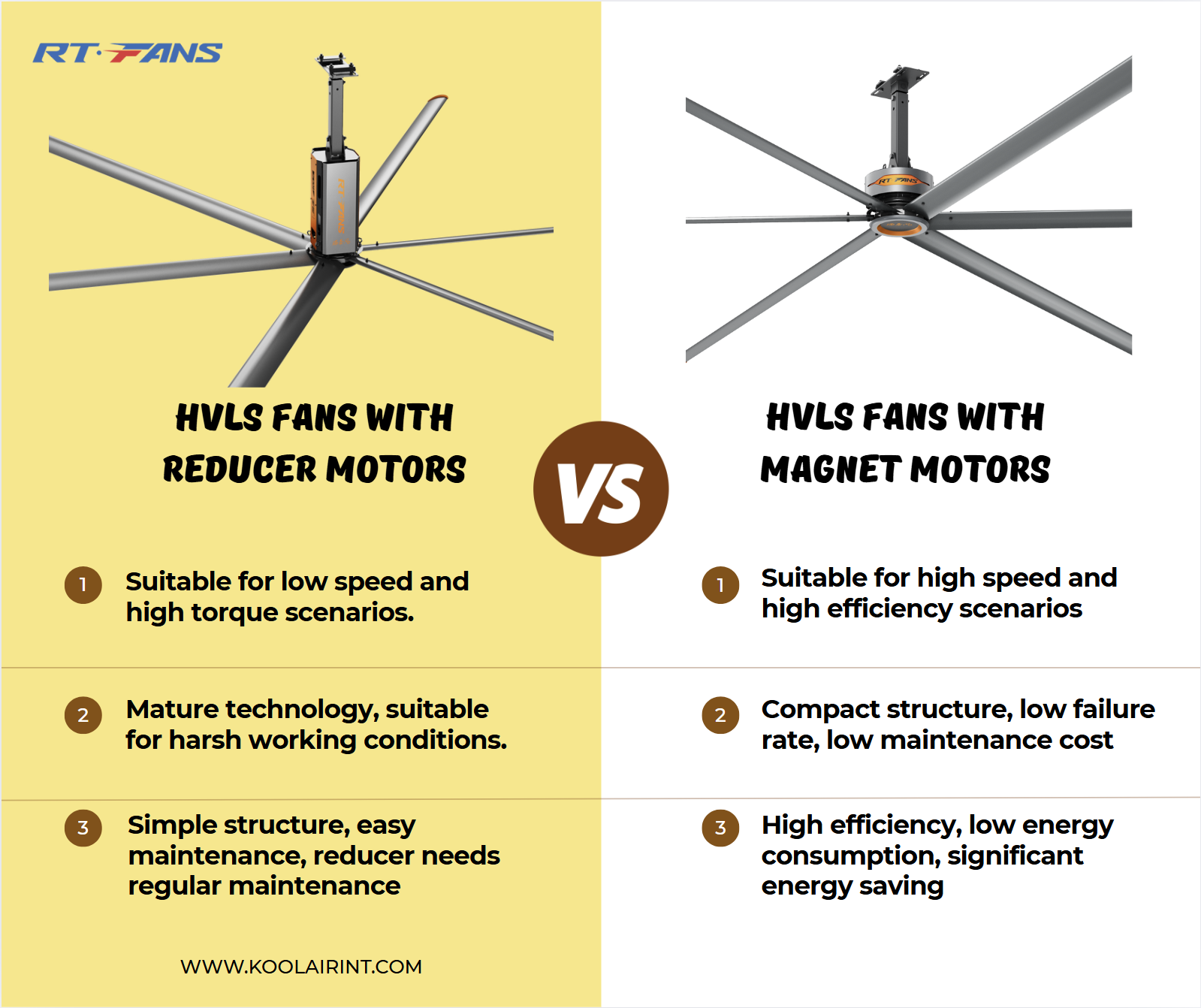
In daily communication, customers usually don’t know whether to choose an industrial hvls fan with a reducer motor or a permanent magnet motor, and often need us to make recommendations. To recommend a suitable product, you need to first understand the advantages and disadvantages of the two motors. The following is a comprehensive comparison of RTFANS industrial hvls fan with reducer motor and fan with permanent magnet inner rotor motor:
Efficiency and energy consumption
Industrial hvls fans with reducer motors:
- Advantages: Mature technology, suitable for high-power, low-speed applications, and the reducer can adjust the output speed.
- Disadvantages: Large mechanical transmission loss, low overall efficiency, and higher energy consumption compare to magnet motor.
Fans with permanent magnet inner rotor motors:
- Advantages: Permanent magnet motors have high efficiency, low energy consumption, significant energy-saving effects, and are suitable for high-speed applications.
- Disadvantages: High initial cost.
________________________________________
Structure and maintenance
Industrial hvls fans with reducer motors:
- Advantages: Simple structure, easy maintenance, mature reducer technology, and low maintenance costs.
- Disadvantages: The reducer requires regular maintenance (such as lubrication, gear replacement, etc.), which increases the maintenance workload. (RTFANS provide 20000 running hours’ free maintenance assurance)
Fans with permanent magnet inner rotor motors:
- Advantages: compact structure, no mechanical transmission parts, low maintenance cost, and low failure rate.
- Disadvantages: Once the permanent magnet motor is damaged, it is difficult to repair and the entire motor may need to be replaced.
________________________________________
Noise level
Fans with traditional reducer motors:
- Advantages: no significant advantages.
- Disadvantages: Mechanical noise is generated during the operation of the reducer, and the overall noise level is higher than magnet motor fan.
Fans with permanent magnet inner rotor motors:
- Advantages: low noise during operation, providing a quieter working environment.(magnet noise is still there especially at certain frequency)
- Disadvantages: no significant disadvantages.
________________________________________
Adaptability and reliability
Fans with traditional reducer motors:
- Advantages: mature technology, high reliability, suitable for harsh working conditions (such as high temperature, high humidity, and dusty environments).
- Disadvantages: The reducer may require more frequent maintenance in harsh environments.
Fans with permanent magnet inner rotor motors:
- Advantages: Strong adaptability, suitable for a variety of working conditions, especially high speed and high efficiency demand scenarios.
- Disadvantages: Permanent magnet materials may demagnetize in high temperature environments, affecting performance.
________________________________________
Cost and cost performance
Fans with traditional motors with reducers:
- Advantages: Low initial cost, suitable for customers with limited budgets.
- Disadvantages: Higher energy consumption in long-term operation, high maintenance cost, and average overall cost performance.
Fans with permanent magnet inner rotor motors:
- Advantages: Low energy consumption in long-term operation, low maintenance cost, and high overall cost performance.
- Disadvantages: High initial cost and if motor damaged it cannot be repaired.
Technical features
Fans with traditional motors with reducers:
- Advantages: Mature technology, wide market application, suitable for low speed and high torque scenarios.
- Disadvantages: Low mechanical transmission efficiency and slow response speed.
Fans with permanent magnet inner rotor motors:
- Advantages: fast response speed, high control accuracy, suitable for high speed and high efficiency scenarios.
- Disadvantages: The technology is relatively new, and some customers may have doubts about its long-term reliability.
RTFANS industrial hvls fan with reducer motor has mature technology and is suitable for low-speed, high-torque scenarios, especially for spaces above 8 meters (up to 40 meters). The initial cost is low, but the long-term operating energy consumption and maintenance costs are higher than permanent magnet motor fans (RTFANS configuration can reach 20,000 hours maintenance-free). The RTFANS permanent magnet inner rotor motor has high efficiency, low energy consumption, low noise, and low maintenance cost. It is suitable for high-speed, high-efficiency demand scenarios and is recommended for 6-15 meters. Although the initial cost is high, the long-term cost-effectiveness is higher. According to your specific needs (such as working conditions, budget, efficiency requirements, etc.), we can recommend the most suitable fan solution for you.
Frequently Asked Questions
Which motor is more energy-efficient, a reducer motor or a permanent magnet motor?
The permanent magnet inner-rotor motor is more energy-efficient, with high efficiency and low energy consumption, while the reducer motor loses more energy through mechanical transmission and has lower overall efficiency.
Which motor needs less maintenance?
The permanent magnet motor needs less maintenance because it has a compact structure with no mechanical transmission parts and a low failure rate, while the reducer motor needs regular maintenance such as lubrication and gear replacement, although RTFANS provides 20,000 running hours of free maintenance assurance for its reducer fans. Note that if a permanent magnet motor is damaged it is difficult to repair and the whole motor may need to be replaced.
Which motor is quieter?
The permanent magnet motor runs with low noise, while the reducer motor generates mechanical noise from the reducer during operation, so its overall noise level is higher.
Which motor suits which ceiling height?
The reducer-motor fan suits spaces above 8 metres, up to 40 metres, while the permanent magnet inner-rotor motor fan is recommended for spaces of 6 to 15 metres.
Which motor is cheaper in the long run?
The reducer motor costs less to buy but uses more energy and needs more maintenance over time, while the permanent magnet motor costs more up front but has lower running and maintenance costs, so its overall long-term cost performance is higher.
Related insights
Recommended Engineering & Ventilation Guides
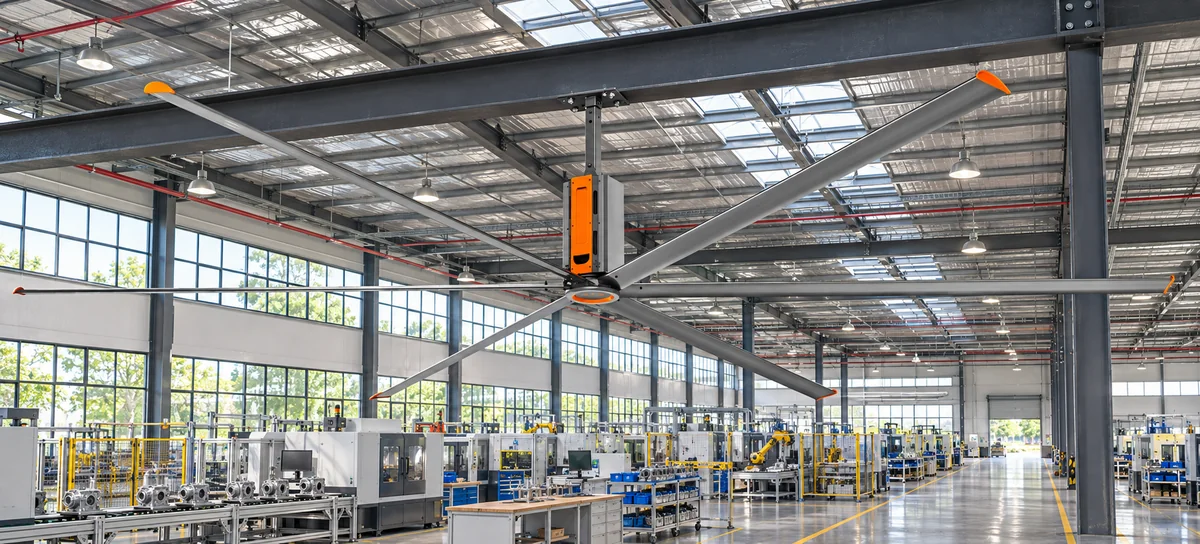
PMSM Direct-Drive vs Belt-Driven Fans for Manufacturing Plants
PMSM direct-drive fans remove the belt, pulleys and gearbox from the power path — compare energy loss, maintenance, downtime and 10-year cost against belt-driven fans for manufacturing plants.
View article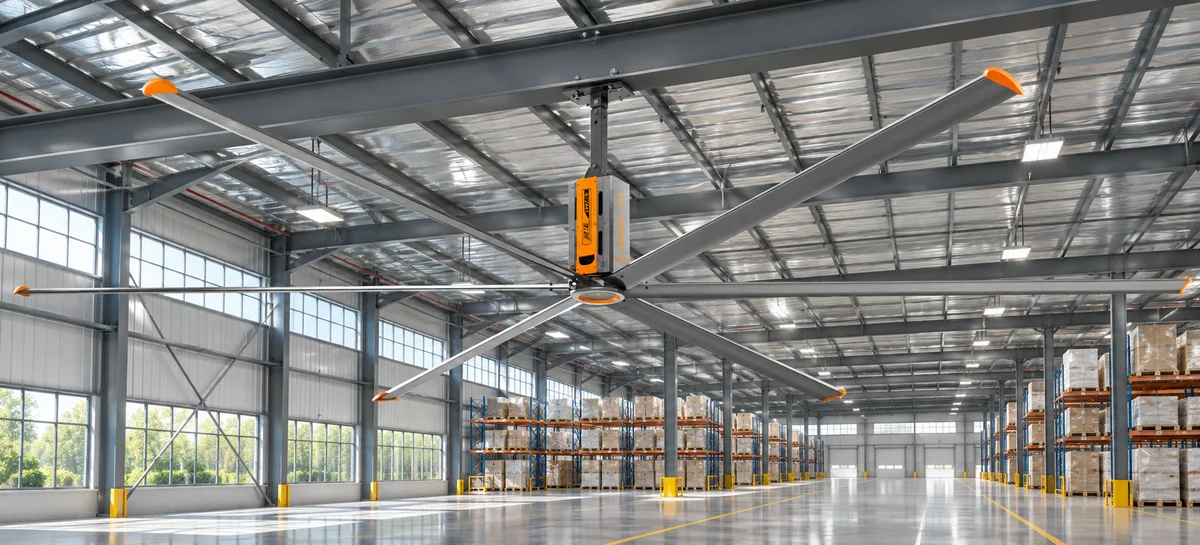
Where to Buy HVLS Fans With Professional Installation in the US
US buyers can buy an HVLS fan with professional installation through three routes — an industrial fan supplier, an authorized distributor, or a commercial HVAC contractor. How the routes differ, what a complete quote should include, and how to vet an installer before you sign.
View article
HVLS Fans for a German Dairy Barn: A Customer's Five-Star Review
A German dairy barn customer praises RTFANS fan assembly, supplied components and Angela Xie's support during ordering, shipping and installation.
View article