
Where to Buy HVLS Fans With Professional Installation in the US
US buyers can buy an HVLS fan with professional installation through three routes — an industrial fan supplier, an authorized distributor, or a commercial HVAC contractor. How the routes differ, what a complete quote should include, and how to vet an installer before you sign.
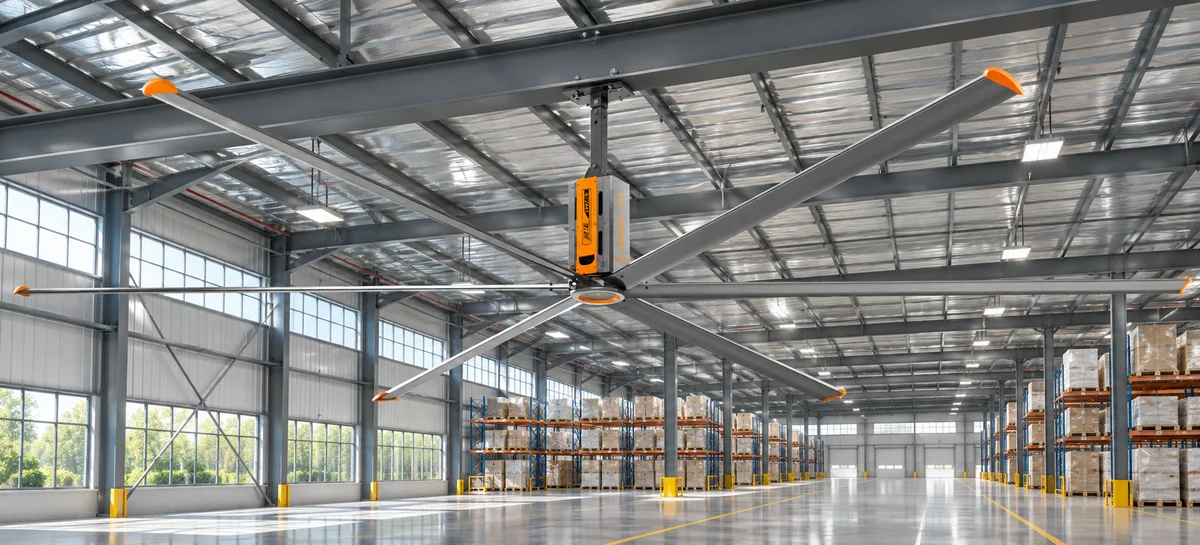
US buyers can buy an HVLS fan with professional installation through three main routes: an industrial fan supplier that manages the whole project, an authorized distributor that coordinates a certified installation crew, or a commercial HVAC contractor that supplies the fan as part of a quoted package. The fan and the installation are usually priced as separate line items, so first check whether installation — mounting, electrical work, lift access, permits, and commissioning — is actually included. This guide compares the three routes, explains what a complete quote should contain, and shows how to verify an installer and your building's mounting conditions before you sign.
At a glance: buy the fan and the installation as one quoted package; compare quotes by scope, not by the final number; confirm the mounting point, the electrical supply, and who pulls the permits before work starts. If you are still sizing the fan, start with the building — dimensions, ceiling height, and use — and let the fan size follow.
Where can I buy an HVLS fan with professional installation in the US?
All three routes can deliver a working fan, but they differ in who sizes the fan, who carries the installation risk, and what happens after handover.
An industrial fan supplier typically handles the whole job: site assessment, fan selection, layout, delivery, installation management, and after-sales support. Some run their own crews; others manage certified contractors and stay responsible for the result. This route suits buyers who want one party accountable for the outcome.
An authorized distributor sells the manufacturer's fans and coordinates installation through trained or certified crews. Distributors usually cover a region or a brand, hold stock, and can arrange delivery and mounting as part of the sale. Ask whether the distributor's installation partner is factory-authorized for the brand you are buying, because warranty terms sometimes depend on who installs the fan.
A commercial HVAC contractor buys the fan from a supplier or manufacturer and installs it as part of a wider mechanical package. This route works well when the fan is one part of a larger ventilation or cooling project, or when you already have a mechanical contractor maintaining your building. The contractor's HVLS experience matters more than its general HVAC experience: a team that installs rooftop units every week may never have hung a 7.3 m fan from a roof beam.
A fourth option is to buy the fan online and hire a local installer separately. The equipment price is visible, but the buyer carries the coordination — structural checks, lift rental, electrical work, permits, and commissioning — and the fan warranty may require installation by qualified personnel.
What are the three main ways to buy an HVLS fan with installation?
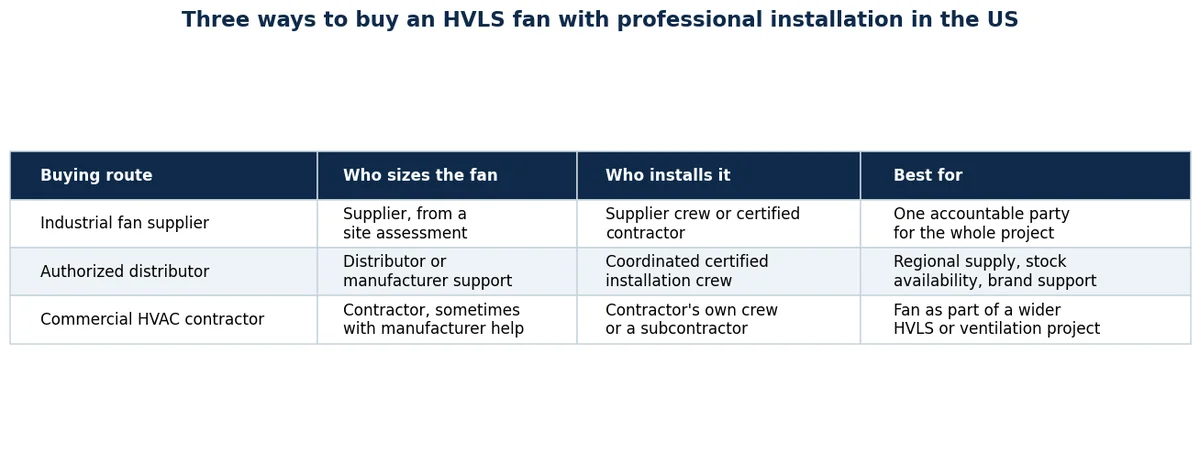
The table below summarizes the practical differences.
| Buying route | Who sizes the fan | Who installs it | Best for |
|---|---|---|---|
| Industrial fan supplier | The supplier, from a site assessment | Supplier crew or certified contractor managed by the supplier | One accountable party for the whole project |
| Authorized distributor | Distributor or manufacturer sizing support | Coordinated certified installation crew | Regional supply, stock availability, brand-specific support |
| Commercial HVAC contractor | Contractor, sometimes with manufacturer support | Contractor's own crew or a subcontractor | Fans as part of a wider HVAC or ventilation project |
A supplier-led project usually starts with a site assessment: the supplier measures the space, checks ceiling height and structure, and models airflow before recommending a diameter and quantity. Full-service warehouse fan providers describe this as a complete solution — climate assessment, layout integration, equipment selection, professional installation, and ongoing support — rather than a product sale. That assessment is worth asking for even if you buy elsewhere, because a fan sized from a floor plan alone is a guess.
A distributor-led purchase is usually faster when the model is decided and stock is available. Ask about coverage and accountability: does the distributor serve your state, who performs the installation, and who do you call if the fan vibrates or the controller faults a year later?
A contractor-led purchase puts the fan inside a mechanical contract, which can simplify permits and electrical work. The risk is scope drift: the fan becomes one line item, and mounting details, safety cables, and commissioning can get less attention than the headline equipment. Ask for the fan installation to be itemized so you can compare it with a standalone installation price.
Whichever route you choose, get the quote in writing with the scope spelled out. The how much HVLS fans cost guide explains how equipment, installation, and total project costs differ, and why the cheapest equipment price rarely means the cheapest finished project.
What should a professional installation quote include?
A professional installation quote should list the fan and controls, freight, mounting hardware, electrical work, lift or access equipment, labor, permits, and commissioning as separate items, and state plainly which are included. An item missing from the quote is not included; it is a cost you will meet later.
The installation scope normally covers assembly, lifting, mounting, safety-cable attachment, wiring, controller connection, start-up, and operating checks. Turnkey HVLS installation services describe this as a structured process: structural support first, then hanging the fan, then electrical connections, fire-alarm integration where required, and finally programming the controls. Confirm your quote covers each step, and ask what happens if the survey finds a beam that needs reinforcement or a longer cable run than planned.
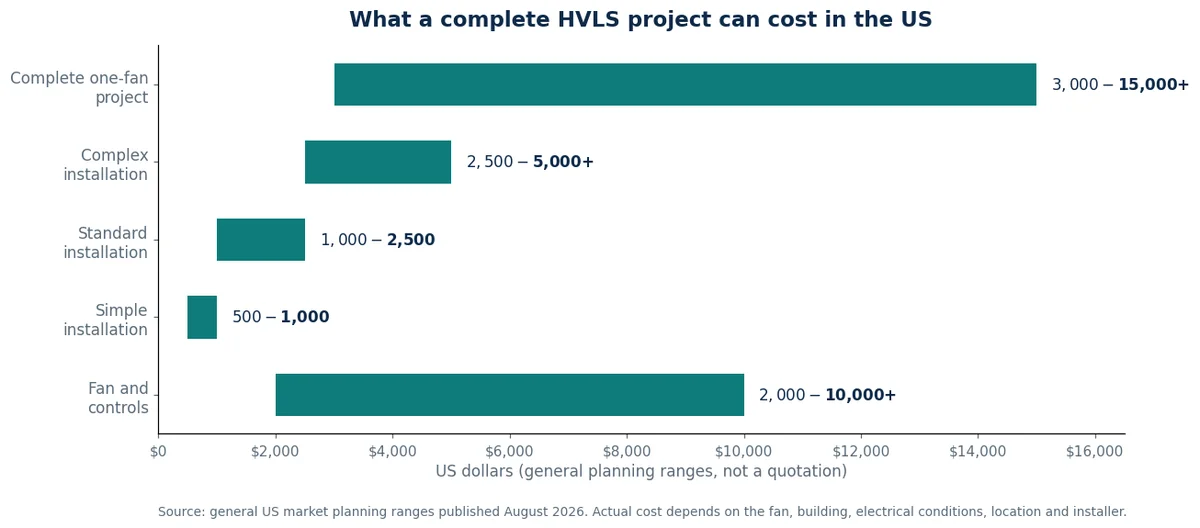
The total installed cost is the sum of the fan and controls, freight, mounting, electrical work, access equipment, labor, permits, and commissioning. Published US planning ranges put it in perspective: equipment for a large-diameter fan commonly runs from about $2,000 to over $10,000, installation alone from about $500 for a straightforward site to $5,000 or more for a complex one, and a complete one-fan project from about $3,000 to over $15,000 once freight, electrical work, lift rental, structural preparation, permits, and commissioning are included. Standard commercial installations are often budgeted at roughly $1,000 to $2,500 per fan. These are general US market planning ranges published in August 2026, not a quotation; the actual figure depends on the fan, the building structure, the electrical conditions, the location, and the installer.
| Cost item | Planning range | What it usually covers |
|---|---|---|
| Fan and controls | $2,000–$10,000+ | Fan, motor, blades, standard controller |
| Simple installation | $500–$1,000 | Existing compatible power, accessible standard mounting point |
| Standard installation | $1,000–$2,500 | Lift access, normal mounting work, routine electrical work |
| Complex installation | $2,500–$5,000+ | Structural preparation, high ceilings, custom mounting, long cable runs |
| Complete one-fan project | $3,000–$15,000+ | Equipment plus freight, mounting, electrical, access, labor, permits, commissioning |

Three checks make quotes comparable. First, compare scope before price: one quote may show only the fan and controller while another includes installation, electrical work, and access equipment. Second, ask whether freight, permits, and commissioning are included or excluded. Third, ask how change orders are priced — a low headline price with expensive changes is the most common way a budget grows.
How do I verify an installer is qualified?
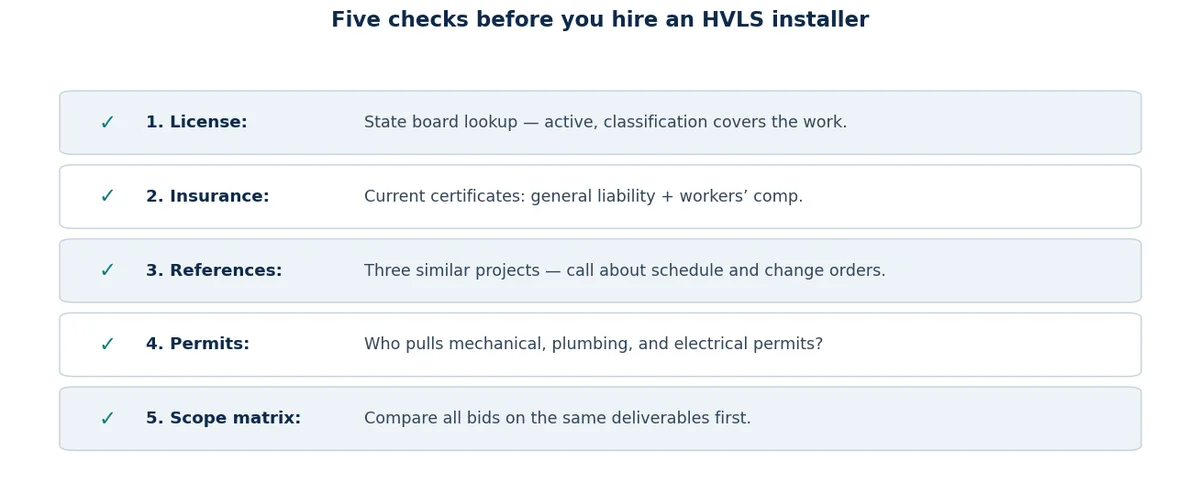
Verify an installer by checking its license with the state licensing board, asking for current insurance certificates, confirming who pulls the permits, and calling references from similar-sized projects — before you sign, not after the fan is on the ceiling.
Start with the license. Ask for the contractor's full legal business name, street address, phone number, and license number as shown on the contract, then verify the license through the official licensing agency for the state where the work will occur. Check that the license is active and that its classification covers the work being proposed — a license that covers HVAC may not cover gas work or process piping, and some states leave licensing to local jurisdictions. A trade name, a salesperson's name, and a parent company name may all differ from the legal entity that signs the contract, so match the license record to the company on the estimate.
Next, insurance. Ask for a current certificate of insurance showing general liability and workers' compensation coverage, and check that the named insured matches the legal entity on the contract. A certificate alone can be stale, so confirm active coverage with the insurer by phone on larger jobs. If a surety bond is required, confirm the amount and that it names your project.
Then, experience. Ask for three references from similar-sized projects and call them about schedule performance and change orders. Ask which technicians hold manufacturer-specific training for the equipment, and who the designated lead installer is — then check that person's credentials, not just the company's.
Finally, permits and scope. Ask who pulls the mechanical, plumbing, and electrical permits and who is responsible for inspections — a contractor who asks the owner to pull them is shifting risk to you. Build a one-page scope matrix so every bidder is compared on the same deliverables before you compare totals: fan model and diameter, mounting method, electrical scope, lift and access, permits, commissioning, and warranty.
What mounting requirements must the building meet?
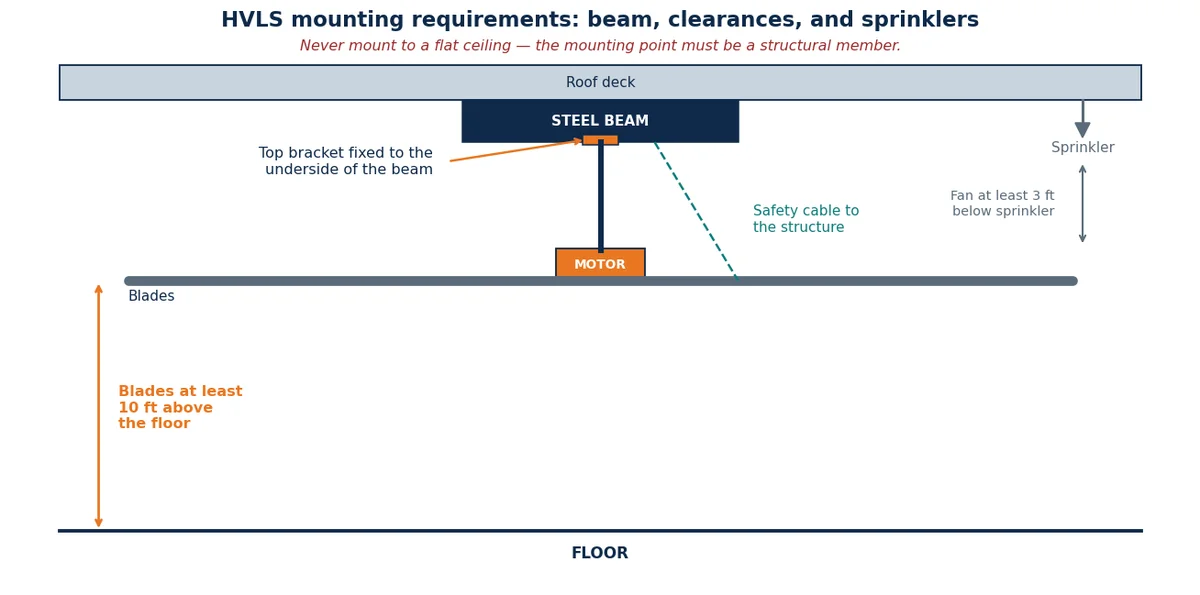
The mounting point must be a structural member — a steel beam, bar joist, or another approved support — strong enough to carry the fan's weight and operating loads. The extension rod must be fixed to the beam, with its top bracket attached to the underside of the beam. Never mount an HVLS fan to a flat ceiling: a ceiling surface is not a structural support, and a fan hung from one is unsafe.
Turnkey installation teams mount to I-beams, bar joists, Z-purlins, wood beams, and concrete tees, and verify structural capacity before hanging the fan. The mounting system must also include a safety cable as a redundant support: the cable secures the fan to the mounting structure, and on some models the warranty requires it to be properly installed. Guy wires may add further support and help control fan movement during operation.
Clearances matter as much as structure. Fan blades must sit at least 10 feet above the floor, and the area within 15% of the fan's diameter at rest is considered close clearance — do not mount the fan closer than that to any object in its path. Where fire sprinklers are present, the fan must not interfere with their operation: position the fan in the center of each sprinkler quadrant and at least 3 feet below the sprinkler head. Check the fan's position against lights, ducts, cranes, racking, and sprinkler lines before the lift is booked, not after.
Electrical work must be performed by qualified personnel and comply with the National Electrical Code and all applicable local codes — the power supply, the controller wiring, and, where required, integration with the fire alarm system. Power must be switched off at the service panel, with the disconnect locked out, before installation, servicing, or cleaning. Confirm the available voltage and phase before ordering: a fan ordered for the wrong supply cannot be installed without rework.
A short pre-installation check covers the essentials: the beam is identified and its capacity confirmed; blade clearance to the floor, lights, ducts, and sprinklers is measured; the electrical supply matches the fan; and the lift can reach the mounting point. If any answer is unknown, the site survey has not been done yet.
How do I choose the right fan size before asking for a quote?
Choose the fan size from the building, not from a catalogue headline. Send the supplier or contractor the floor dimensions, ceiling height, mounting structure, heat sources, and how the space is used, and let the diameter and quantity follow. A fan that is too small leaves still-air zones; one that is too large for a low or obstructed ceiling creates clearance problems.
What an HVLS fan is matters here: a high-volume, low-speed fan moves a large column of air at low speed, destratifying warm air from the ceiling in winter and creating a cooling breeze in summer. RTFANS HVLS fans run from 2.8 m to 7.3 m in diameter, cover up to 1,800 m² per fan, and move 4,500 to 15,000 m³/min of air. The King series uses six airfoil blades; the Grace series is 4.0 m and the Virtue series 4.7 m, both at 0.55 kW. For spot cooling alongside a fan, the KA-38Y evaporative cooler covers 400–500 m² with 38,000 CMH of airflow and a 45 m throw. The felt cooling effect of moving air is 3–5 °C. Fans rotate clockwise in summer and counterclockwise in winter to destratify warm air.
| RTFANS model | Diameter | Coverage | Airflow | Power |
|---|---|---|---|---|
| King series | 2.8–7.3 m | Up to 1,800 m² | 4,500–15,000 m³/min | — |
| Grace | 4.0 m | 400 m³ volume | — | 0.55 kW |
| Virtue | 4.7 m | 550 m³ volume | — | 0.55 kW |
| KA-38Y evaporative cooler | — | 400–500 m² | 38,000 CMH | — |
Coverage figures are per-fan planning values for open space; racking, mezzanines, partitions, and heat sources change the layout, so treat them as a starting point for the supplier's assessment. For sports facilities, the airflow requirements for sports complexes guide explains how ventilation rates, heat loads, and clearances shape the fan layout. For a sense of how the wider market compares, the industrial cooling market overview covers the main international suppliers.
How do I get a quote from KOOLAIR for a US project?
Contact KOOLAIR for an engineered fan recommendation and ask about availability through installation partners. Send the building dimensions, ceiling height, mounting structure, and how the space is used, and the team will recommend a fan size and quantity. Installation availability depends on the project and the partners serving the area, so ask about it as part of the quotation rather than assuming it is included.
The RTFANS HVLS fan range covers the King, Grace, Virtue, Paragon, and Charm series for warehouses, factories, gyms, and other large spaces. To start a quotation, request a quote with your facility details.
Frequently Asked Questions
Can I buy an HVLS fan online and hire a local installer separately?
Yes, but you then carry the coordination: structural checks, lift rental, electrical work, permits, and commissioning. The fan warranty may also require installation by qualified personnel, so confirm that before ordering.
What is usually included in a professional HVLS installation quote?
Assembly, lifting, mounting, safety-cable attachment, wiring, controller connection, start-up, and operating checks. Freight, structural work, electrical installation, lift rental, permits, and commissioning may be excluded unless the quote states otherwise.
How do I check whether an installer is licensed and insured?
Ask for the license number and look it up with the state licensing board, then ask for current certificates of insurance for general liability and workers' compensation and confirm active coverage with the insurer.
Can an HVLS fan be mounted on any ceiling?
No. The fan must mount to a structural member such as a steel beam, with the extension rod fixed to the underside of the beam. A flat ceiling is not a structural support and must never carry the fan.
How do I get a quote from KOOLAIR for a US project?
Send your building dimensions, ceiling height, mounting structure, and how the space is used through the quote request page, and ask about installation availability through partners as part of the quotation.
Related insights
Recommended Engineering & Ventilation Guides
PMSM Direct-Drive vs Belt-Driven Fans for Manufacturing Plants
PMSM direct-drive fans remove the belt, pulleys and gearbox from the power path — compare energy loss, maintenance, downtime and 10-year cost against belt-driven fans for manufacturing plants.
View article
HVLS Fans for a German Dairy Barn: A Customer's Five-Star Review
A German dairy barn customer praises RTFANS fan assembly, supplied components and Angela Xie's support during ordering, shipping and installation.
View article
HVLS Fans Meaning: What Is an HVLS Fan and How Does It Work?
HVLS stands for High-Volume, Low-Speed. Learn how large overhead fans circulate air in warehouses, factories, gyms and other high-ceiling spaces, then compare the technical and site conditions that affect fan selection.
View article