
PMSM Direct-Drive vs Belt-Driven Fans for Manufacturing Plants
PMSM direct-drive fans remove the belt, pulleys and gearbox from the power path — compare energy loss, maintenance, downtime and 10-year cost against belt-driven fans for manufacturing plants.
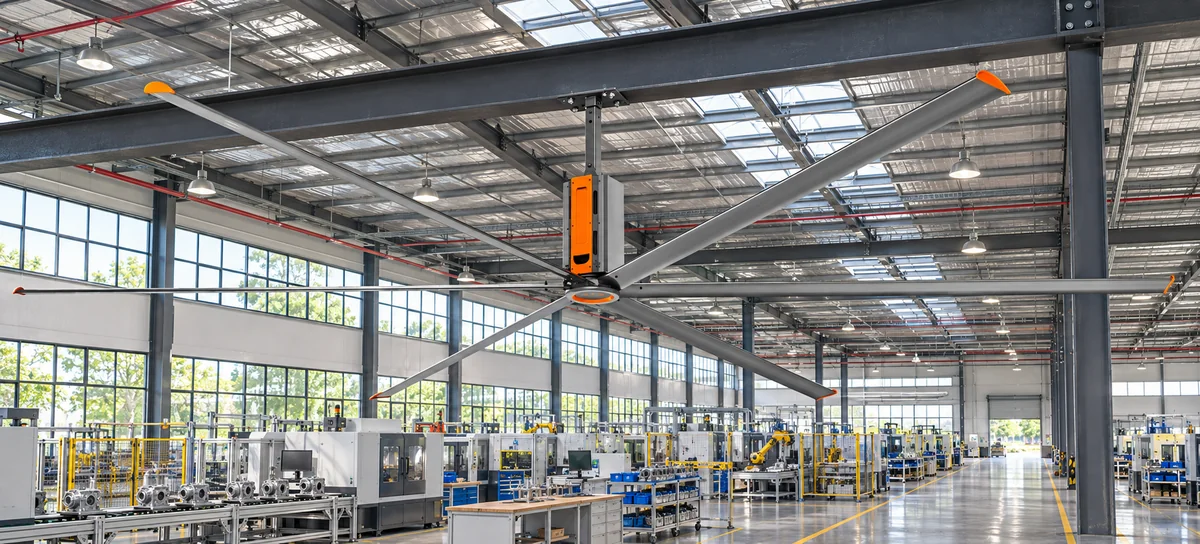
For a plant that runs its fans thousands of hours a year, the choice between a PMSM direct-drive fan and a belt-driven fan is mostly a choice about what happens after installation. A direct-drive PMSM fan removes the belt, pulleys and gearbox from the power path, so there is nothing to tension, stretch or replace. A belt-driven fan keeps a wear item between the motor and the blades that costs energy and maintenance attention for its whole life. Belt drives are cheaper to buy and easier to repair with local parts, so they still make sense for intermittent duty or tight budgets — but for continuous, multi-shift operation, the direct-drive PMSM usually wins on total cost of ownership.
What is the difference between a PMSM direct-drive fan and a belt-driven fan?
A PMSM direct-drive fan connects a permanent magnet synchronous motor straight to the fan shaft, with no belt, pulley or gearbox in between. A belt-driven fan uses a motor that turns a pulley, a belt that carries the power, and a second pulley on the fan shaft — sometimes with a gearbox as well. That single difference explains almost every practical difference that follows: efficiency, maintenance, noise, speed control and failure modes.
A permanent magnet synchronous motor (PMSM) uses permanent magnets on the rotor instead of the copper rotor winding of a conventional induction motor. With no rotor copper loss and no slip — the rotor turns in exact synchronism with the magnetic field — a PMSM holds high efficiency even at part load, where most plant fans spend most of their hours. RTFANS PMSM HVLS fans use this design in a fully enclosed motor mounted directly on the fan axle, with no gearbox, no lubrication and no belt to maintain. The motor is smaller and lighter for the same output, runs cooler, and responds faster to speed commands.
A belt-driven fan is the older, familiar arrangement. The motor — usually a standard induction motor — spins a drive pulley, and a V-belt transmits the torque to a larger driven pulley on the fan shaft, which sets the speed ratio. The ratio can be changed simply by fitting different pulleys, and if the fan jams, the belt slips instead of breaking the machine. That tolerance for shock loads is a genuine advantage in rough plant duty. But every belt drive pays for it with friction: the belt slips slightly, flexes around the pulleys, and stretches on the tight side. All three effects turn electricity into heat before it reaches the blades.
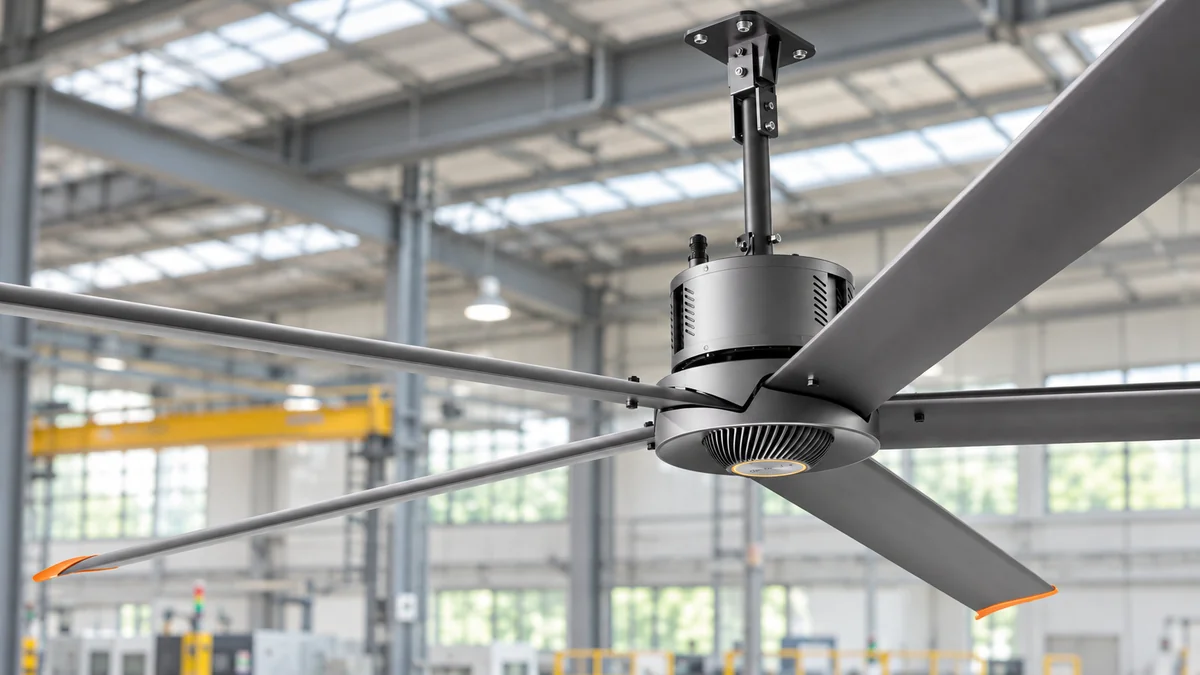
The two systems are also sized differently. A direct-drive PMSM is a low-speed, high-torque motor built for the fan's own speed — RTFANS HVLS fans turn at only 20 to 80 RPM depending on model, so the motor delivers full torque at those speeds without any reduction stage. A belt-driven fan pairs a standard high-speed motor with pulleys that step the speed down, adding rotating parts and bearing loads from belt tension. In short, direct drive removes a whole subsystem; belt drive keeps it, and keeps its costs.
How much energy does a belt drive waste compared with direct drive?
A new, properly tensioned standard V-belt drive is about 95% efficient, so roughly 5% of the power the motor produces is lost in the belt — and as the belt wears and stretches, efficiency can fall to 90% or lower. A direct-drive coupling has no transmission stage, so its transmission loss is effectively zero. On top of that, the PMSM motor itself loses about 15–20% less energy than a comparable induction motor, and it keeps its efficiency at part load, where induction motors fade.
The belt figures come from the US Department of Energy's Industrial Assessment Centers training material on belts and power transmission: a new, properly tensioned traditional V-belt runs at approximately 95% efficiency, dropping to 90% or lower as belts wear, while notched (cogged) V-belts reach about 97% and synchronous belts 97% to 99% because they do not depend on friction. Belts that are too loose slip excessively; belts that are too tight increase bearing loads and shorten belt life — so 95% is a best case that depends on disciplined tensioning, not a figure a plant gets automatically.
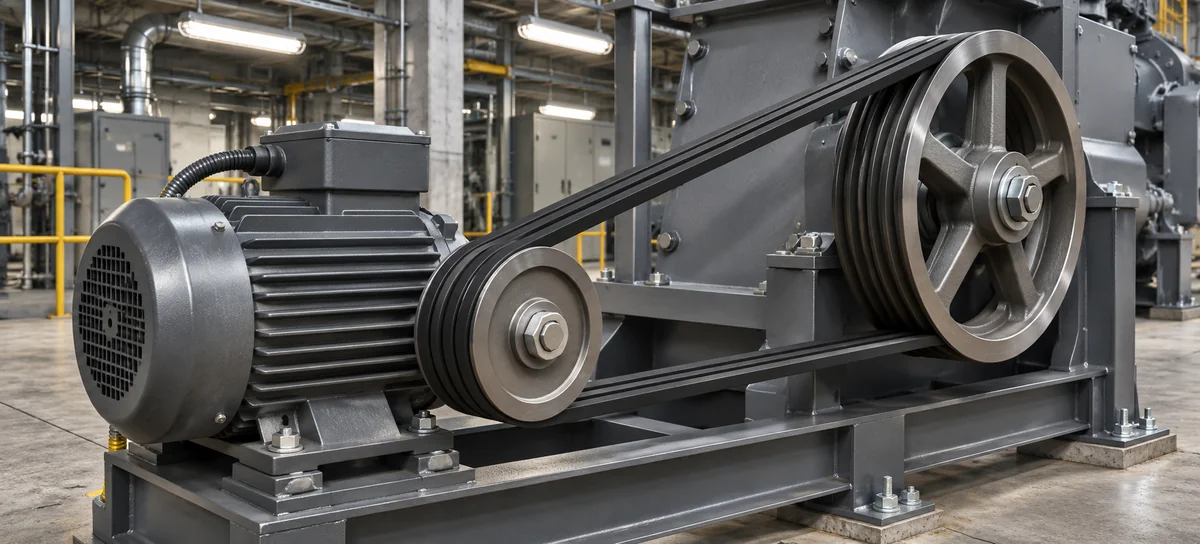
What does 5% mean in a real plant? Take one fan that needs 1.5 kW at the shaft and runs 6,000 hours a year on two shifts. With a new V-belt at 95% efficiency, the motor must deliver about 1.58 kW to get 1.5 kW to the fan — roughly 79 W lost in the belt, or about 470 kWh a year. At an assumed electricity price of $0.10 per kWh, that is about $47 a year for one fan, and about $470 a year across ten fans; the loss roughly doubles if belts wear toward 90% efficiency. These are illustrative figures built from the published belt-efficiency data above, not a quotation — substitute your own tariff and running hours and the arithmetic is the same.
The motor side matters just as much. Induction motors lose efficiency at part load, which is where fans operate most of the time, while a PMSM's synchronous design keeps losses low across its speed range. Industry reporting on permanent magnet motors puts their losses at around 15–20% lower than equivalent induction motors. The efficiency classes in IEC 60034-30-1 give buyers a common language: each step up the IE scale — IE1 standard, IE2 high, IE3 premium, IE4 super premium, IE5 ultra premium — cuts motor losses by roughly 20%, and the newest PMSM designs reach into the IE4 and IE5 range that induction motors struggle to match. Compare system efficiency — motor plus transmission — not the motor nameplate alone.
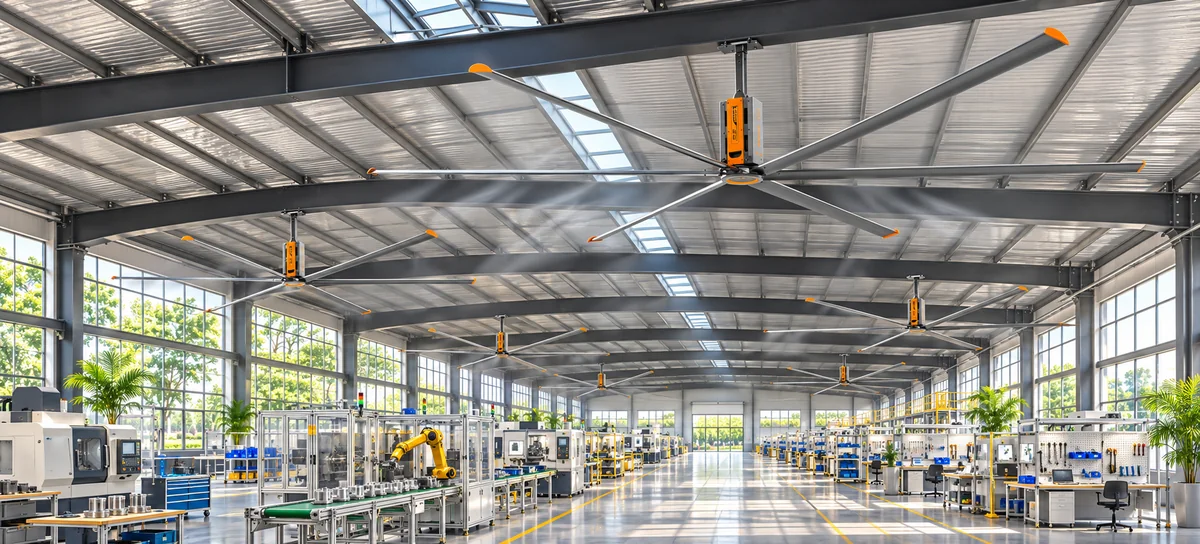
What does each system cost over 10 years?
Over ten years of continuous plant duty, the direct-drive PMSM fan usually costs less in total, even though it costs more to buy: the belt-driven fan's lower purchase price is gradually overtaken by belt energy losses, replacement belts, tensioning labour and unplanned belt failures. The exact crossover depends on running hours, electricity price and labour rates, so treat the table below as a comparison of cost drivers, not as prices — this article publishes no brand price list.
| Cost driver (10 years) | PMSM direct-drive fan | Belt-driven fan |
|---|---|---|
| Purchase price | Higher — PMSM motor and controller cost more | Lower — standard motor, off-the-shelf pulleys |
| Energy lost in transmission | Near zero — no belt, pulley or gearbox | 5% when new, up to 10% or more as belts wear |
| Motor part-load efficiency | High across the speed range | Falls at part load (induction motor) |
| Belts, pulleys, tensioning | None — no wear items in the drive | Belts replaced on schedule; pulleys wear |
| Lubrication | None in the drive (fully enclosed PMSM) | Gearbox oil where fitted |
| Unplanned downtime | Low — fewest rotating drive parts | Higher — a belt can stop a fan mid-shift |
| Speed control | Precise, direct electronic control | Needs a pulley swap or variable-speed drive |
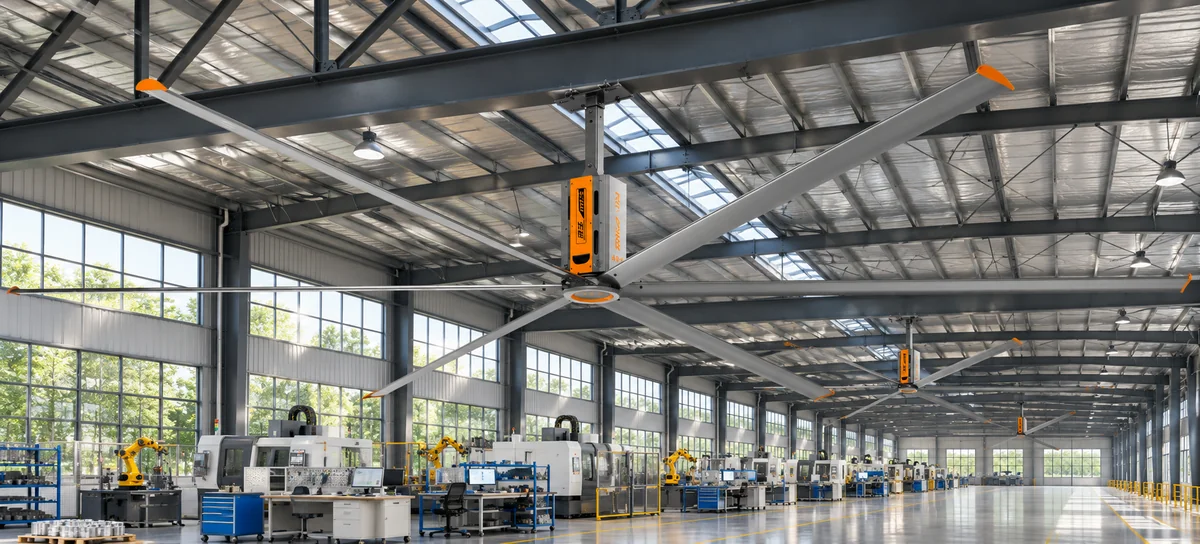
Two points deserve emphasis. First, energy is the largest running cost for a fan that runs 6,000 hours a year: the belt loss is paid every hour the fan runs, while the PMSM's price premium is paid once. Second, belt maintenance is not only the cost of belts — each visit needs access equipment, a shutdown window and a technician working at height, and a belt that snaps on a hot afternoon stops that fan until someone can reach it. None of this makes belt drives a bad product; it makes them a product whose real price shows up in the operating budget rather than on the purchase order — which is why the comparison should be done on ten-year cost, not on the quote alone.
How do maintenance and downtime compare?
A PMSM direct-drive fan needs far less drive maintenance than a belt-driven fan, because there is nothing to tension, align, lubricate or replace in the transmission: the fully enclosed PMSM has no gearbox and no belt, so drive maintenance is essentially reduced to bearings and the controller. A belt-driven fan needs regular belt inspection, tension checks, alignment checks, belt replacement and pulley-groove inspection for its whole service life.
The belt routine is specific and unforgiving. Belts stretch most in their first 48 hours under load, so a new belt needs re-tensioning after run-in, and tension then drifts as the belt ages. Under-tensioned belts slip, squeal and wear prematurely; over-tensioned belts strain bearings and consume excess energy — maintenance-industry reporting puts the energy penalty of under-tensioning alone at up to 20%. Misalignment can cost at least 1% efficiency, with the loss growing as the misalignment worsens, and worn pulley grooves accelerate all of it, because a groove that no longer matches the belt profile increases slip. For multi-belt drives, the belts must be a matched set from the same manufacturer, or the load is shared unevenly.
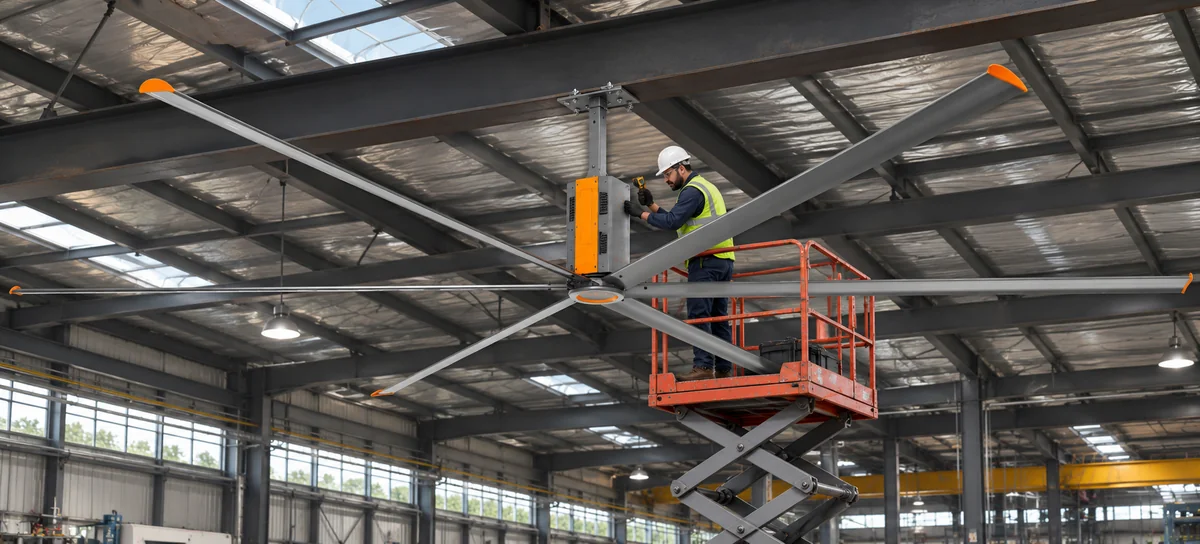
By contrast, the maintenance story on the PMSM side is mostly about what is not there. RTFANS describes its PMSM HVLS fans as a fully enclosed design that eliminates transmission gears — and with them the noise, the lubrication and the maintenance that gears require — while direct mounting on the axle simplifies the whole structure. That does not mean a PMSM fan is maintenance-free: bearings still need attention, the controller needs a clean, ventilated home, and a damaged permanent magnet motor is harder to repair than a standard induction motor — in the worst case the whole motor must be replaced rather than rewound. But those are occasional events, not a recurring calendar of belt work. RTFANS' own comparison of its reducer motor vs permanent magnet motor fans makes the same point from the other side: its geared fans carry a 20,000-hour maintenance-free assurance, generous for a geared drive — and still a scheduled interval that a direct-drive PMSM does not need for its transmission, because there is no transmission.
Which drive holds up better in continuous, harsh plant duty?
For continuous, multi-shift duty in a hot, dusty or humid plant, the PMSM direct-drive fan is the stronger choice: it has fewer wear parts, runs cooler, holds efficiency at part load and has no belt to degrade in heat or dust — provided the motor is protected against its own weakness, demagnetisation at sustained high temperature. Belt drives tolerate shock loads and misalignment better, but heat, dust and long hours are exactly the conditions that age belts fastest.
Heat is the key factor on both sides. A PMSM runs cooler than an equivalent induction motor because its losses are lower, which extends bearing and insulation life — but permanent magnets can demagnetise if held at high temperature for long periods, so the motor's temperature rating and the plant's ambient conditions must be checked together. RTFANS' guidance reflects this trade-off: its permanent-magnet fans are recommended for ceiling heights of 6 to 15 metres, while its geared fans are rated for spaces above 8 metres and up to 40 metres, where the mature geared design's tolerance for harsh conditions is an advantage. Neither type is automatically right for every hall; ceiling height, ambient temperature and dust load decide.
Dust and humidity attack belts directly: dust on pulleys accelerates wear and changes the friction the belt depends on, while humidity and temperature swings change belt length and tension, which is why tension must be re-checked rather than set once. A direct-drive fan has no belt for dust to attack, and its fully enclosed motor keeps contaminants out of the windings. Noise is a smaller but real factor: the gearbox and belt add mechanical noise, while a PMSM direct drive runs quiet — relevant where fans run above workstations all shift.
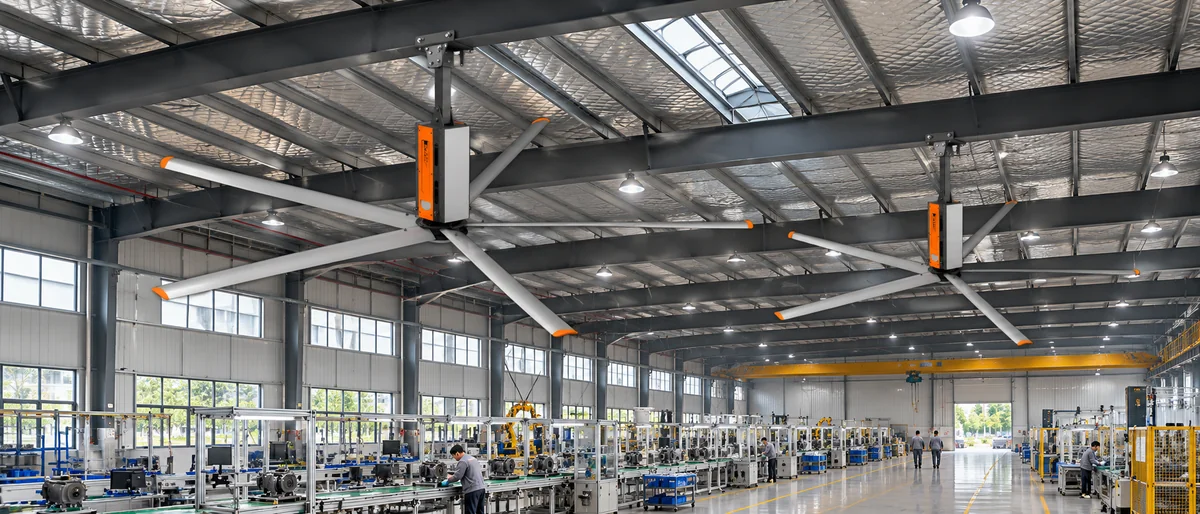
One caution applies to both types: installation quality decides reliability more than the drive type does. A fan hung from a flat ceiling instead of a beam, a rod fixed without a proper bracket, or a controller wired without ventilation will cause trouble whatever motor is inside. RTFANS HVLS fans must be mounted with the extension rod fixed to a structural beam, the top bracket fastened to the underside of the beam — never to a flat ceiling. Check the mounting, the safety cable and the rotation direction at commissioning, and re-check them at every planned shutdown.
When does a belt-driven fan still make sense?
A belt-driven fan still makes sense when the fan runs intermittently, the budget is tight, the plant already has belt-maintenance skills and spares, or the drive needs a speed ratio that is easier to set with pulleys than with a controller. In those cases the belt's low purchase price and easy local repair outweigh its energy and maintenance penalties.
The clearest case is intermittent duty: a fan that runs a few hundred hours a year — a seasonal packing hall, a workshop used two days a week — loses so little energy through its belt that the saving from a PMSM would take many years to repay the price premium. A tight capital budget points the same way, especially for a small fleet where the maintenance burden of a few belts is small. Plants with their own millwrights and a shelf of matched belts can also live happily with belt drives, because the maintenance is familiar, fast and cheap when done in-house. And where a process needs an unusual speed ratio, or a motor must be swapped for a stocked standard frame in an emergency, the belt drive's flexibility — change a pulley, fit a standard motor — is a practical advantage a purpose-built direct-drive motor cannot match.
What should not decide the choice is the purchase price alone. A belt-driven fan that looks cheaper on the quote can cost more within a few years once belt losses, replacement belts and access labour are counted. Run the ten-year arithmetic with your own hours and tariff before deciding, and ask the supplier for the motor efficiency class, the transmission losses and the maintenance schedule in writing. If a supplier cannot state those three numbers, that is itself useful information.
How do you choose the right drive for your plant?
Choose by duty, not by habit: count the running hours, check the ceiling height and ambient conditions, price ten years of energy and maintenance, and confirm the mounting structure before you compare quotes. The checklist below turns the comparison in this article into a decision you can complete in one meeting.
- Count the hours. Above roughly 4,000 running hours a year, the PMSM's savings usually repay its premium; below roughly 1,000 hours, the belt drive's lower price usually wins. Between the two, run the numbers.
- Check the ceiling and the air. PMSM direct-drive fans suit ceiling heights of about 6 to 15 metres; taller halls and extreme heat, humidity or dust may favour a geared or belt-driven design — confirm with the supplier's application data for your hall.
- Ask for the efficiency class. Get the motor's IE class (IEC 60034-30-1) and the transmission loss in writing. A fan sold without either number cannot be compared fairly with one that states them.
- Price the maintenance, not just the fan. Include belt replacement, tensioning visits, access equipment and shutdown windows over ten years — and the cost of one unplanned stoppage in peak season.
- Confirm the structure first. Verify the beam the fan will hang from, the bracket, the safety cable and the electrical supply before ordering. A fan that cannot be mounted correctly is the wrong fan at any price.
- Plan the controls. Direct-drive PMSM fans are controlled electronically and hold precise speeds; belt-driven fans need a pulley change or a variable-speed drive to change speed. Match the control method to how the plant varies airflow through the day.
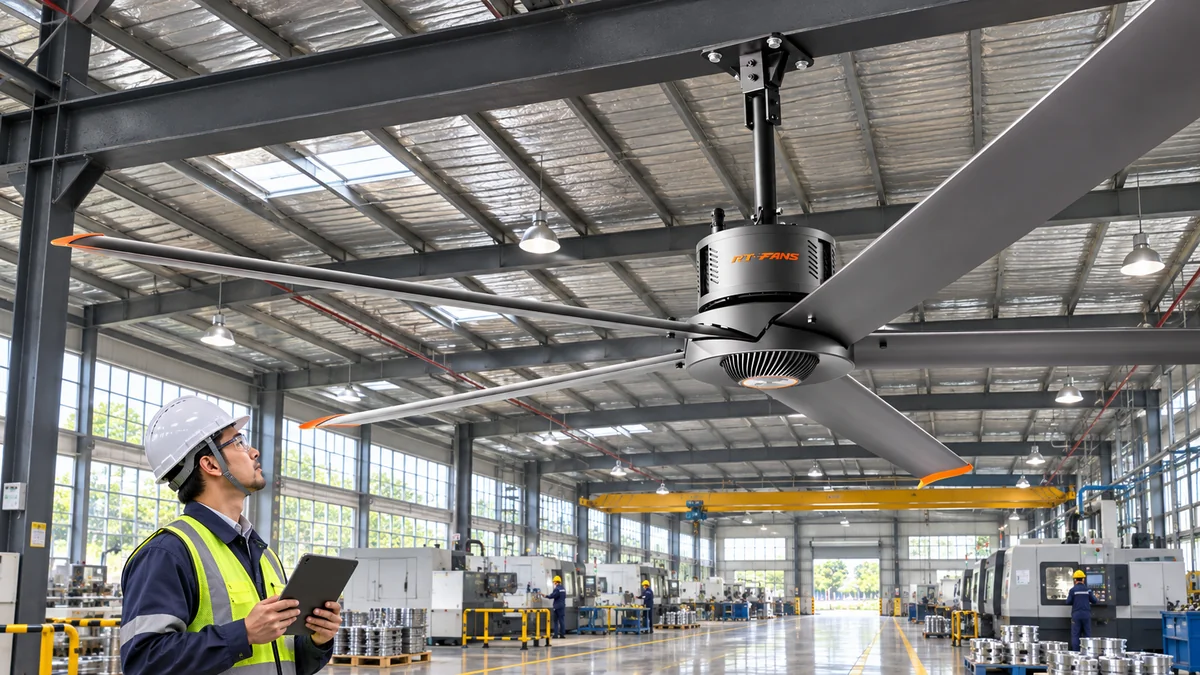
If the answers point to continuous, multi-shift duty in a normal industrial hall, a PMSM direct-drive HVLS fan is the default recommendation — the configuration RTFANS builds its modern HVLS range around, with diameters from 2.8 to 7.3 metres covering up to 1,800 m² per fan. If the answers point to intermittent duty, a tight budget or a hall that needs a geared drive's height range, a belt-driven or geared fan is the honest choice. Either way, the right question is not "which fan is better" but "which drive costs less and stops less often in my plant, over ten years". For manufacturing cooling projects, and for plants weighing energy-efficient cooling options across the whole building, that ten-year view is where the decision belongs.
Frequently Asked Questions
What is a PMSM direct-drive fan?
A PMSM direct-drive fan is a fan whose permanent magnet synchronous motor is mounted directly on the fan shaft, with no belt, pulley or gearbox between the motor and the blades. The permanent magnets replace the rotor winding of a conventional induction motor, so there is no rotor copper loss and no slip, and the fully enclosed design needs no lubrication for the drive.
How much energy does a belt drive waste?
A new, properly tensioned standard V-belt drive is about 95% efficient, so about 5% of the motor's output is lost in the belt; as the belt wears, efficiency can fall to 90% or lower. Notched V-belts reach about 97% and synchronous belts 97% to 99%. A direct-drive coupling has no transmission stage, so its transmission loss is effectively zero.
Are PMSM fans more expensive than belt-driven fans?
Yes, up front: the PMSM motor and its electronic controller cost more than a standard induction motor with pulleys and a belt. Over ten years of continuous duty, however, the PMSM fan usually costs less in total, because it avoids belt energy losses, belt replacement, tensioning labour and belt-related downtime. For intermittent duty the belt-driven fan can stay cheaper overall.
Do PMSM direct-drive fans need less maintenance?
Yes, for the drive itself: there is no belt to tension, align or replace, no gearbox oil to change and no pulley grooves to inspect. Bearings and the controller still need attention, and a damaged permanent magnet motor is harder to repair than a standard motor — in the worst case the whole motor must be replaced — but drive maintenance becomes an occasional check rather than a recurring schedule.
Can a belt-driven fan be converted to direct drive?
Not by a simple parts swap. Direct drive needs a low-speed, high-torque PMSM built for the fan's own speed, plus its controller and mounting — effectively a different fan. If an existing belt-driven fan is costing too much in maintenance and energy, the practical options are to upgrade the belt to a notched or synchronous type, tighten the tensioning and alignment routine, or replace the fan with a direct-drive unit at the next planned renewal.
Get a tailored quote
Tell us your hall size, ceiling height, running hours and how many fans you need, and we will size the drive and the fan for your plant — PMSM direct drive where it pays, geared or belt-driven where it does not. Request a quote.
Related insights
Recommended Engineering & Ventilation Guides
Where to Buy HVLS Fans With Professional Installation in the US
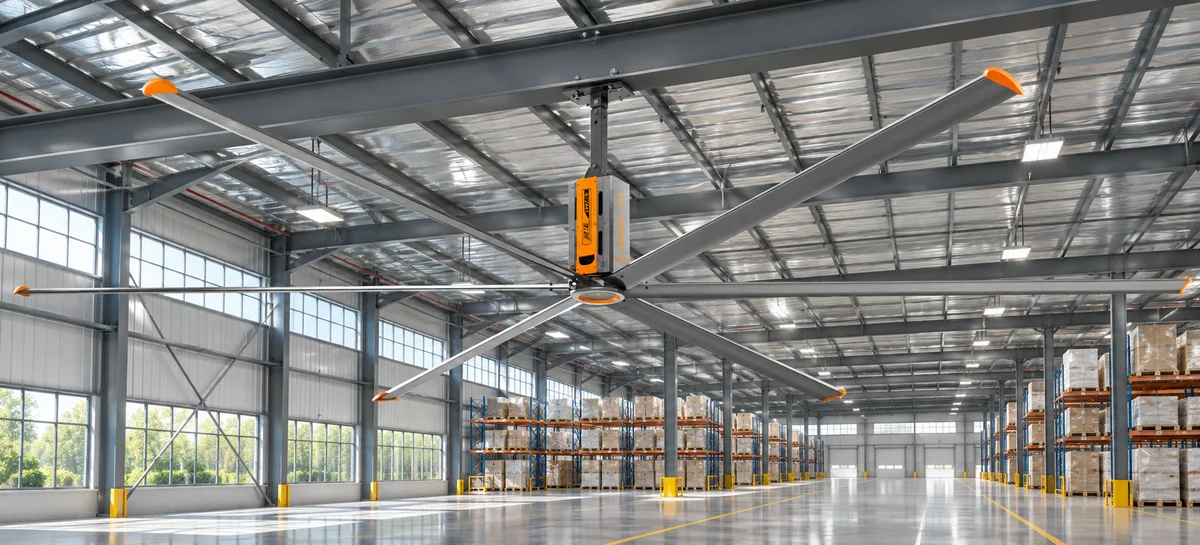
US buyers can buy an HVLS fan with professional installation through three routes — an industrial fan supplier, an authorized distributor, or a commercial HVAC contractor. How the routes differ, what a complete quote should include, and how to vet an installer before you sign.
View article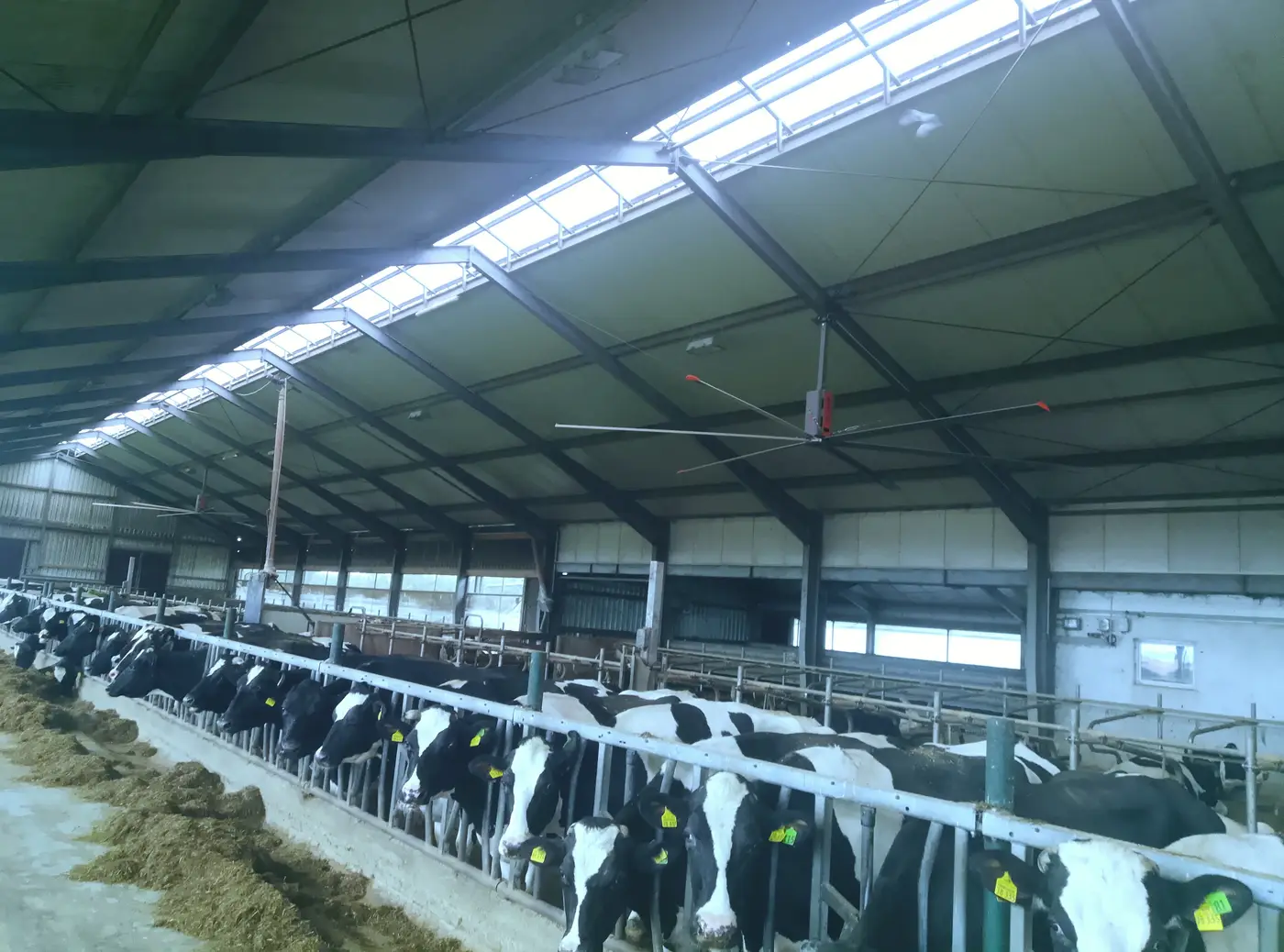
HVLS Fans for a German Dairy Barn: A Customer's Five-Star Review
A German dairy barn customer praises RTFANS fan assembly, supplied components and Angela Xie's support during ordering, shipping and installation.
View article
HVLS Fans Meaning: What Is an HVLS Fan and How Does It Work?
HVLS stands for High-Volume, Low-Speed. Learn how large overhead fans circulate air in warehouses, factories, gyms and other high-ceiling spaces, then compare the technical and site conditions that affect fan selection.
View article