
High-End Ventilation System Cost Comparison
Premium ventilation pricing explained by component — equipment, installation, energy and upkeep — with verified dealer prices, RTFANS factory-direct prices and a 10-year total-cost-of-ownership worked example.
The short answer: for a single premium HVLS fan, expect $5,000–$10,000 for the equipment alone (VividAir, 2023), $1,000–$5,000 for installation, and about $0.17 per hour to run at $0.10/kWh. Dealer listings put a Big Ass Fans Powerfoil 6 at $6,499–$7,199 and a Powerfoil X4 at $9,999–$10,699 (November 2026). RTFANS factory-direct prices on its own Alibaba storefront start far lower — a 7.3 m PMSM HVLS fan at $299–$1,300 (November 2026 snapshot, before freight and installation). But the purchase price is only the first line of the bill: over 10 years, energy and installation often matter more than the sticker price. This article breaks the cost into components, shows a worked total-cost-of-ownership example with every assumption labelled, and gives you a checklist for comparing quotes fairly.
Key takeaways
- Equipment is only part of the cost. Installation ($1,000–$5,000 per fan), energy, and upkeep decide the real 10-year bill.
- Premium US brands generally quote per project. Public prices come from dealers, not the manufacturers' own sites — always confirm with a written quote.
- A direct-drive HVLS fan costs cents per hour to run. At $0.10/kWh, a 0.55 kW fan costs about $0.06 per hour.
- The cheapest quote is not always the cheapest system. Diameter, motor type, warranty length, and what is included (controls, mounting, freight) change the total.
- RTFANS prices are factory-direct from its own storefront. Compare them against dealer prices on the same basis: same diameter, same coverage, same inclusions.
What does a high-end ventilation system cost up front?
A high-end ventilation system is not one product. For a warehouse or factory it usually means one or more HVLS fans, sometimes plus evaporative coolers, exhaust fans, controls, and ducting. The up-front bill has three lines: equipment, installation, and commissioning.
For a single premium HVLS fan, the equipment range most often quoted in the US market is $5,000–$10,000, according to VividAir's cost guide (published May 2023, updated September 2023). The range is wide because diameter runs from 8 to 20+ feet, materials differ, and some manufacturers include multi-year warranties in the purchase price. Dealer listings checked in November 2026 sit inside that range: a Big Ass Fans Powerfoil 6 lists at $6,499 (8–14 ft) to $7,199 (16–24 ft) at Portable Air Group, and $6,509–$6,869 for the 20 ft model at Global Industrial; a Powerfoil X4 lists at $9,999–$10,699. Smaller architectural models list lower — a Big Ass Fans Essence 14 ft at $4,079 on HVACDirect.
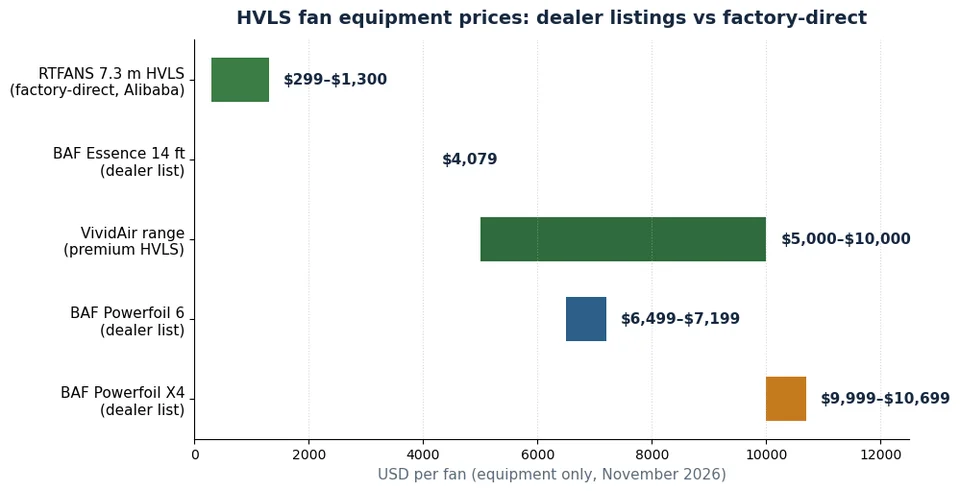
RTFANS prices from its own Alibaba storefront (snapshot 12 November 2026, subject to final quotation, freight and installation excluded) are factory-direct: a 7.3 m PMSM HVLS fan (RT-KS06) at $299–$1,300, a 24 ft HVLS fan (RT-KS Series) at $399–$500, a Grace evaporative cooler at $1,999–$2,299, an RT-1380 exhaust fan at $95–$110, and an RTF-20Y portable cooler at $1,250–$1,650. For a closer look at what a single fan costs on its own, see our guide to how much HVLS fans cost. We have also compared Big Ass Fans and RTFANS head to head, model by model, so you can see where the price gap comes from. The gap between factory-direct and dealer pricing is the point of this comparison — not a verdict. A dealer price usually bundles US warehousing, local support, and a dealer margin; a factory-direct price usually does not include freight, import duty, or local installation. Compare them on the same basis, which is what the checklist at the end of this article is for.
What is included in the equipment price?
Not every quoted price buys the same thing. Before comparing two numbers, check what each one includes:
- The fan itself — diameter, blade count and material, motor type (direct-drive PMSM or geared AC), and rated airflow and coverage.
- Controls — a wall controller, variable-speed drive, or smart controls may be included or sold separately. A quote without controls is not comparable to a quote with them.
- Mounting hardware — extension rod, beam mount, and safety cable. HVLS fans must mount to a structural beam or other approved support, never to a flat ceiling; the mount is part of the system, not an accessory.
- Warranty — premium brands often include multi-year warranties in the purchase price. Check the length and what it covers (motor, blades, controls, labour) before treating a higher price as expensive.
- Freight and duty — factory-direct prices normally exclude international freight and import duty; dealer prices normally include domestic freight. Neither is "hidden" — they are just on different lines.
If a quote does not itemise these five, ask for an itemised version. Two quotes that look $2,000 apart can be identical once the inclusions match.
How much does installation add?
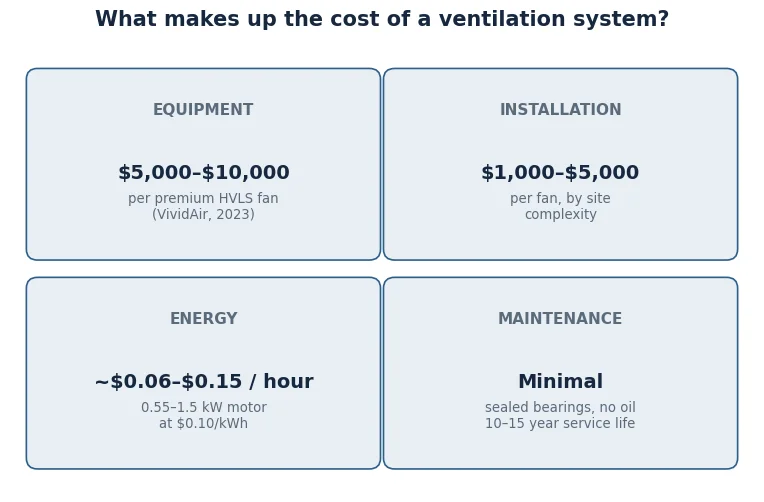
VividAir puts installation at $1,000–$5,000 per fan, depending on the complexity of the site. Facilities with very high ceilings or that need additional support structures cost more; a straightforward install by an in-house team costs less. Factory-certified installation, where the manufacturer sends its own team, sits at the top of that range and covers mechanical and electrical work.
Three things move installation cost most:
- Ceiling height and structure. A fan needs a structural beam to hang from. If the beam needs reinforcement, or the drop rod is long, labour and hardware rise.
- Electrical work. A dedicated circuit, the controller location, and cable runs. Retrofitting an old building costs more than a new build with conduit already planned.
- Access. High-bay warehouses need lifts and scheduled downtime. A site that can only be worked on at night or on weekends pays more.
A realistic planning figure for a single-fan project is therefore equipment plus $1,000–$5,000 for installation. For a multi-fan project, ask for installation as a separate line — it is usually cheaper per fan than a single install, and it should be visible in the quote.
What does a high-end system cost to run?
This is where HVLS fans are strongest. They move a large volume of air at low speed, so the motor is small for the coverage. VividAir states a typical operating cost of about $0.17 per hour at $0.10/kWh for a 20 ft fan moving roughly 325,000 CFM with a 1–2 HP motor.
The arithmetic is simple and you can run it for any fan:
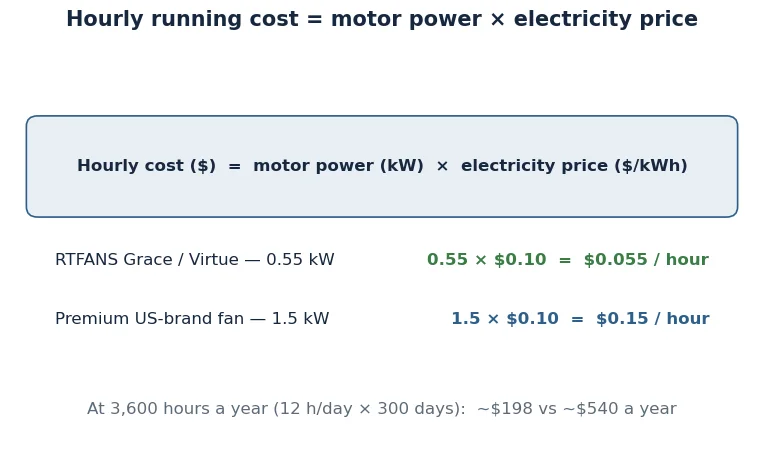
Hourly cost = motor power (kW) × electricity price ($/kWh)
RTFANS Grace (4.0 m) and Virtue (4.7 m) fans use a 0.55 kW motor. At $0.10/kWh that is 0.55 × 0.10 = $0.055 per hour — about six cents. A 1.5 kW motor at the same rate is $0.15 per hour. Your local electricity price changes the answer, so replace $0.10 with your own rate; the formula does not change.
Running cost also depends on hours. A fan running 12 hours a day, 300 days a year runs 3,600 hours a year. At $0.055 per hour that is about $198 a year; at $0.15 per hour it is about $540 a year. The difference between a 0.55 kW and a 1.5 kW motor is roughly $340 a year, every year, for the same coverage — which is why motor power belongs in a price comparison, not just the purchase price.
Evaporative coolers add water and a pump to the running cost. RTFANS coolers range from 20,000 to 60,000 CMH; their running cost depends on the model and local water and electricity prices, so ask for the model's rated power and water consumption in the quote and run the same formula.
What is the total cost of ownership over 10 years?
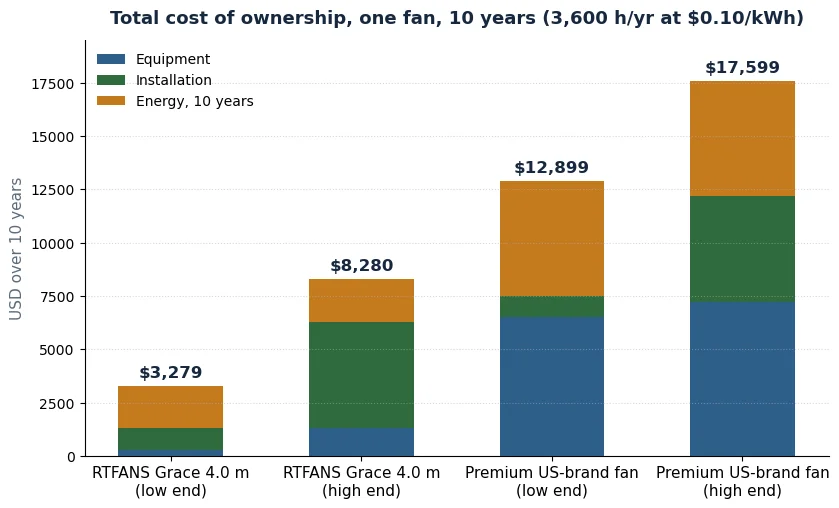
VividAir gives a 10–15 year service life for a well-built HVLS fan, with sealed bearings and no oil changes — effectively maintenance-free in normal use. Ten years is therefore a fair horizon for a total-cost-of-ownership (TCO) comparison. The table below is a worked example for one fan. Every assumption is labelled; replace it with your own numbers to get your own answer.
| Cost line | RTFANS Grace 4.0 m (0.55 kW) | Premium US-brand fan (1.5 kW) |
|---|---|---|
| Equipment | $299–$1,300 (RTFANS Alibaba storefront, Nov 2026; excludes freight/duty) | $6,499–$7,199 (dealer list, Nov 2026; domestic freight typically included) |
| Installation | $1,000–$5,000 (VividAir range) | $1,000–$5,000 (VividAir range) |
| Energy, 10 years (3,600 h/yr at $0.10/kWh) | ~$1,980 | ~$5,400 |
| Maintenance, 10 years | Minimal for sealed-bearing direct-drive units (no figure quoted; confirm warranty terms) | Minimal for sealed-bearing direct-drive units (no figure quoted; confirm warranty terms) |
| 10-year total (equipment + install + energy) | ~$3,280–$8,280 | ~$12,900–$17,600 |
Assumptions: 12 hours/day, 300 days/year (3,600 hours/year); electricity $0.10/kWh; 10-year horizon; installation at the VividAir range for both; freight, duty, and controls excluded from both columns because they vary by project. The table is not a promise — it is a method. Change the electricity price, the hours, or the installation figure and the totals move; the method stays the same.
Two things the table makes visible. First, energy is a large share of the 10-year bill for a fan that runs all day — a lower-power motor pays back every year. Second, the equipment gap between factory-direct and dealer pricing is large, but it narrows once installation and freight are added on the factory-direct side. Get both quotes on the same basis before deciding.
What makes one quote more expensive than another?
Five factors explain most of the price difference between two high-end systems:
- Diameter and coverage. A 7.3 m fan covers up to 1,800 m² (RTFANS King series); a smaller fan covers less and costs less. Never compare a 4 m fan's price with a 7.3 m fan's price — compare cost per square metre covered.
- Motor type. Direct-drive PMSM motors (no gearbox, no oil, fewer wearing parts) cost more up front than geared AC motors and less to maintain. RTFANS King, Grace, and Virtue fans use PMSM direct drive; ask any supplier which motor type their price assumes.
- Materials and build. Blade material, hub construction, and finish (including the blue Sports-King variant for sports arenas) change cost and durability. Ask what the blades and hub are made of, not just the diameter.
- Controls and integration. A basic wall controller, a variable-speed drive, BMS integration, and multi-fan grouping are different prices. List them separately in the quote.
- Brand, warranty, and support. A longer warranty, a local service network, and a manufacturer that answers the phone have a price. So does a brand premium with no service behind it. Ask for the warranty document, not just the number of years.
How do you compare quotes fairly?
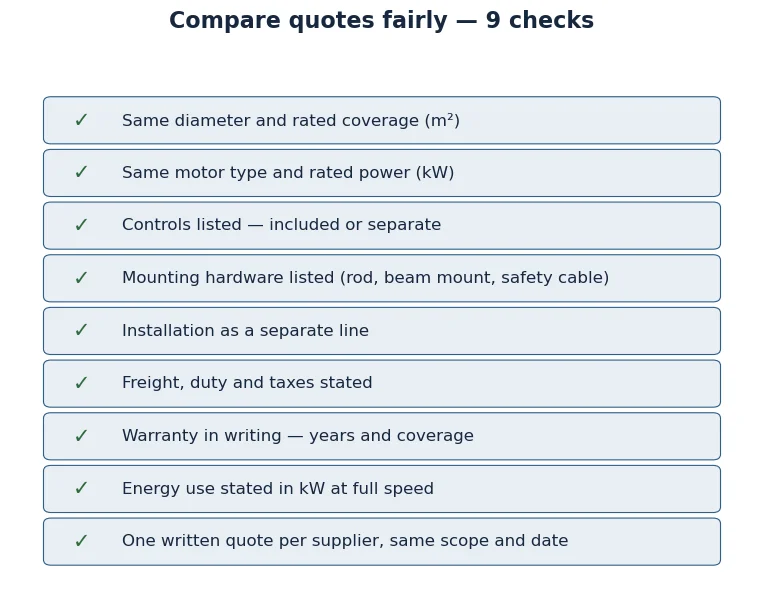
Use this checklist on every quote. If a supplier cannot answer a line, the quote is not yet comparable.
- Same diameter and same rated coverage (m²), not just the same number of fans.
- Same motor type (PMSM direct drive or geared AC) and rated power (kW).
- Controls listed as a line item — included or separate, with the model named.
- Mounting hardware listed — extension rod, beam mount, safety cable.
- Installation listed separately, with ceiling height and electrical work stated.
- Freight, import duty, and taxes stated — included or excluded, with the amount.
- Warranty in writing — years, what it covers, and who performs service.
- Energy use stated — rated power (kW) at full speed, so you can run the hourly-cost formula.
- One written quote per supplier, same date, same scope. Verbal prices do not count.
Where does RTFANS fit on price?
RTFANS is a factory-direct manufacturer (Guangdong Ruitai, 23 years, 90+ countries, 20,000+ installations) selling through its own storefront and distributors. Its HVLS range runs 2.8–7.3 m with coverage up to 1,800 m² and airflow of 4,500–15,000 m³/min; the King series uses six airfoil blades, Grace (4.0 m) and Virtue (4.7 m) use five blades and a 0.55 kW PMSM motor. Evaporative coolers range from 20,000 to 60,000 CMH. Prices on its Alibaba storefront (November 2026 snapshot) are factory-direct and exclude freight, duty, and installation — the quote you receive will add those lines for your project.
That is the honest way to read the price gap in this article: factory-direct pricing against dealer pricing, on the same scope, with the same checklist. For the wider market context, see our industrial cooling market and supplier landscape. If you want a like-for-like figure for your building, request a written quote with the diameter, coverage, controls, mounting, installation, and warranty itemised — then compare it with the checklist above, not with a headline number.
Frequently Asked Questions
How much does a high-end HVLS fan cost?
For a premium US-brand fan, expect $5,000–$10,000 for the equipment alone (VividAir), with dealer listings at $6,499–$7,199 for a Big Ass Fans Powerfoil 6 and $9,999–$10,699 for a Powerfoil X4 (November 2026). Installation adds $1,000–$5,000 per fan. RTFANS factory-direct prices on its own storefront start at $299–$1,300 for a 7.3 m fan (November 2026, before freight and installation).
Why do HVLS fan prices vary so much?
Diameter, motor type, materials, controls, warranty, and whether the price is factory-direct or dealer pricing. A 7.3 m direct-drive fan and a 4 m geared fan are different products; compare cost per square metre covered, not headline price.
What does it cost to run an HVLS fan?
About $0.06 per hour for a 0.55 kW fan at $0.10/kWh, and about $0.15 per hour for a 1.5 kW fan at the same rate. The formula is motor power (kW) × your electricity price ($/kWh). At 3,600 hours a year, that is roughly $198 versus $540 a year.
How long does a high-end HVLS fan last?
VividAir gives 10–15 years for a well-built fan with sealed bearings and no oil changes, depending on use, maintenance, and environment. Use 10 years as the horizon for a total-cost-of-ownership comparison.
How do I compare ventilation quotes fairly?
Same diameter and coverage, same motor type and power, controls and mounting listed, installation as a separate line, freight and duty stated, warranty in writing, and energy use stated in kW. Get one written quote per supplier on the same scope and date.
Get a tailored quote
Every building is different — ceiling height, layout, heat sources, and local energy prices all change the answer. Send your floor plan and ceiling height through the request-a-quote page and RTFANS will return an itemised written quote: diameter, coverage, controls, mounting, installation, and warranty, so you can compare it line by line with any other supplier.
Related insights
Recommended Engineering & Ventilation Guides
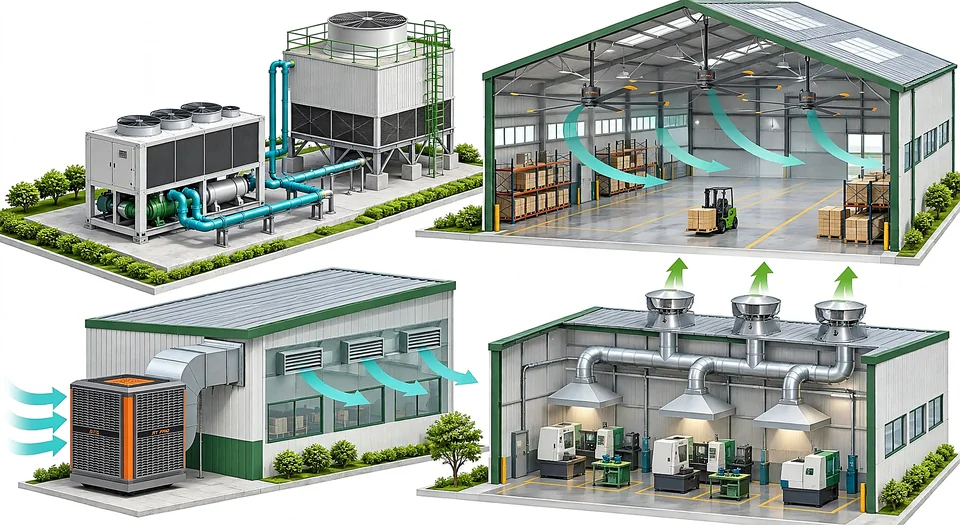
Industrial Cooling Market and Supplier Landscape: How to Shortlist the Right Partner in 2026
Industrial cooling covers several different equipment markets, from chillers and cooling towers to HVLS fans, evaporative coolers, and industrial ventilation. This guide explains how the segments overlap, how to interpret market estimates, and how buyers can compare suppliers for a real facility.
View article
5090 vs 7090 Cooling Pad: What's the Difference?
Compare 5090 and 7090 evaporative cooling pads by flute geometry, listed depth, dimensions, installation fit, airflow, and maintenance requirements.
View article
Partner with Kool Air (brand: RTFANS)-a leading manufacturer and solution provider in large space ventilation and cooling field
Seize the Multi-Billion Dollar Opportunity in Large-Space Ventilation & CoolingJoin Our Global Network of HVAC Distributors & Contractors – Let’s [...]
View article