
Industrial Cooling Market and Supplier Landscape: How to Shortlist the Right Partner in 2026
Industrial cooling covers several different equipment markets, from chillers and cooling towers to HVLS fans, evaporative coolers, and industrial ventilation. This guide explains how the segments overlap, how to interpret market estimates, and how buyers can compare suppliers for a real facility.
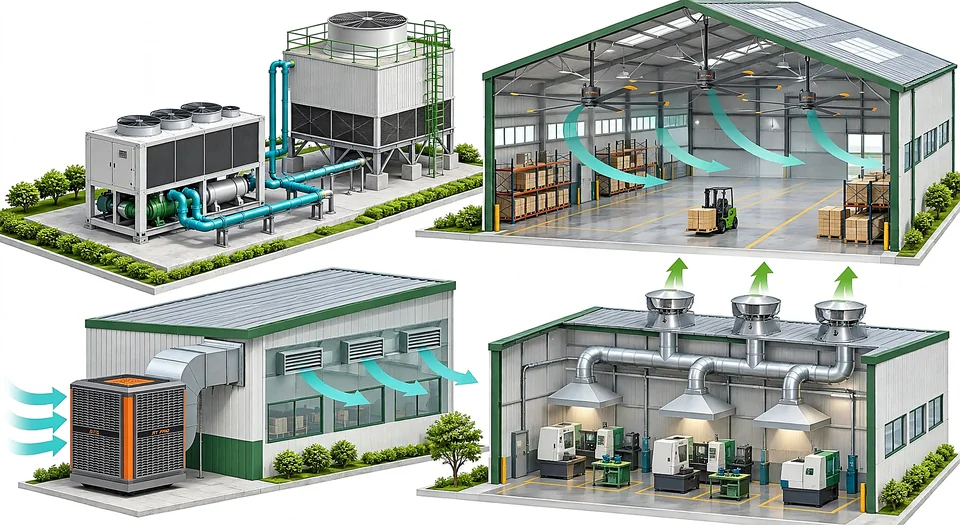
Industrial cooling is best understood as several overlapping equipment markets. Large HVAC and process cooling suppliers build chillers, cooling towers, heat exchangers, and controls. HVLS specialists focus on large-volume air movement. Evaporative-cooling suppliers provide fresh-air units, wetted media, or pad-and-fan systems. Industrial ventilation manufacturers supply the fans, air-handling equipment, and exhaust hardware that move air through a building.
That distinction matters when you create a shortlist. A supplier that is a strong fit for a central chilled-water plant may not make the right equipment for a hot, open warehouse. Conversely, an HVLS or evaporative-cooling specialist may be relevant for a factory floor without being the right partner for process-temperature control. The first buying decision is therefore the equipment category and operating problem, followed by the supplier.
How large is the industrial cooling market?
Public research estimates for the global industrial cooling systems market vary widely. The source review cites 2026 estimates from roughly USD 19 billion to USD 26 billion, with forecast growth of about 6% to 7% a year. The spread is expected because research firms use different definitions: some count chillers, cooling towers, and process cooling; others include space cooling, ventilation, or related equipment.
| Public estimate cited in the source review | 2026 estimate | Published forecast | Reported CAGR |
|---|---|---|---|
| Coherent Market Insights | USD 23.20 billion | USD 37.92 billion by 2033 | 7.3% |
| Fortune Business Insights | USD 25.72 billion | USD 43.13 billion by 2034 | 6.67% |
| Research Nester | USD 24.34 billion | USD 45.26 billion by 2036 | 6.4% |
| MarkWide Research | USD 18.7 billion | USD 33.81 billion by 2035 | 6.8% |
These are third-party estimates, not RTFANS measurements. They should be used as an order-of-magnitude view rather than as a precise market fact. Before using any number in a business case, check the research firm's definition, geography, base year, and whether replacement or service revenue is included.
Across the cited reports, the demand themes are similar: growth in factories and warehouses, data-centre construction, energy-efficiency requirements, and the need for fresh-air ventilation in large spaces. Those themes explain why buyers may see several equipment categories in the same project, but they do not make the categories interchangeable.
Which suppliers serve large HVAC and process cooling?
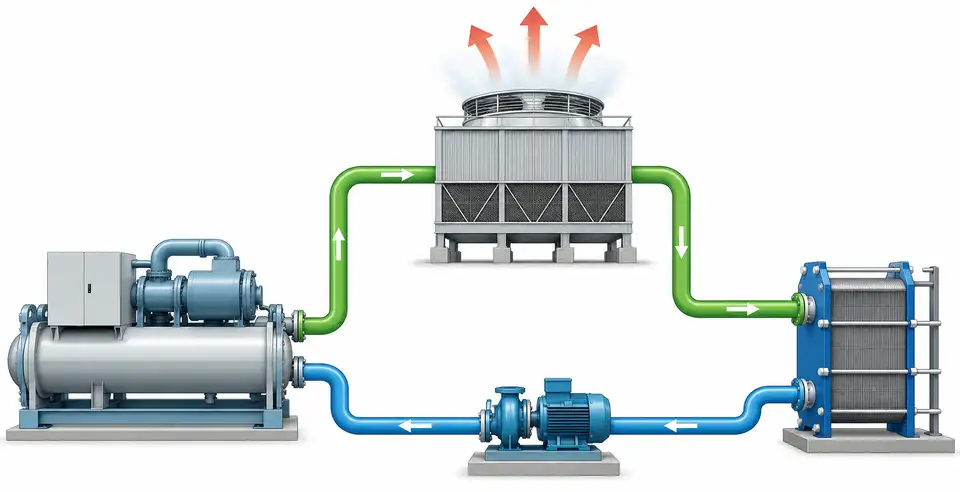
Large HVAC and process-cooling projects typically involve companies such as Johnson Controls, Daikin, Trane Technologies, Carrier, SPX, EVAPCO, Baltimore Aircoil Company, Schneider Electric, Emerson, Rittal, GEA, and Alfa Laval. Their portfolios cover some combination of chillers, cooling towers, refrigeration, heat transfer, controls, or process equipment.
This segment is relevant when the project needs process-temperature control, a central chilled-water plant, a cooling tower, or engineered heat rejection. It is a different starting point from space cooling in an open hall. If the problem is hot working zones, poor air distribution, or stagnant air in a warehouse, the shortlist may instead begin with HVLS fans, evaporative air coolers, exhaust, and building openings.
Which suppliers serve the HVLS fan market?
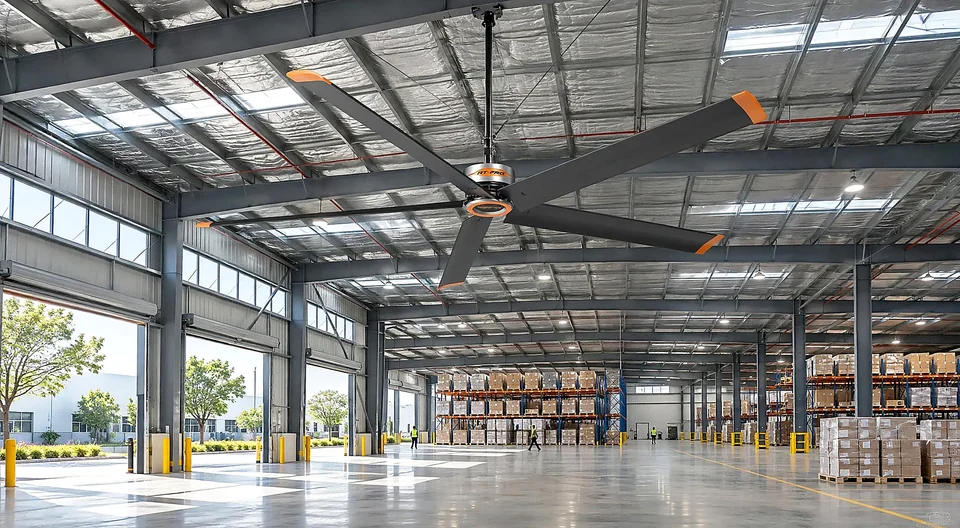
The HVLS market includes specialist manufacturers and industrial-equipment companies with dedicated fan ranges. Examples commonly encountered in public supplier material include Big Ass Fans, MacroAir, Hunter Industrial, Rite-Hite, Greenheck, Patterson Fan Company, Humongous Fan, and Chinese manufacturers such as RTFANS, Kale, and OPT.
This is a landscape of representative names, not a measured ranking. Public sources do not provide a consistent, comparable revenue or market-share table for HVLS manufacturers. A useful comparison asks whether the supplier manufactures the fan or resells it, which drive system and safety details are documented, whether the supplier can support the site conditions, and whether it can provide a comparable layout or reference installation.
The current RTFANS product record lists HVLS fan categories from 2.8 m to 7.3 m diameter. Final selection still depends on the building layout, ceiling height, heat sources, obstructions, controls, and installation conditions. A diameter range is a product range, not a guaranteed coverage promise. For background, see the existing HVLS fan guide and the current HVLS fan product range.
Which suppliers serve evaporative cooling?
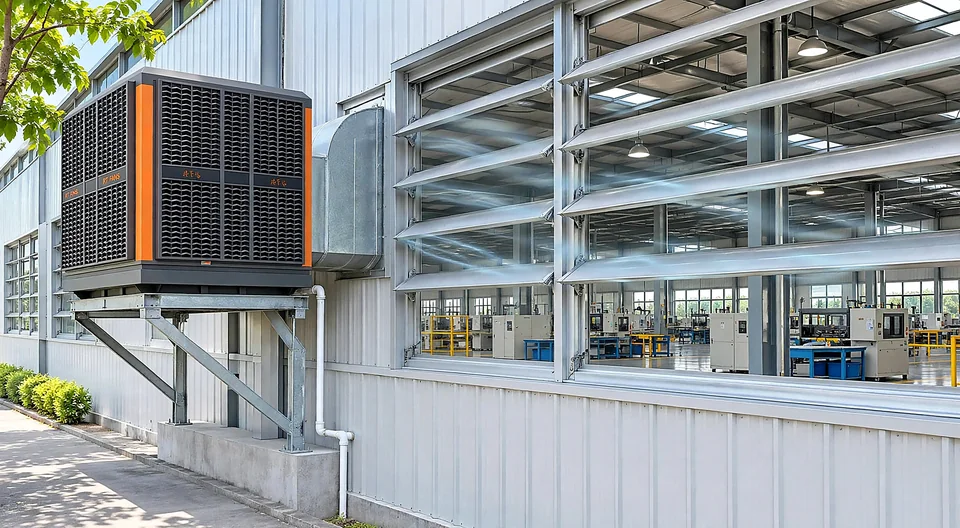
Evaporative cooling includes portable units, fixed wall or roof units, pad-and-fan systems, and evaporative heat-rejection equipment. A supplier that is strong in one subcategory is not automatically strong in all of them.
Public supplier examples include Portacool and Munters, as well as EVAPCO and Baltimore Aircoil for evaporative heat-rejection equipment. Direct industrial air-cooler suppliers, including RTFANS, serve large ventilated facilities with project-sized fresh-air equipment. The current RTFANS product record lists industrial evaporative-air-cooler configurations from 20,000 to 60,000 CMH. Climate, humidity, airflow, discharge direction, exhaust path, and layout must be confirmed before final selection.
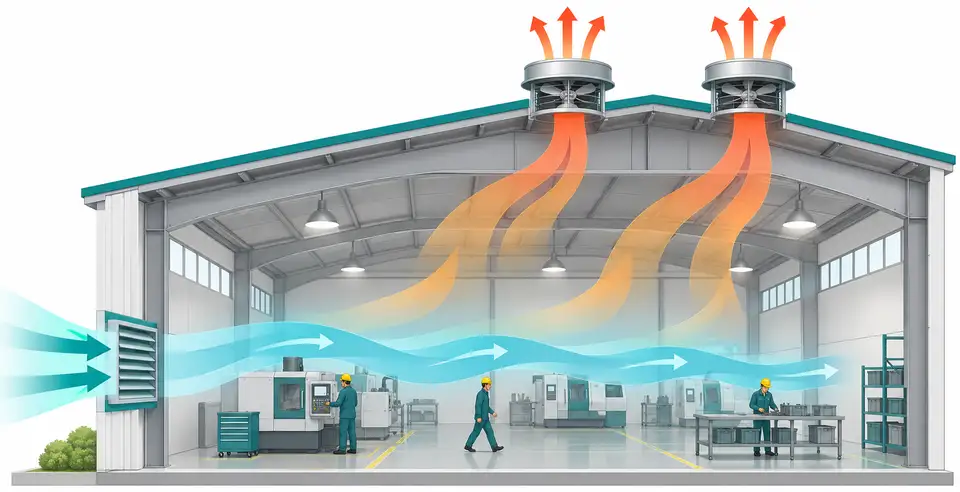
For a warehouse or production facility, review the warehouse cooling application, manufacturing cooling application, and broader fan-and-cooler solution.
Which suppliers make industrial ventilation equipment?
Industrial ventilation suppliers provide axial and centrifugal fans, roof ventilators, air-handling units, and related ducting or control equipment. Examples include Systemair, Greenheck, Twin City Fan, FläktGroup, and Soler & Palau. Their equipment is often specified alongside HVLS fans or evaporative coolers because air movement, outdoor-air supply, and heat removal are separate design tasks.
How should buyers compare industrial cooling suppliers?
1. Segment fit
Describe the problem in operating terms: process temperature, worker comfort, destratification, fresh-air supply, exhaust, or spot cooling. Ask whether the supplier designs and manufactures the equipment needed for that problem.
2. Construction and operating data
For an HVLS fan, review the drive system, blade material, controls, safety retention, electrical options, and maintenance access. For an evaporative cooler, review airflow, media, water supply, discharge direction, drainage, exhaust, and the climate assumptions behind the design.
3. Support footprint and commercial terms
Check where the equipment is manufactured, who handles commissioning, which spare parts are stocked, and what the warranty actually covers. Confirm whether third-party installation affects warranty coverage.
4. Comparable evidence
Request a reference installation, layout, test report, or case study that matches the building type and operating conditions. Ask what was measured, over what period, and whether the result applies to the same equipment and climate.
The ventilation and cooling calculator can help organize floor area, ceiling height, heat sources, and equipment combinations before a technical review. It does not replace a site survey or engineering approval.

Where does RTFANS fit?
RTFANS, exported by Kool Air International, operates in the HVLS-fan, evaporative-air-cooling, cooling-pad, and industrial-ventilation segments. The company states that the RTFANS brand dates from 2003, export activity began in 2014, and delivery has reached more than 90 countries and regions as of May 2026. Company materials also state that more than 20,000 fan-and-cooler combination systems are in operation worldwide. These are company statements and should be reviewed against project documentation when used in procurement.
For a project that needs air movement and fresh-air cooling in a large, ventilated space, share the floor area, ceiling height, heat sources, openings, destination, and operating schedule through the request-a-quote form. The configuration should be reviewed before a quotation is prepared.

Frequently Asked Questions
Who are the biggest industrial cooling companies?
There is no single answer because the term covers different markets. Define the equipment category before comparing company size.
Is there a reliable ranking of HVLS fan manufacturers?
No consistent public dataset ranks HVLS manufacturers by revenue or market share. Treat ordered “top 10” lists as editorial selections.
How precise is the industrial cooling market-size estimate?
It is not precise enough to treat one published figure as a universal fact. The cited 2026 estimates range from roughly USD 19 billion to USD 26 billion because the research firms count different equipment and regions.
Should I choose a specialist or a full-line HVAC supplier?
Choose the supplier with documented experience in the equipment and operating problem you have. A project can require both a full-line HVAC group and an HVLS or evaporative-cooling specialist.
What information should I provide when requesting a quote?
Provide the building use, floor area, ceiling height, heat sources, openings, climate information, desired air path, electrical standard, destination, and any existing equipment. Drawings, photos, and operating schedules help identify constraints.
Last updated: 18 November 2026. Market figures are estimates published by the cited research firms. Supplier examples are representative names from public company material and the supplied source review; they are not a ranked market-share list. RTFANS product and company information is based on current company records and is identified as company-stated where appropriate.
Related insights
Recommended Engineering & Ventilation Guides

5090 vs 7090 Cooling Pad: What's the Difference?
Compare 5090 and 7090 evaporative cooling pads by flute geometry, listed depth, dimensions, installation fit, airflow, and maintenance requirements.
View article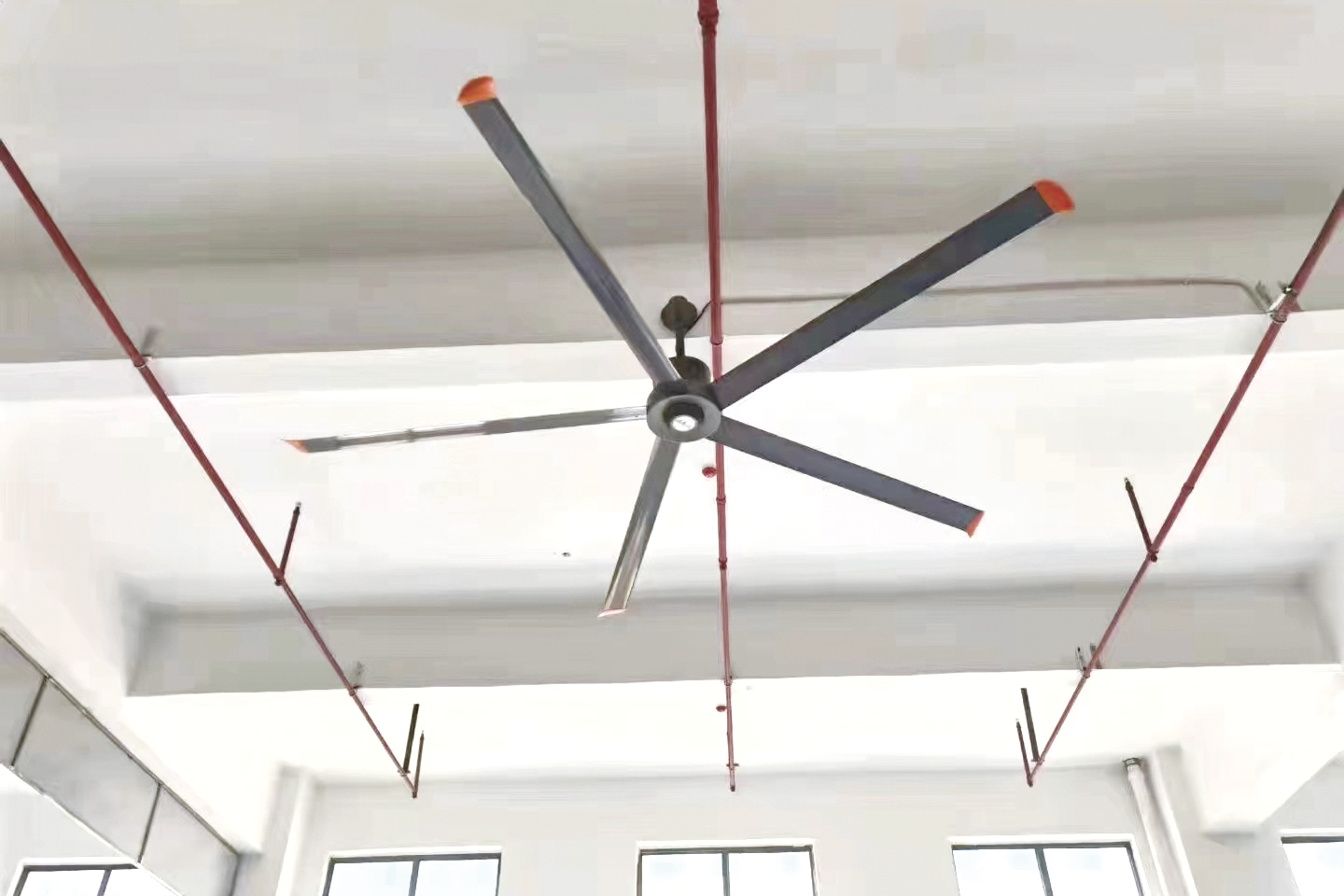
Partner with Kool Air (brand: RTFANS)-a leading manufacturer and solution provider in large space ventilation and cooling field
Seize the Multi-Billion Dollar Opportunity in Large-Space Ventilation & CoolingJoin Our Global Network of HVAC Distributors & Contractors – Let’s [...]
View article
Real Breeze Doesn't Just Dry Sweat - It Boosts Productivity!
Do you know the most coveted workstation in this factory? Right under the RT.FANS HVLS fan! This isn’t a joke. [...]
View article