
Ceiling Fans vs. HVLS Fans: Which Is Right for Your Facility?
Standard ceiling fans work well in rooms up to about 400 sq ft with 8 to 10 ft ceilings, such as offices, break rooms, and retail counters. Past that point, or in spaces with ceilings above roughly 14 ft and wide open floors, HVLS fans can be a better fit, because one large, slow fan can cover what a dozen small ones can't. Floor area alone doesn't settle it. Ceiling height and structure, obstructions, occupancy, and how much heat the space carries all matter. When moving air isn't enough, evaporative cooling is the add-on. We're KOOLAIR, a manufacturer of HVLS fans and evaporative air coolers. We've been building since 2003 and export to more than 90 countries and regions. We make recommendations based on your facility's dimensions, ceiling structure, climate, and occupancy.
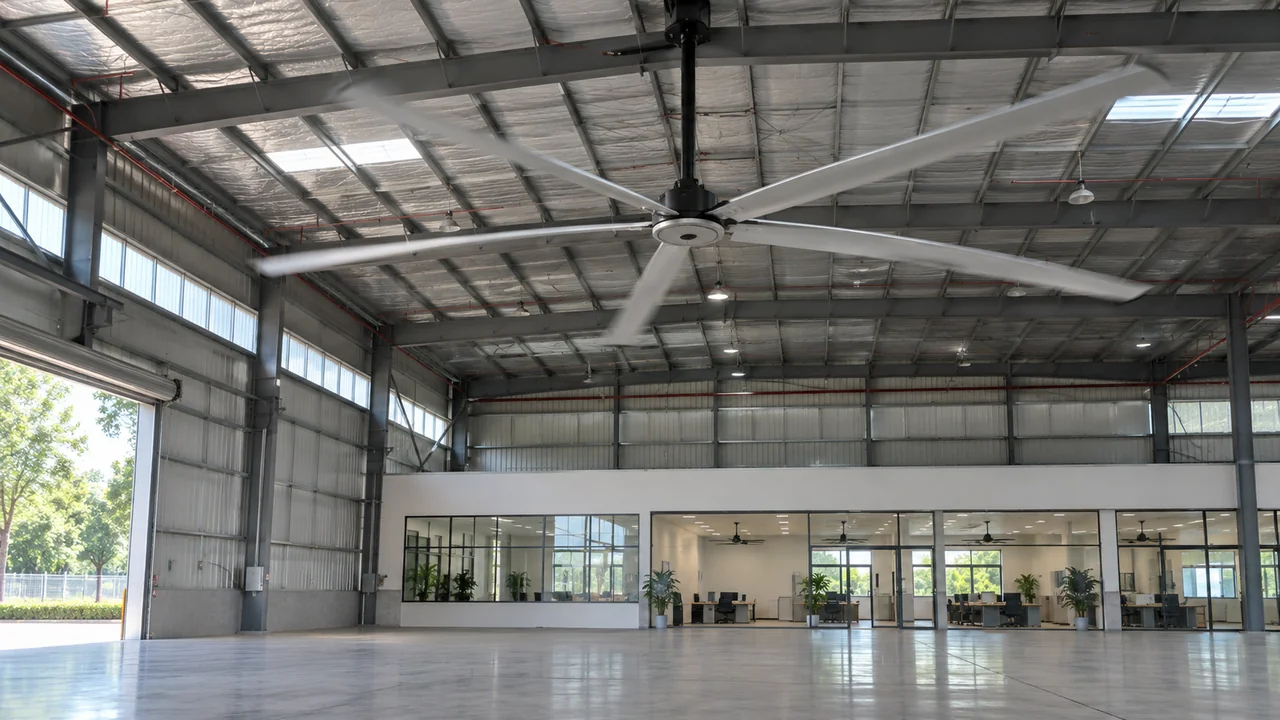
Standard ceiling fans work well in rooms up to about 400 sq ft with 8 to 10 ft ceilings, such as offices, break rooms, and retail counters. Past that point, or in spaces with ceilings above roughly 14 ft and wide open floors, HVLS fans can be a better fit, because one large, slow fan can cover what a dozen small ones can't. Floor area alone doesn't settle it. Ceiling height and structure, obstructions, occupancy, and how much heat the space carries all matter. When moving air isn't enough, evaporative cooling is the add-on.
We're KOOLAIR, a manufacturer of HVLS fans and evaporative air coolers. We've been building since 2003 and export to more than 90 countries and regions. We make recommendations based on your facility's dimensions, ceiling structure, climate, and occupancy.
Key takeaways
- Size by floor area: Standard fans cover roughly 100 to 400 sq ft. Above that, you can use several units or a single large fan of 56 in or more, and very large floors may call for HVLS fans.
- Mount by ceiling height: Low-profile mounts suit lower ceilings, as long as the blades keep the required clearance. Tall industrial ceilings call for HVLS fans on verified structural support.
- Compare certified efficiency: Judge fans by certified CFM per watt, not by maximum CFM on the box.
- Add cooling when heat is the problem: Fans move air but don't lower its temperature. Evaporative coolers do.
How do ceiling fans improve air circulation and comfort?
Ceiling fans improve comfort mainly by moving air across skin, which speeds up evaporation and makes people feel cooler without changing the room temperature. They also break up layered air, so warm air stuck near the ceiling mixes back down to where people work.
Why moving air feels cooler without lowering the temperature
Fans cool people, not rooms, so in most comfort applications there is little point running one over an empty break room. The exception is air mixing: some spaces run fans to even out temperatures or support HVAC performance even when nobody is there.
How fan direction breaks up stale, layered air
Warm air collects near the ceiling while cooler air stays at the floor. In summer mode, the fan pushes air down for a breeze. In winter, reversing direction at low speed moves warm ceiling air around without a direct draft.
What this means for large commercial and industrial floors
The same physics applies in a warehouse or factory, but at 30 ft ceilings the scale changes. The questions become how much floor and how much height need to be covered.
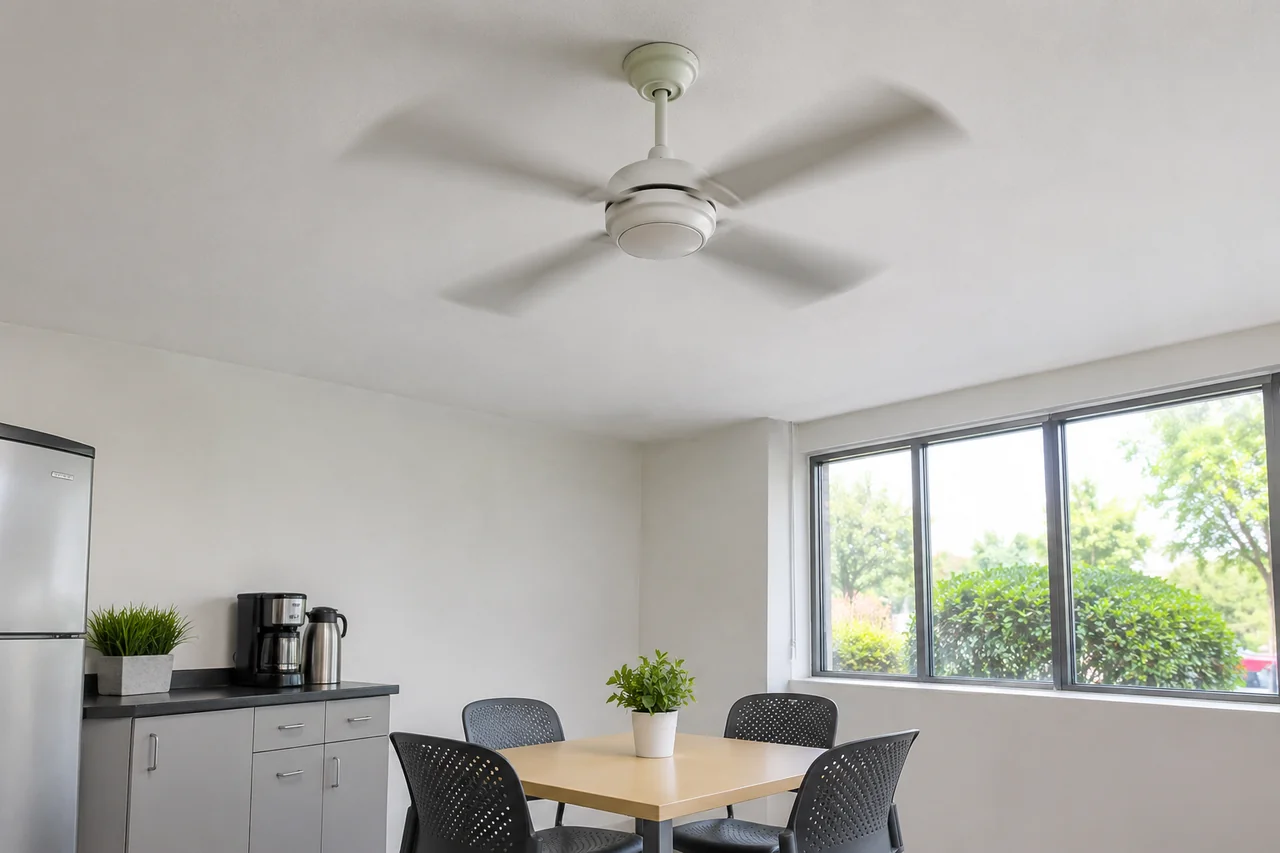
What size ceiling fan do you need, and how do ceiling height and mounting change the choice?
Match blade span to floor area first, then pick the mount based on ceiling height. These are standard starting points from ENERGY STAR, and coverage recommendations vary by manufacturer.
| Room area | Recommended fan size |
|---|---|
| Up to 75 sq ft | 29 to 36 in |
| 76 to 144 sq ft | 36 to 42 in |
| 145 to 225 sq ft | 44 in |
| 226 to 400 sq ft | 50 to 54 in |
| Over 400 sq ft | 56 in or larger, or multiple fans |
For open-plan or L-shaped areas, size the fan for the main occupied zone rather than the whole floor plan.
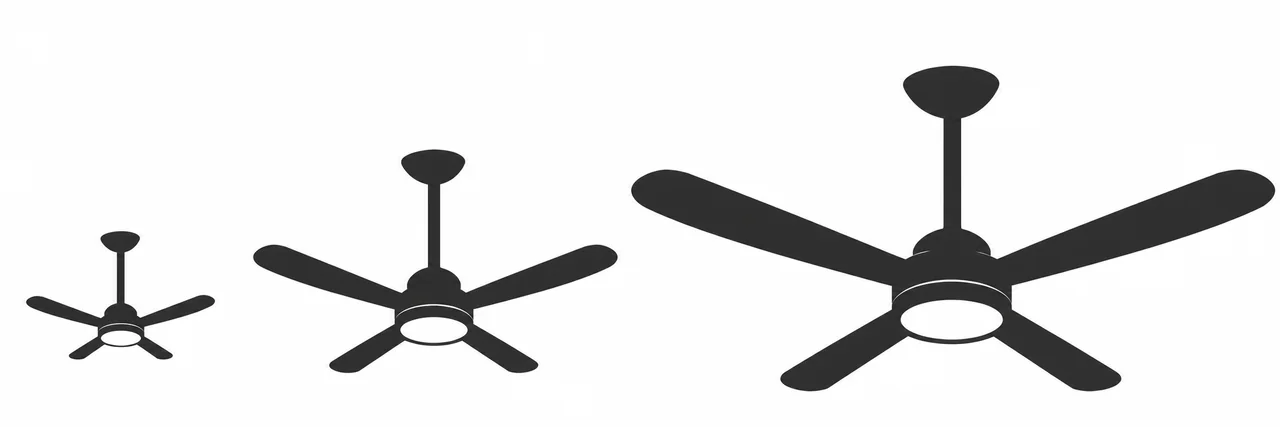
Pick the mount by ceiling height
For ceilings of 8 ft or lower, a flush-mount or low-profile fan is the usual choice. The trade-off is less airflow, since the blades sit closer to the ceiling. Some low ceilings can't accommodate a fan at all, because the blades must stay at least 7 ft above the floor. Ceilings around 8 to 9 ft take a short downrod. Above 9 ft, use an extended downrod so the blades hang roughly 8 to 9 ft above the floor and never below 7 ft. Vaulted or sloped ceilings need an angled-ceiling adapter.
Check the fan's total drop, including the motor housing and light kit, not just the downrod length. Confirm clearances against the manufacturer's instructions and your local building and fire requirements, including sprinkler clearance.
The point where adding more small fans stops working
Over 400 sq ft, you have two options: several standard fans or one larger fan of 56 in or more. Multiple fans can mean more wiring, more mounting points, and possibly more noise, though two smaller fans can also give more even airflow in some layouts. Once the floor gets much larger, or the ceiling gets tall, large-diameter fans become the more practical route. As a rough example, a 10,000 sq ft floor would need dozens of 400 sq ft fan zones, while one HVLS fan can cover a floor of that size depending on diameter, ceiling height, and layout.
Standard ceiling fans or HVLS fans: which works for a warehouse, factory, or large commercial space?
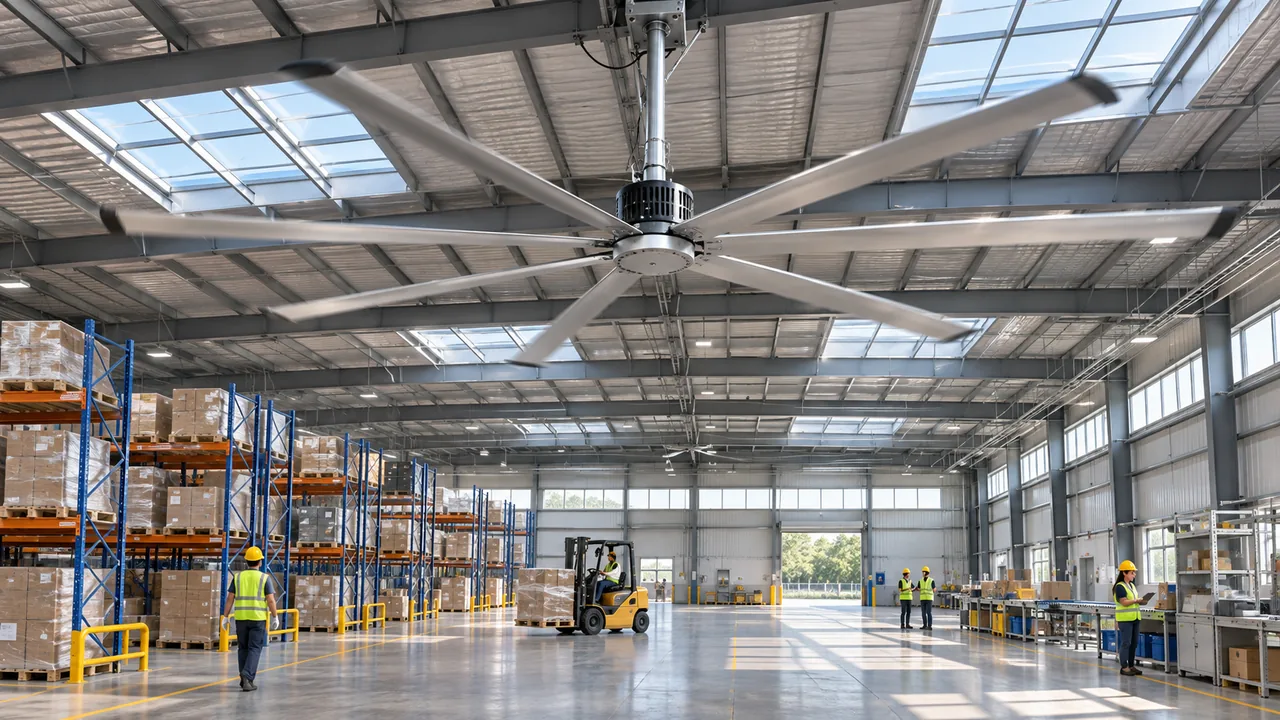
HVLS fans are often a good fit for warehouses, factories, and large commercial spaces that are open and have suitable clearances and structural support. Standard ceiling fans belong in individual rooms. A single HVLS fan typically covers about 2,000 to 22,500 sq ft depending on diameter, ceiling height, and layout, while a standard fan covers roughly 100 to 400 sq ft. Exact coverage varies by model, so check the manufacturer's coverage data.
Side-by-side comparison
| Factor | Standard ceiling fan | HVLS fan |
|---|---|---|
| Best-fit space | Offices, break rooms, retail counters | Warehouses, factories, sports facilities |
| Ceiling height | About 8 to 10 ft | Roughly 14 ft and up; many installs sit at 20 to 30 ft |
| Coverage per unit | About 100 to 400 sq ft | About 2,000 to 22,500 sq ft |
| Airflow style | Faster, narrower jet | Slow, wide column of air |
| Mounting | Standard ceiling box or downrod | Verified structural member or engineered frame |
| Units for a large floor | Many | One or a few |
For large footprints, we recommend our HVLS industrial fans.
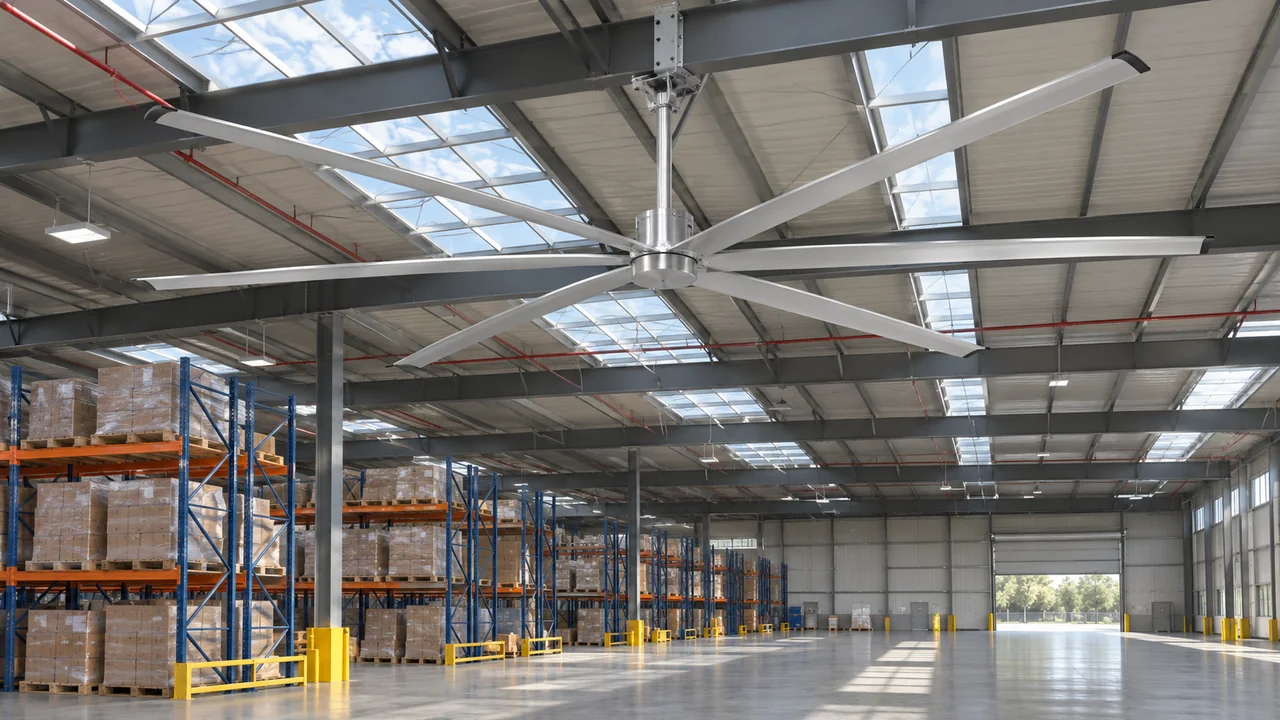
How HVLS fans move so much air at low speed
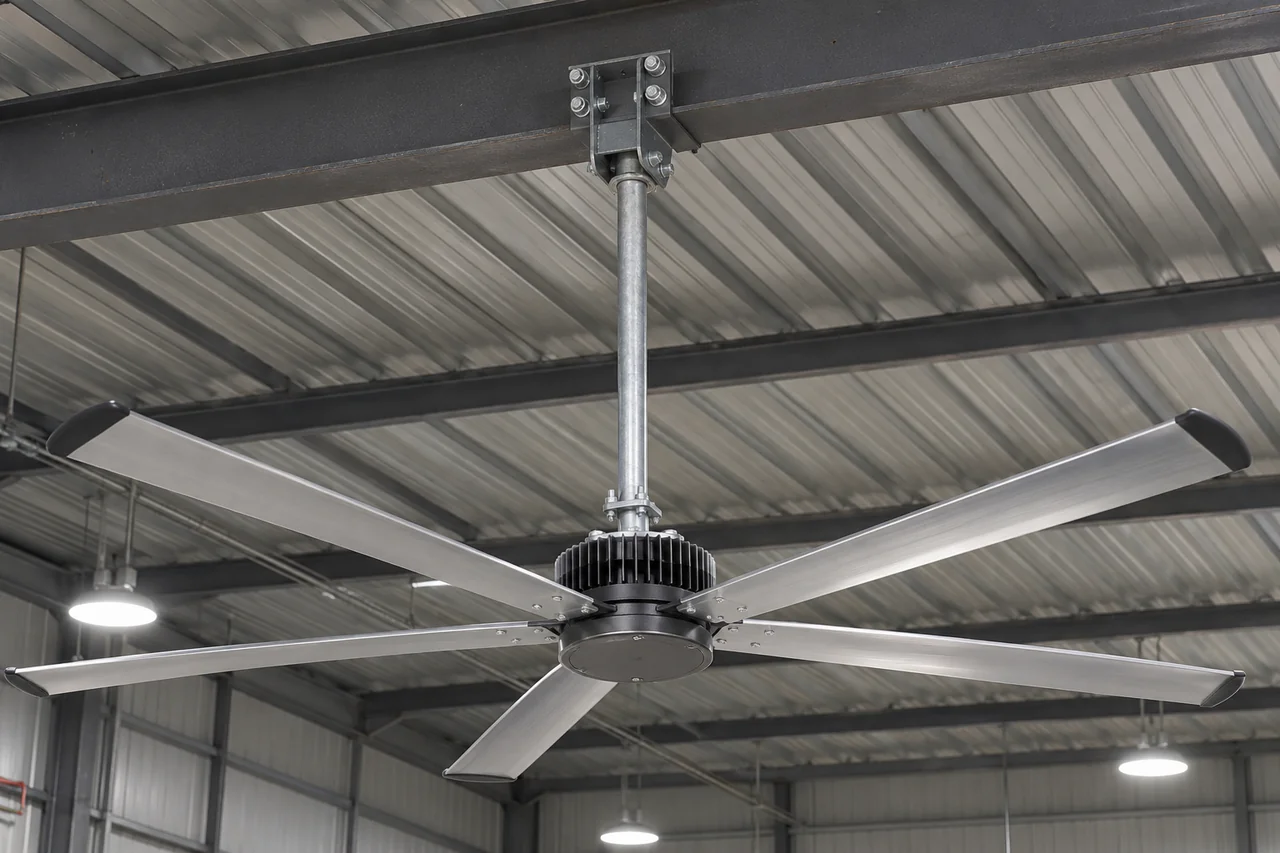
Large-diameter blades push a big, slow column of air down and out across the floor. For the full picture, see how big HVLS ceiling fans work. Our PMSM models use a gearless, permanent-magnet direct drive, which delivers high torque with lower noise and reduced maintenance.
Mounting requirements that catch buyers off guard
The roof truss or beam has to carry both the weight and the dynamic movement of the fan. Don't attach one to a suspended ceiling or a lightweight roof deck, and have an engineer confirm the support. Then map obstructions such as lights, sprinklers, ductwork, and crane paths before choosing a location. Planning guidance puts the lowest blade point at least 10 ft above the floor. Also check clearance above mezzanines, occupied platforms, forklift masts, and raised loads. The manufacturer's manual and your local building and fire requirements control the final clearances.
Leave clear access for inspection and cleaning after installation: a fan that needs a scaffold and a shutdown to reach will not be maintained, and a dirty or unbalanced fan moves less air for the same power.
How much energy do these fans use, and which features are worth paying for?
Judge efficiency by certified CFM per watt, not maximum CFM
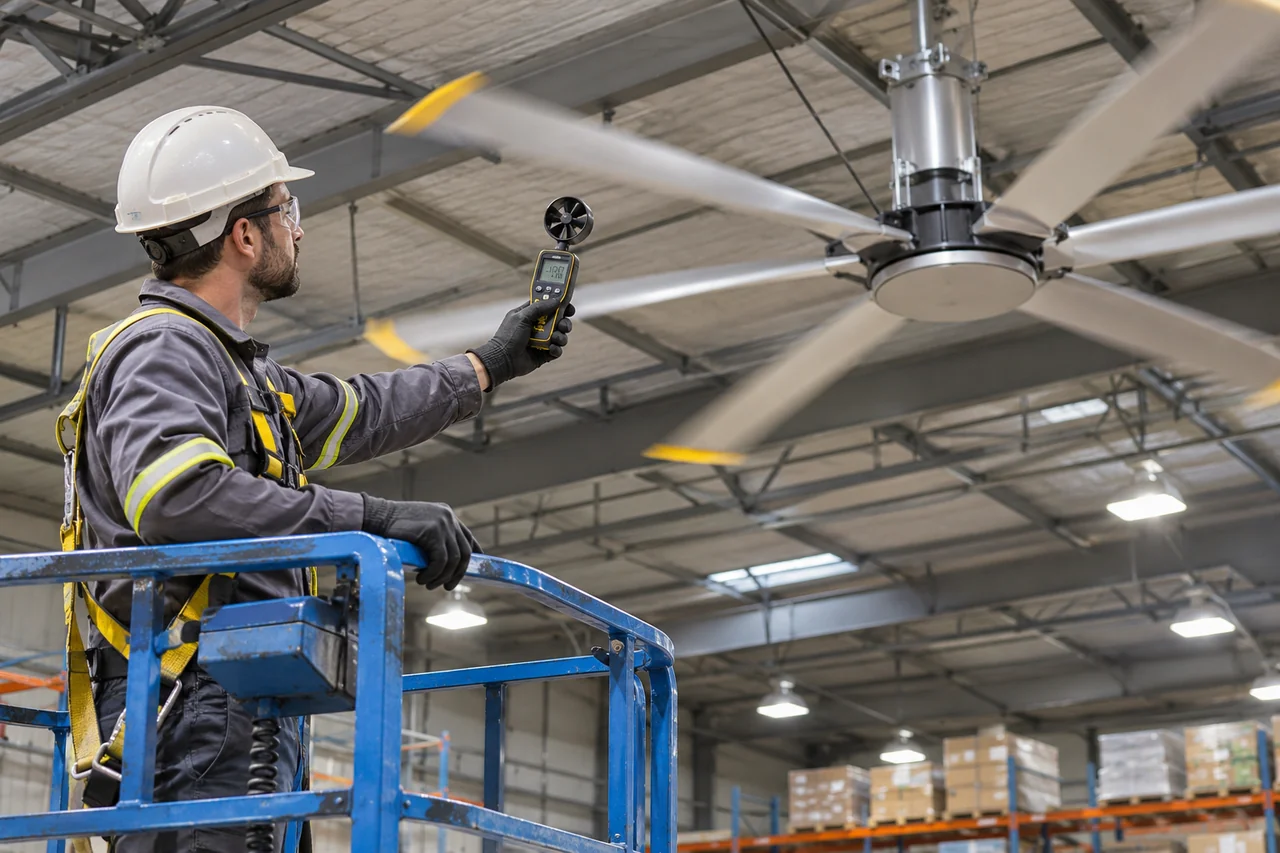
Sticker CFM misleads because it ignores how much power the fan draws to get there. As a guide, well-rated 52 in fans reach roughly 366 CFM per watt, and a certified 72 in fan reaches about 385. Larger fans are often more efficient and quieter for big rooms.
Fans with DC or PMSM motors can draw less power than conventional AC models, and that gap compounds over a full-shift operating schedule. At the facility scale, standard fans draw roughly 15 to 90 W each, while one HVLS fan can replace about 5 to 15 smaller units. In one published warehouse example, 13 conventional fans used 11 kWh per day, versus 7 kWh per day for one 14-foot HVLS fan. That's a 36% reduction. Results depend on layout, ceiling height, and operating hours, so treat it as an illustration rather than a guarantee.
Controls matter as much as the motor: a fan left running at full speed in an empty building wastes the saving its efficient motor earned. Match speed and running hours to occupancy, and check the result against the meter rather than the brochure. The US Department of Energy publishes ceiling-fan and thermostat guidance in its Energy Saver guide, and our guide to HVLS fan energy consumption shows how to estimate the running cost before you buy.
How to compare fan quotes
A low sticker price on a lower-efficiency fan can cost more over its lifetime. In the premium model discussed in the research, energy savings alone did not pay back the higher price, so buy for the actual job. Weigh purchase price, installed cost, power draw, noise, controls, and maintenance together. Before comparing quotes, check how much HVLS fans cost.
Lights, remotes, and ratings in commercial settings
Fans with integrated lights suit offices, showrooms, and retail, where one fixture does both jobs. Remote-controlled fans are convenient, but a remote isn't the same as a smart fan with app, voice, or scheduling support. A low-profile style also fits the look of customer-facing spaces.
Choose dry-rated fans for indoor spaces and damp-rated models for humid or covered areas. Wet-rated models belong anywhere rain can reach, such as open docks or pergolas.
When does evaporative cooling make sense alongside your fans?
Evaporative cooling makes sense when heat, not stale air, is the real problem. Very hot production floors and open venues are typical cases, where moving hot air only goes so far. The International Energy Agency notes that space cooling is the fastest-growing end use in buildings, and that comfort can come from fans and ventilation as well as air conditioning.
What airflow can't do on its own
Fans move air but don't lower its temperature. On a hot day, an HVLS fan makes workers more comfortable, but the air itself stays hot.
How evaporative air coolers fill the gap
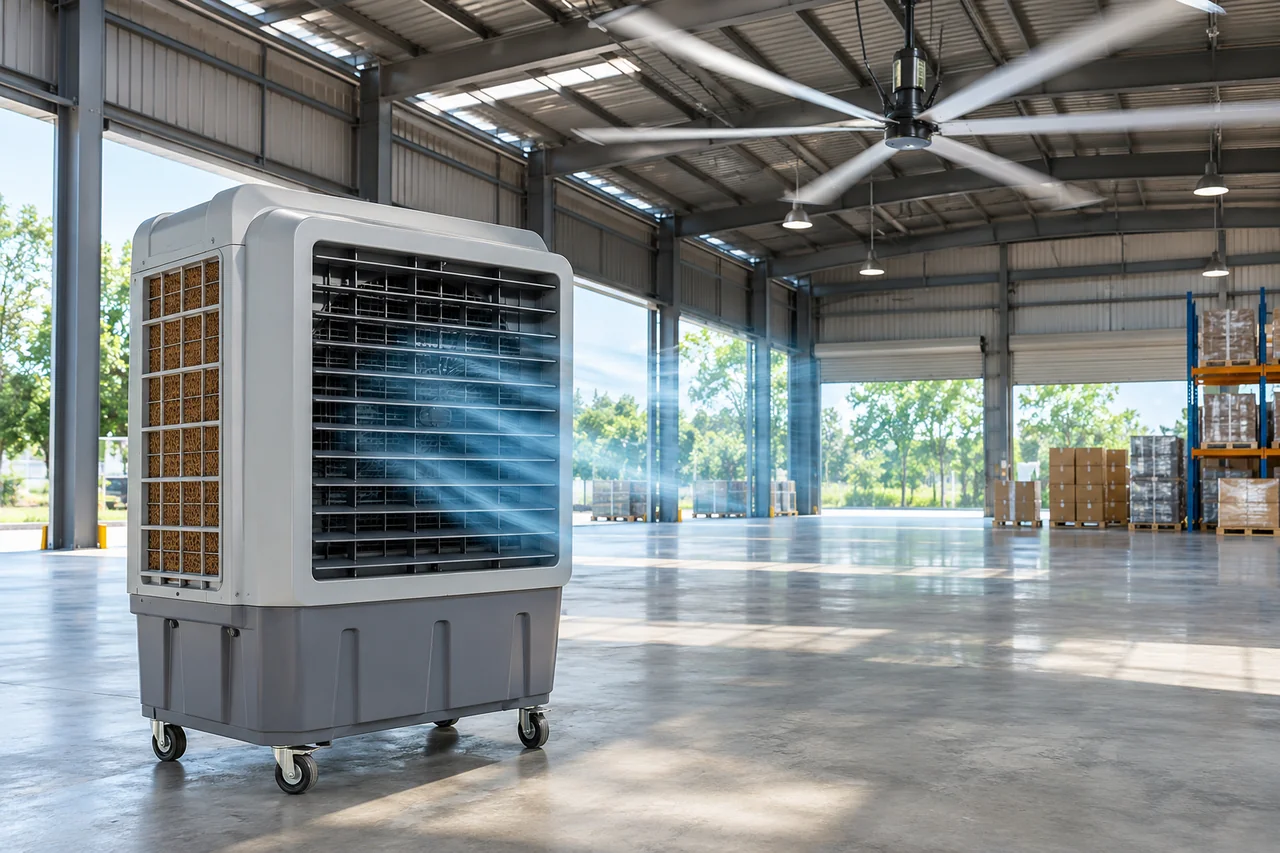
Our evaporative air coolers introduce a continuous supply of fresh, cooled air. They also support positive pressure and air exchange in open or semi-open spaces, with no ducted HVAC.
They fit best in dry or moderately humid climates. Direct evaporative cooling works poorly in humid air because humid air is already close to saturation. As a rough guide, it performs well below about 40% relative humidity, declines from roughly 40 to 60%, and often drops sharply above 60 to 70%. Actual results also depend on incoming air conditions and the equipment. In consistently hot, humid conditions, a refrigerated system is the better fit, so climate is part of how we make recommendations.
Fan and cooler combined systems from KOOLAIR
Our combined systems pair HVLS airflow with evaporative cooling, so cooled air reaches a wider working area. They suit warehouses, factories, sports facilities, and temporary or semi-permanent event spaces. Distributors and brands can also work with us on OEM and ODM options to build market-specific product lines.
Ready to choose? How to pick the right fan for your facility
Use standard ceiling fans for small rooms and low ceilings, HVLS fans for large, open floors with tall ceilings and sound structural support, and evaporative cooling when heat is the real problem.
Before you ask for a recommendation, gather these details:
- Floor dimensions
- Ceiling height and roof structure
- Local climate
- Occupancy and heat sources
- Existing obstructions such as sprinklers, lights, and cranes
Use the ventilation and cooling calculator to check airflow and fan count for your floor area and ceiling height. Share the details with our team and we'll give you an engineered, facility-specific equipment recommendation. You'll know what to buy before a single fan goes up.
Frequently Asked Questions
Can you install an HVLS fan on a suspended ceiling?
No, you should not attach an HVLS fan to a suspended ceiling or lightweight roof deck. Have an engineer confirm that a structural member or engineered frame can support the fan's weight and dynamic movement.
Should you leave a ceiling fan running in an empty room?
You generally don't need to run a ceiling fan in an empty room when its purpose is comfort. You may still use it to mix air, even out temperatures, or support HVAC performance.
What fan rating do you need for an open loading dock?
You need a wet-rated fan wherever rain can reach it, such as an open dock. Damp-rated models are for humid or covered areas, while dry-rated fans suit indoor spaces.
Can you use evaporative cooling in a humid facility?
Direct evaporative cooling works poorly in humid air, so a refrigerated system is a better fit in consistently hot, humid conditions. Evaporative cooling performs well below about 40% relative humidity, but results also depend on incoming air conditions and the equipment.
Do HVLS fans work with air conditioning?
Yes. An HVLS fan does not replace air conditioning, but it makes the system work less: moving air lets people feel comfortable at a higher thermostat setting in summer, and in winter the fan pushes warm air down from the ceiling. Pairing the two spreads cooled or heated air evenly across a large floor.
The bottom line
Standard ceiling fans suit small rooms and low ceilings; HVLS fans suit large, open floors with tall ceilings and sound structural support; and evaporative cooling is the answer when heat, not stale air, is the real problem. Size by floor area, mount to verified structure, judge efficiency by certified CFM per watt, and run the numbers before you buy.
Request a quote for a fan sized to your facility.
Related insights
Recommended Engineering & Ventilation Guides
PMSM vs BLDC Motors for HVLS Fans: Which Is Better?
When buyers compare large ceiling fans, the motor is usually the first technical question after size and coverage. Two motor types dominate the conversation: PMSM and BLDC. Both use permanent magnets and run without brushes. The difference matters most exactly where an HVLS fan works hardest: turning a very large, heavy set of blades at very low speed, all day. This article explains what each motor is, how they differ, and which one fits an HVLS fan — including the related question buyers keep asking: hub motor vs PMSM motor which is better? Short answer: PMSM direct drive fits a full-size HVLS fan best; BLDC fits smaller fans.
View article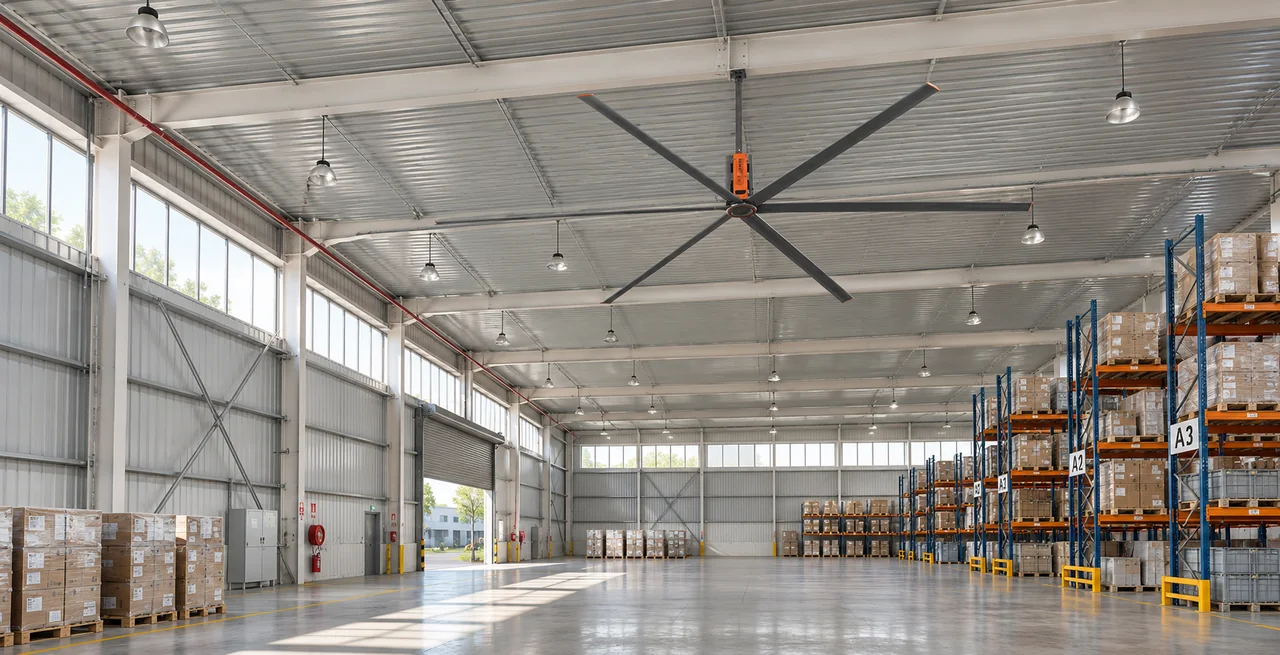
How Do HVLS Fans Impact Energy Consumption and Overall Utility Costs?
Do HVLS fans raise or lower your energy bill? Both — and the balance depends on how you buy and run them. A high-volume, low-speed (HVLS) fan uses relatively little electricity itself — a big fan turning slowly, not a compressor. Its main effect is what it does to the rest of the building: in summer it makes people feel cooler without lowering the air temperature, so the air conditioning works less; in winter it pushes warm air down from the ceiling, so the heating system works less. Sized and controlled right, it usually pays for its own electricity over and over. This guide explains where the energy goes, how a fan changes heating and cooling load, and how to estimate the running cost — without promising a percentage saving, because the result depends on your building, your climate and how the fan is used.
View article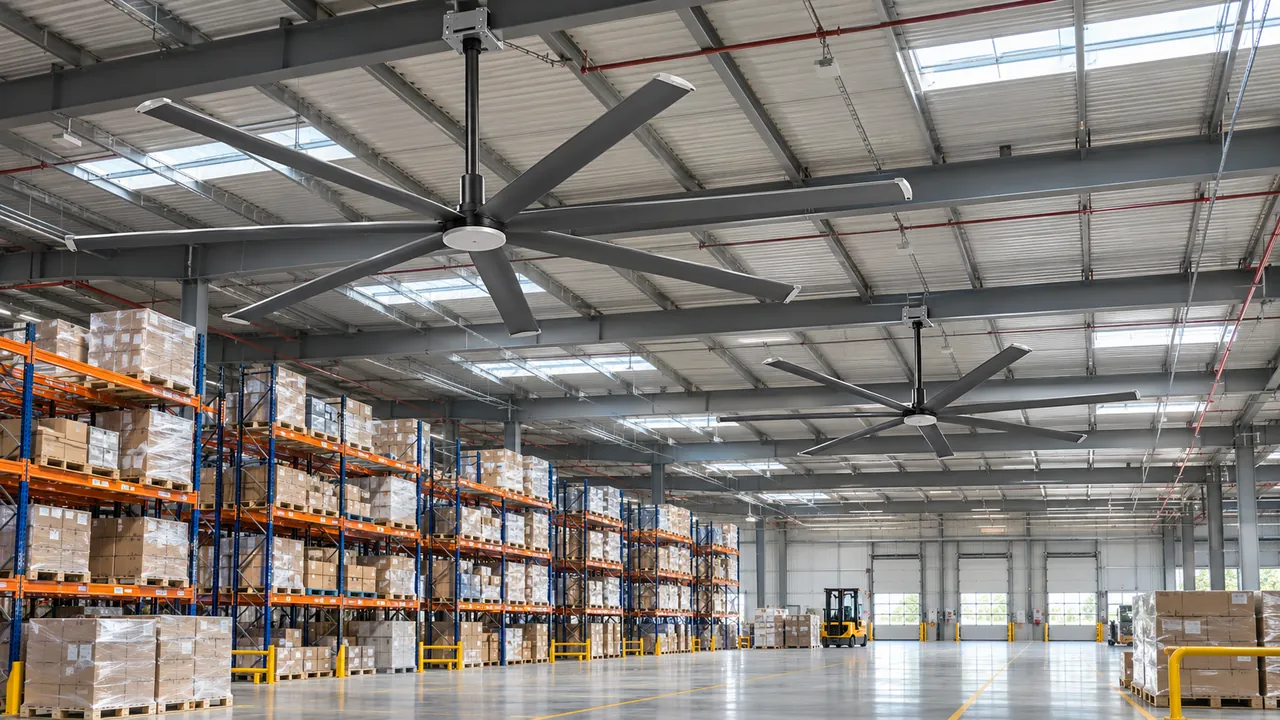
Big Ass Fans vs Rite-Hite HVLS Fans: Which Should You Buy for Your Distribution Center?
A distribution center is a hard place to keep comfortable. High ceilings, long aisles, tall racks, dock doors opening and closing all day, and people working across a floor the size of several football fields. A high-volume, low-speed (HVLS) fan is one of the few pieces of equipment that can move air across that whole space from a single mounting point. Two of the best-known American brands in this category are Big Ass Fans and Rite-Hite. Both sell large-diameter fans in the 8- to 24-foot range, both offer direct-drive and gearbox models, and both will quote a distribution-center project. The right choice depends on the models, the building, the installed price, and the support available in your market. This guide compares the two brands' current HVLS lines for distribution centers and gives a buy-one-or-the-other conclusion, not a claim that either brand is universally better.
View article