
How Do HVLS Fans Impact Energy Consumption and Overall Utility Costs?
Do HVLS fans raise or lower your energy bill? Both — and the balance depends on how you buy and run them. A high-volume, low-speed (HVLS) fan uses relatively little electricity itself — a big fan turning slowly, not a compressor. Its main effect is what it does to the rest of the building: in summer it makes people feel cooler without lowering the air temperature, so the air conditioning works less; in winter it pushes warm air down from the ceiling, so the heating system works less. Sized and controlled right, it usually pays for its own electricity over and over. This guide explains where the energy goes, how a fan changes heating and cooling load, and how to estimate the running cost — without promising a percentage saving, because the result depends on your building, your climate and how the fan is used.
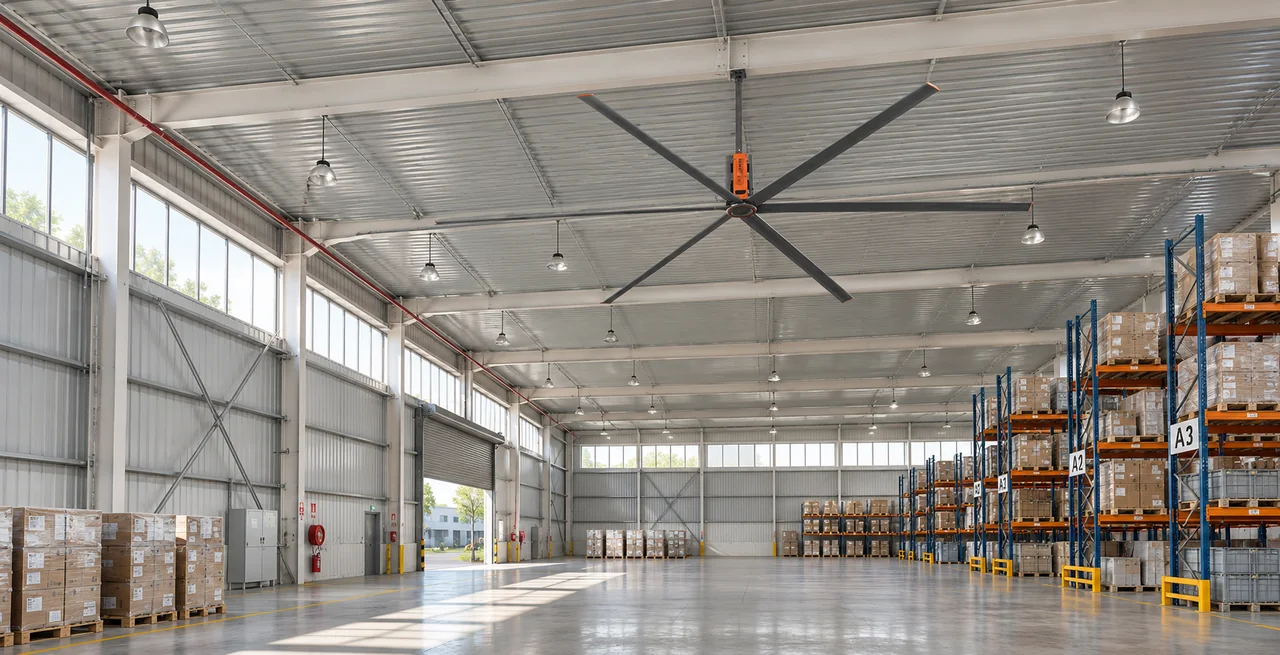
Do HVLS fans raise or lower your energy bill? Both — and the balance depends on how you buy and run them. A high-volume, low-speed (HVLS) fan uses relatively little electricity itself — a big fan turning slowly, not a compressor. Its main effect is what it does to the rest of the building: in summer it makes people feel cooler without lowering the air temperature, so the air conditioning works less; in winter it pushes warm air down from the ceiling, so the heating system works less. Sized and controlled right, it usually pays for its own electricity over and over.
HVLS fan power consumption is the first number to check: the fan’s rated power, in kilowatts, is on the nameplate, and multiplying it by running hours and the electricity tariff gives the annual running cost before any saving from reduced heating or cooling is counted.
This guide explains where the energy goes, how a fan changes heating and cooling load, and how to estimate the running cost — without promising a percentage saving, because the result depends on your building, your climate and how the fan is used.
The short answer: a fan moves air, it does not make cold air
An HVLS fan does not cool or heat the air. It moves a large volume of air slowly — typically 4,500 to 15,000 cubic metres per minute — changing how people feel and how evenly the temperature is spread.
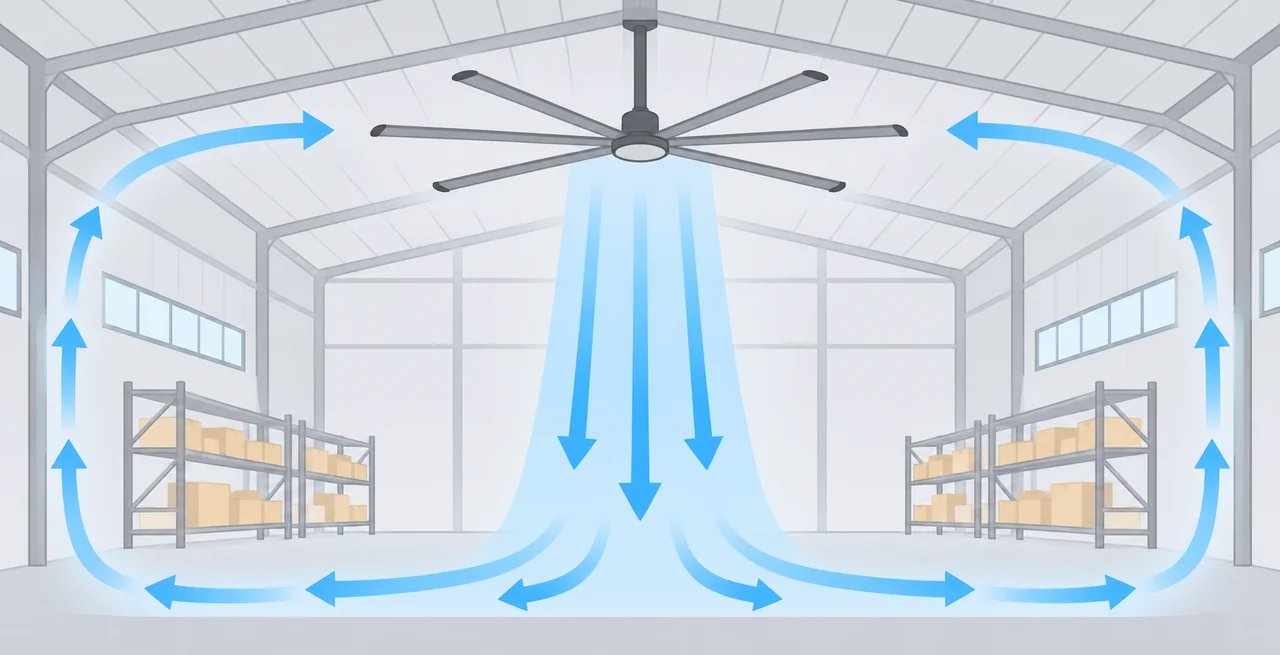
In summer, moving air across the skin increases evaporation, which makes a person feel cooler even though the air temperature has not changed. That is the basis of the summer saving: if people feel comfortable at a higher air temperature, the cooling system does not have to work as hard to hold a lower one. In winter, warm air rises and collects near the ceiling while the floor stays cold. A slow-running fan pushes that warm air back down and mixes the air, so the temperature is more even and the heater cycles less. This is destratification — the main way a fan cuts heating cost. The fan's impact is mostly indirect — its own use is small next to the load it can displace, but only if it is the right size, in the right place, and controlled properly.
What decides how much electricity a fan uses
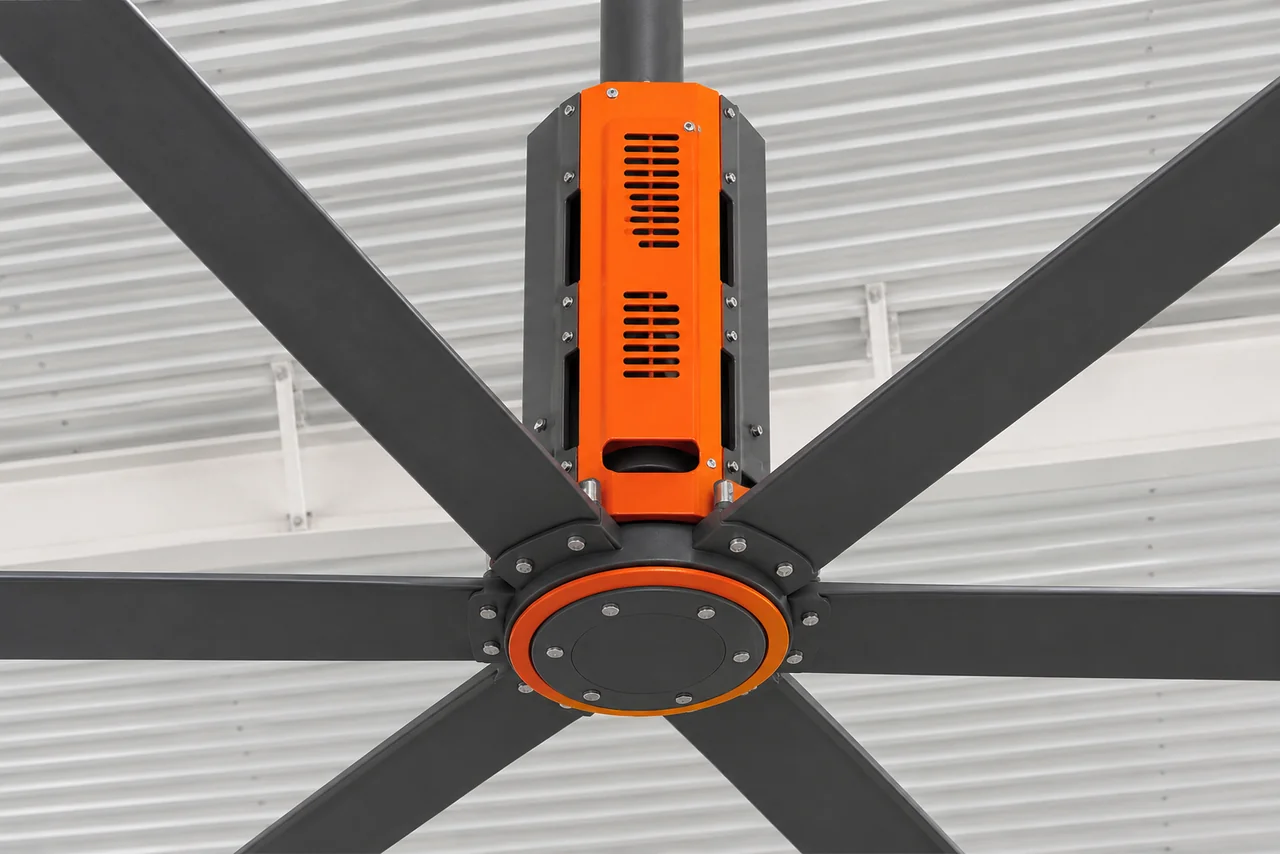
Three things decide a fan's own energy use: the motor, the size and speed, and how long it runs. Modern HVLS fans use a direct-drive permanent-magnet motor, which has fewer moving parts than an older geared motor — no gearbox, no belts, less friction and less to wear out — so it turns electricity into air movement more efficiently. When you compare fans, ask whether the motor is direct-drive or geared, and ask for the rated power on the nameplate: that is the number you need for any running-cost estimate.
Diameter and speed are the second factor. HVLS fans are made in diameters from 2.8 to 7.3 metres. A larger diameter moves more air at a lower speed, which is quieter and uses less energy per unit of air. But the largest fan is not the answer by default — one too large for the space wastes money on purchase and on the structure to hang it. For the method, see how to measure a ceiling fan and the guide to what HVLS fans are. Blade design matters too — the RTFANS King uses six blades, the Grace, Virtue, Paragon and Charm II five — but judge a fan by rated power and airflow together.
Running hours are the third factor, and the one most buyers underestimate. A fan that runs 24 hours a day uses three times the electricity of the same fan running 8 hours a day, even though the building may only be occupied for 8 of those hours. A fan with a timer, thermostat, or speed control matched to occupancy and season uses far less than one left on full speed. If the building is empty at night, the fan should be off or on its lowest setting.
Summer: how air movement cuts cooling cost
Summer is where most of the saving happens, and it works through the thermostat. The lower the cooling set temperature, the harder the cooling system works. A fan lets you raise that set temperature while people feel just as comfortable.
The US Department of Energy's Energy Saver guide makes the general point: you can save as much as 10% a year on heating and cooling by turning your thermostat down 7 to 10 degrees Fahrenheit for 8 hours a day in the fall and winter, and turning it up in the summer. The principle is the same in a commercial building — every degree you can raise the cooling setpoint in summer reduces the load on the system, and a fan is what makes that higher setpoint comfortable. The US Department of Energy publishes this thermostat guidance in its Energy Saver guide. ENERGY STAR adds that certified ceiling fans are up to 44% more efficient than conventional fans, because they use improved motors and blade designs. That figure is for ceiling fans generally, not a specific HVLS model, but the lesson carries over: a better motor and better blades deliver the same air movement for less electricity.
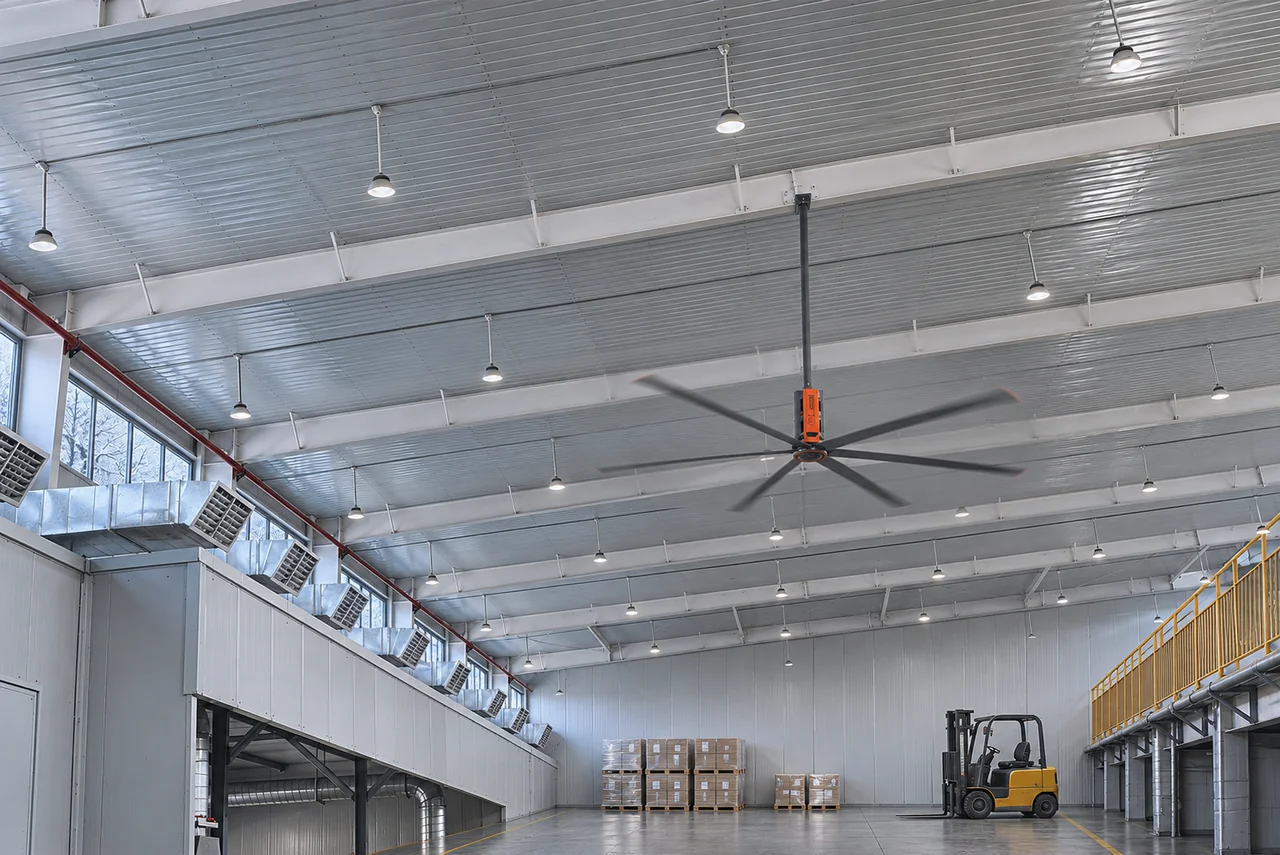
A fan also works best when it is not working alone. In a hot building, the fan moves air, but it does not bring in fresh air or remove heat. Pairing it with ventilation — open doors, louvres, or an exhaust fan — and with evaporative cooling where the climate suits it, gives a bigger effect than the fan on its own. For a wider look, see the guide to eco-friendly cooling for large commercial environments and the energy-efficient cooling solutions page. If the cooling system is already undersized, size it and the fan together.
Winter: destratification and the heating bill
Winter is the season most buyers forget, and it is where a fan can quietly save a lot. In a tall building, the air near the ceiling can be many degrees warmer than the air at the floor, while the heating system tries to warm the people at the floor — and much of its heat rises and sits at the top of the building doing nothing.
Running an HVLS fan slowly in winter, in reverse, gently pushes the warm ceiling air down without creating a draught at floor level, mixing the air and evening out the temperature. The floor gets warmer, the ceiling cooler, and the heater runs less. The key is the speed: a fast fan in winter creates a wind-chill effect that makes people feel colder, which defeats the purpose, while a slow fan destratifies without a draught. This is another reason controls matter — a fan that can run at a low winter speed, by a speed control or a reverse setting, is worth more than a fan with a single speed. A single-speed fan will be too fast for winter, so you will either leave it off or run it and make people cold.
Destratification works best in tall buildings with high ceilings, because that is where the temperature difference between floor and ceiling is largest. The International Energy Agency notes that space cooling is the fastest-growing end use in buildings, and that comfort can be delivered by equipment, by fans, or by natural ventilation — not only by air conditioning — and that the choice should be made using life-cycle calculations.
Estimating the running cost before you buy
Before you buy, work out the running cost on paper. It takes ten minutes. The method needs only three numbers: the fan's rated power, the hours it will run, and your electricity tariff.
First, get the rated power from the fan's nameplate or datasheet, in watts or kilowatts — the exact diameter and motor you are buying, not a brochure headline or a different model. A larger diameter usually has a higher rated power, but it also moves more air, so compare fans by the air they move for the power they use. Second, estimate the running hours honestly: count only the hours the building is occupied and warm or cold enough to need the fan, and allow for lower-speed running for part of that time. A fan on a timer or a thermostat will run far fewer hours than one left on all day. Use the ventilation and cooling calculator to check airflow and fan count for your floor area and ceiling height before you order.
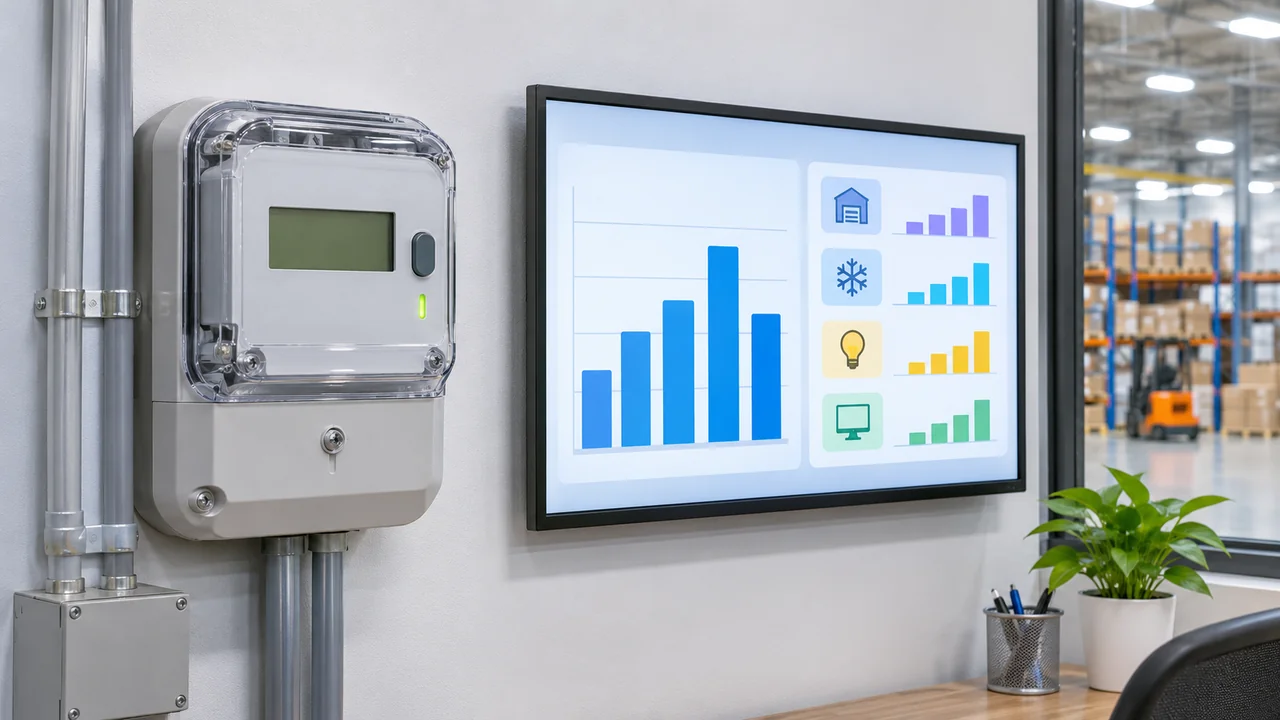
Third, multiply the power by the hours and by your tariff. Rated power in kilowatts, times hours per year, gives kilowatt-hours per year; multiply that by the price you pay per kilowatt-hour, and you have the fan's annual electricity cost. That is the number to compare against the saving — the reduction in heating and cooling runtime the fan makes possible. Your tariff is on your electricity bill, usually as a per-kilowatt-hour rate.
Do not accept a payback period or a percentage saving without this working. A figure that does not state the tariff, the running hours, the fan's rated power and the load it displaces is a sales claim, not a calculation.
What to check before you buy
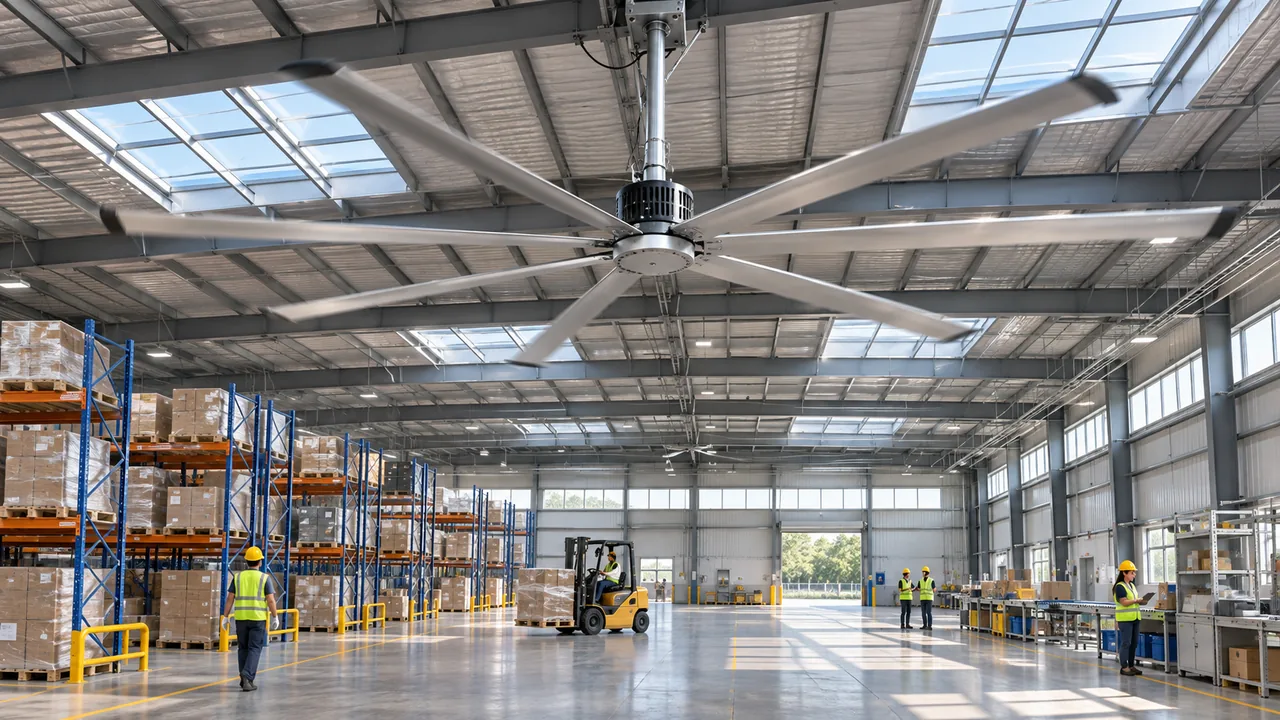
Four checks decide whether the fan will save energy in your building, rather than just using it. First, sizing. A fan that is too small leaves dead spots where the air does not move, so the cooling or heating system has to cover those spots anyway. A fan that is too large wastes money on purchase and on the structure to hang it. Start with the floor area and the ceiling height, and use the calculator to check the diameter and the number of fans. In a warehouse with racking, the coverage is smaller, because racks block the horizontal spread — so you plan for more fans.
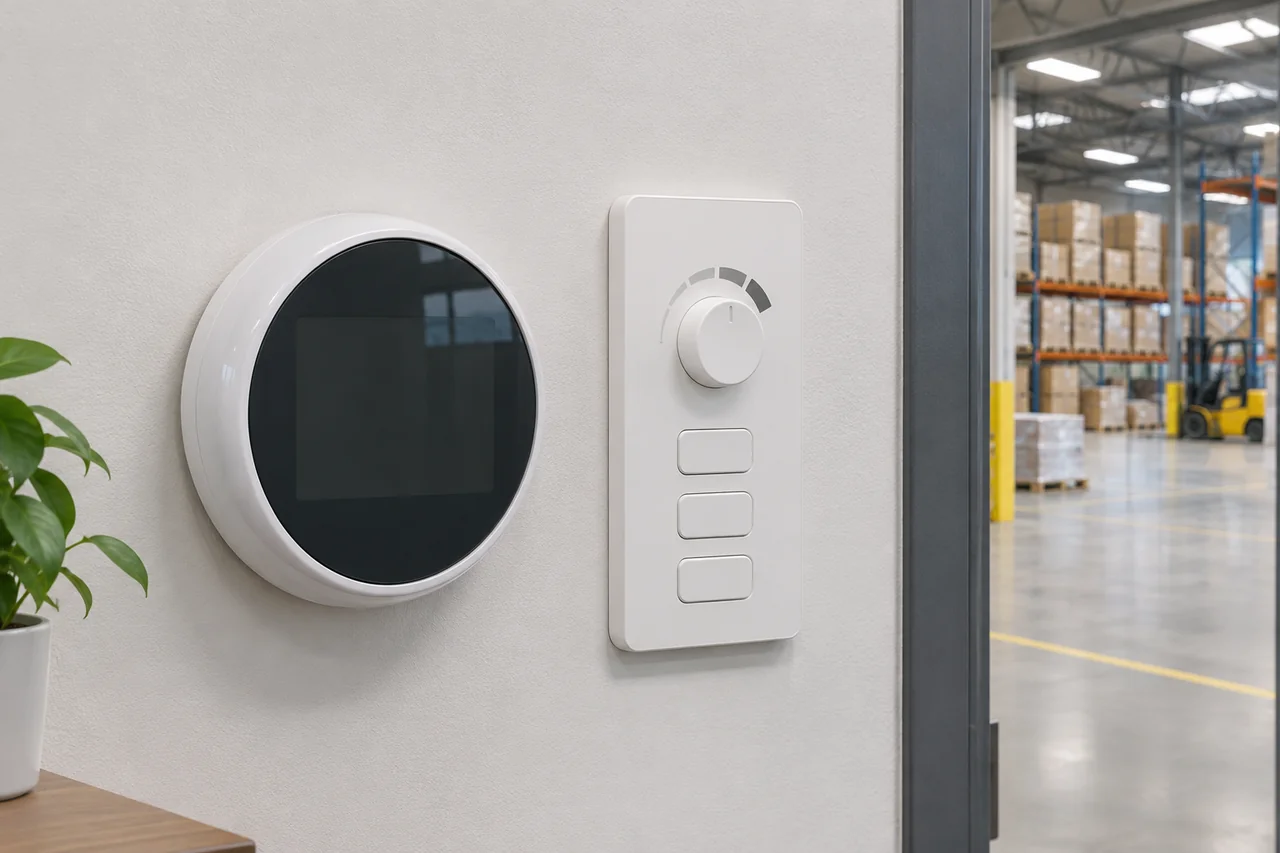
Second, controls. A fan without a speed control or a timer will be left on full speed all day. Look for a control that sets the speed and a schedule, and runs several fans together if you have more than one. A thermostat that turns the fan up when the building is warm and down when it is not saves more electricity than any motor upgrade. Ask whether the control is included in the price, and whether it can be reached easily — one hidden in a locked room will not be used.
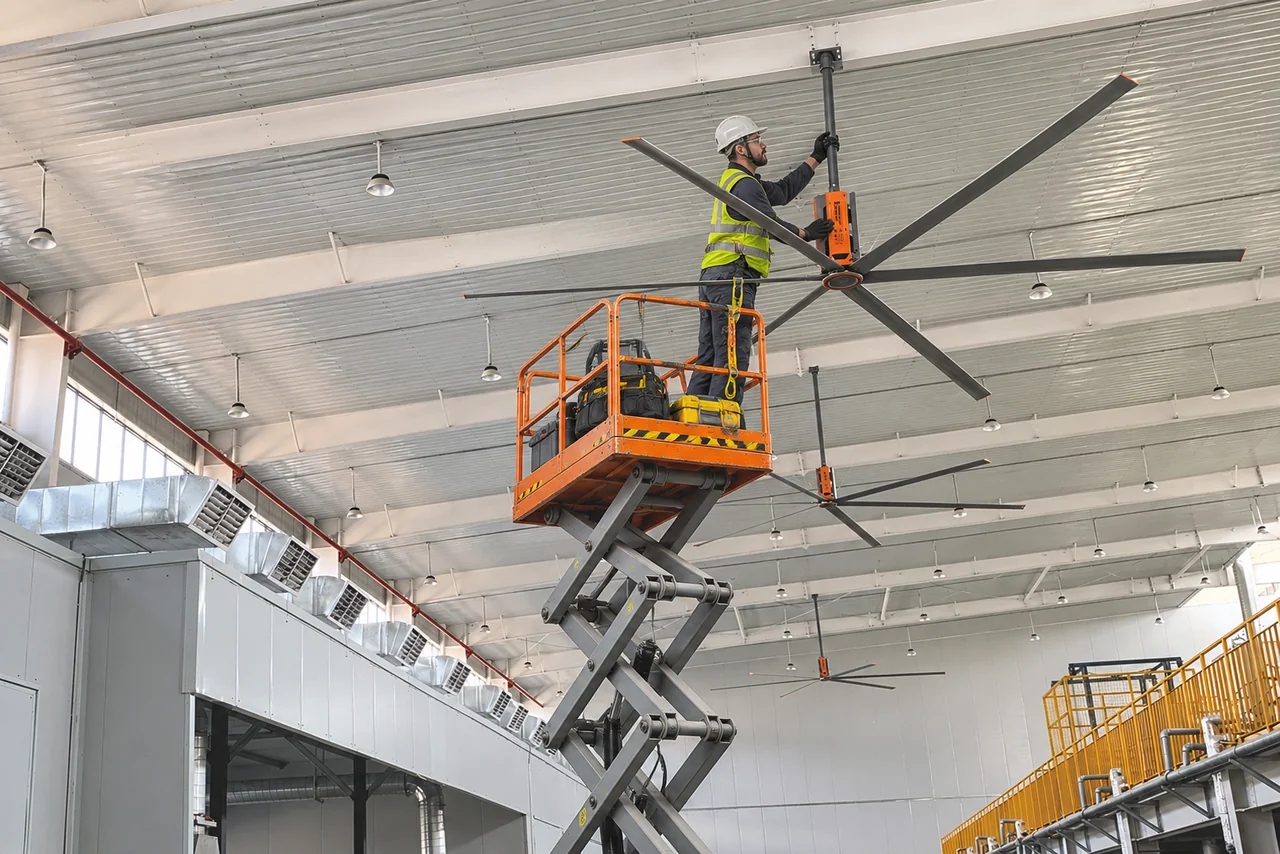
Third, mounting and safety. The fan hangs from a drop rod, and the rod must be fixed to the building structure — a beam — with a bracket designed for the fan's weight and the forces it creates when it runs. A bracket fixed to a flat ceiling panel, or a rod too long and unbraced, is a hazard, and a fan that is not mounted properly will vibrate, wasting energy and shortening its life.
Fourth, maintenance. A fan that is dirty, unbalanced, or running with worn bearings uses more electricity and moves less air. Dust on the blades changes their shape and reduces airflow; a vibrating fan wastes energy as heat and noise. Plan for periodic inspection and cleaning. A fan that is easy to inspect and clean will be maintained; one that needs a scaffold and a shutdown will not.
When fans alone are not enough
Fans are not a complete cooling or heating system. A fan does not lower the air temperature, remove humidity, or bring in fresh air. In a very hot and humid climate, moving hot humid air across the skin does not cool people much, because evaporation is slow when the air is already wet. Then the fan needs to work with ventilation or evaporative cooling, or the building needs air conditioning as well.
A fan also does less in a well-insulated building with a small cooling load, because there is less load to displace. It still improves comfort, but judge the purchase on comfort as well as on the bill. Finally, a fan cannot fix a building that leaks air, has no insulation, or has a cooling system that is far too small. Fix the building envelope and the cooling system first, or at the same time, and let the fan make a good system better.
Frequently Asked Questions
Do HVLS fans use a lot of electricity?
No, not compared with the heating and cooling systems in the same building. An HVLS fan is a large fan turning slowly on a direct-drive motor, and its rated power is a small fraction of an air conditioner's. The exact figure is on the fan's nameplate — use that, and multiply it by the hours the fan will run and by your tariff to get the annual cost. For HVLS fan power consumption, use the nameplate kilowatt rating of the exact model: a big fan turning slowly draws far less power than the air conditioner or heater it helps, which is why the fan’s own consumption is rarely the deciding cost.
Can an HVLS fan really lower my utility bill?
It can, if it is sized and controlled properly. In summer it lets you raise the cooling setpoint while people stay comfortable, so the air conditioner works less. In winter it pushes warm air down, so the heater works less. The saving depends on your building, climate, tariff and how the fan is run. No supplier can honestly promise a percentage saving without knowing those things.
Should I run the fan in winter?
Yes, but slowly and in reverse. In winter the fan should run at a low speed, pushing warm air down without creating a draught at floor level. That is destratification, and it evens out the temperature so the heater cycles less. A fast fan in winter will make people feel colder, so make sure the control supports a low reverse speed before you buy.
What is the cheapest way to run an HVLS fan?
Run it only when the building is occupied and only as fast as needed. Use a timer or a thermostat so the fan is off at night and at a low speed when the building is cool. Keep the blades clean and the fan balanced, because a dirty or vibrating fan uses more electricity and moves less air.
Do I still need air conditioning if I install HVLS fans?
Usually, yes — the fan is not a replacement for air conditioning. A fan moves air and makes people feel cooler, but it does not lower the air temperature, remove humidity or bring in fresh air. In a hot climate, or a building with a large cooling load, you will still need air conditioning or evaporative cooling. The fan's job is to make that system work less and spread the cooled air evenly.
The bottom line
An HVLS fan changes your utility costs in two ways: it adds a small electricity load of its own, and it reduces the heating and cooling load of the building. Whether the second outweighs the first depends on sizing, controls and running hours — not on the fan's headline price. Buy the right diameter, buy a direct-drive motor, buy a control that matches the fan to occupancy and season, and run the numbers on rated power, hours and tariff before you sign. Done that way, a fan is one of the cheapest ways to make a large building comfortable.
Request a quote for an HVLS fan sized to your building.
Related insights
Recommended Engineering & Ventilation Guides
PMSM vs BLDC Motors for HVLS Fans: Which Is Better?
When buyers compare large ceiling fans, the motor is usually the first technical question after size and coverage. Two motor types dominate the conversation: PMSM and BLDC. Both use permanent magnets and run without brushes. The difference matters most exactly where an HVLS fan works hardest: turning a very large, heavy set of blades at very low speed, all day. This article explains what each motor is, how they differ, and which one fits an HVLS fan — including the related question buyers keep asking: hub motor vs PMSM motor which is better? Short answer: PMSM direct drive fits a full-size HVLS fan best; BLDC fits smaller fans.
View article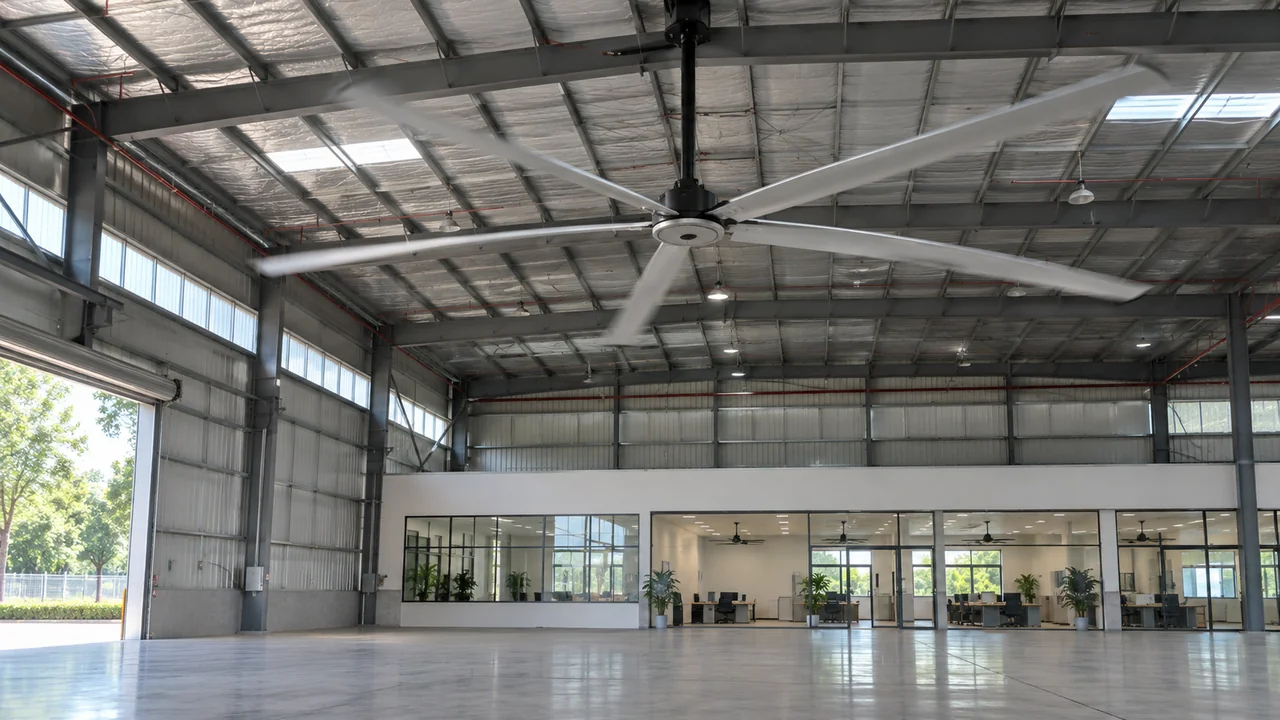
Ceiling Fans vs. HVLS Fans: Which Is Right for Your Facility?
Standard ceiling fans work well in rooms up to about 400 sq ft with 8 to 10 ft ceilings, such as offices, break rooms, and retail counters. Past that point, or in spaces with ceilings above roughly 14 ft and wide open floors, HVLS fans can be a better fit, because one large, slow fan can cover what a dozen small ones can't. Floor area alone doesn't settle it. Ceiling height and structure, obstructions, occupancy, and how much heat the space carries all matter. When moving air isn't enough, evaporative cooling is the add-on. We're KOOLAIR, a manufacturer of HVLS fans and evaporative air coolers. We've been building since 2003 and export to more than 90 countries and regions. We make recommendations based on your facility's dimensions, ceiling structure, climate, and occupancy.
View article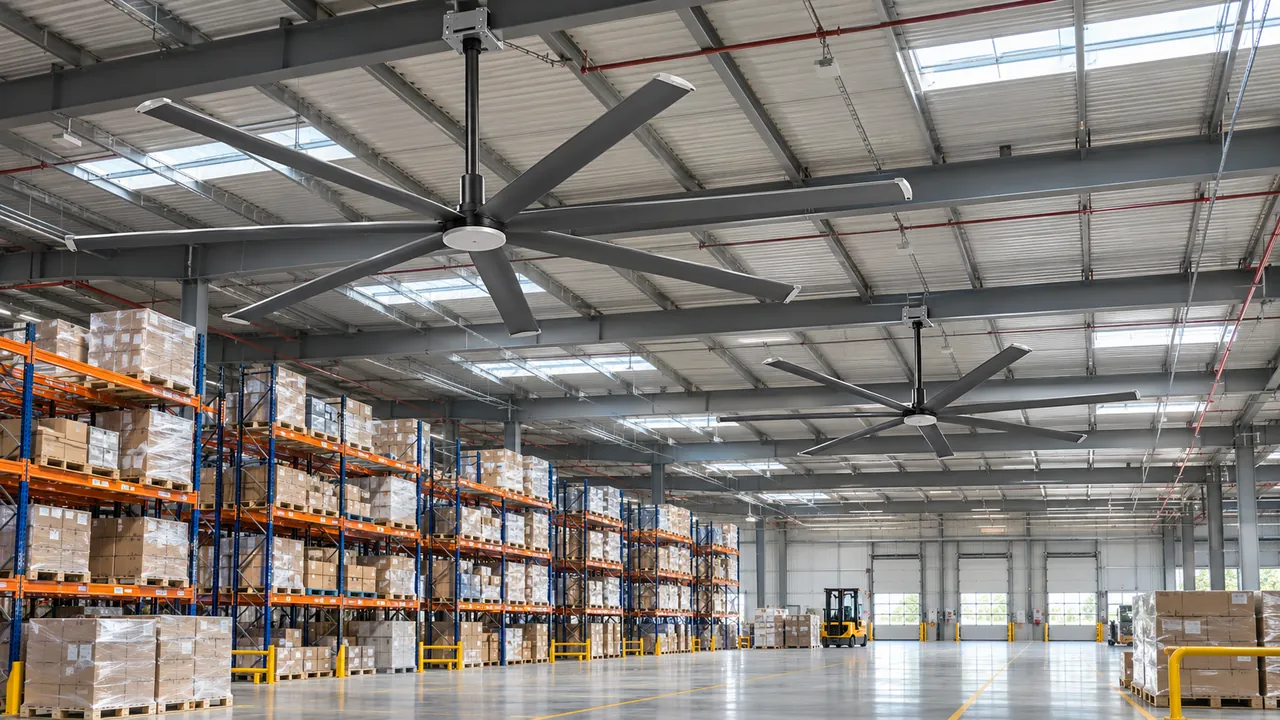
Big Ass Fans vs Rite-Hite HVLS Fans: Which Should You Buy for Your Distribution Center?
A distribution center is a hard place to keep comfortable. High ceilings, long aisles, tall racks, dock doors opening and closing all day, and people working across a floor the size of several football fields. A high-volume, low-speed (HVLS) fan is one of the few pieces of equipment that can move air across that whole space from a single mounting point. Two of the best-known American brands in this category are Big Ass Fans and Rite-Hite. Both sell large-diameter fans in the 8- to 24-foot range, both offer direct-drive and gearbox models, and both will quote a distribution-center project. The right choice depends on the models, the building, the installed price, and the support available in your market. This guide compares the two brands' current HVLS lines for distribution centers and gives a buy-one-or-the-other conclusion, not a claim that either brand is universally better.
View article