
Big Ass Fans vs Rite-Hite HVLS Fans: Which Should You Buy for Your Distribution Center?
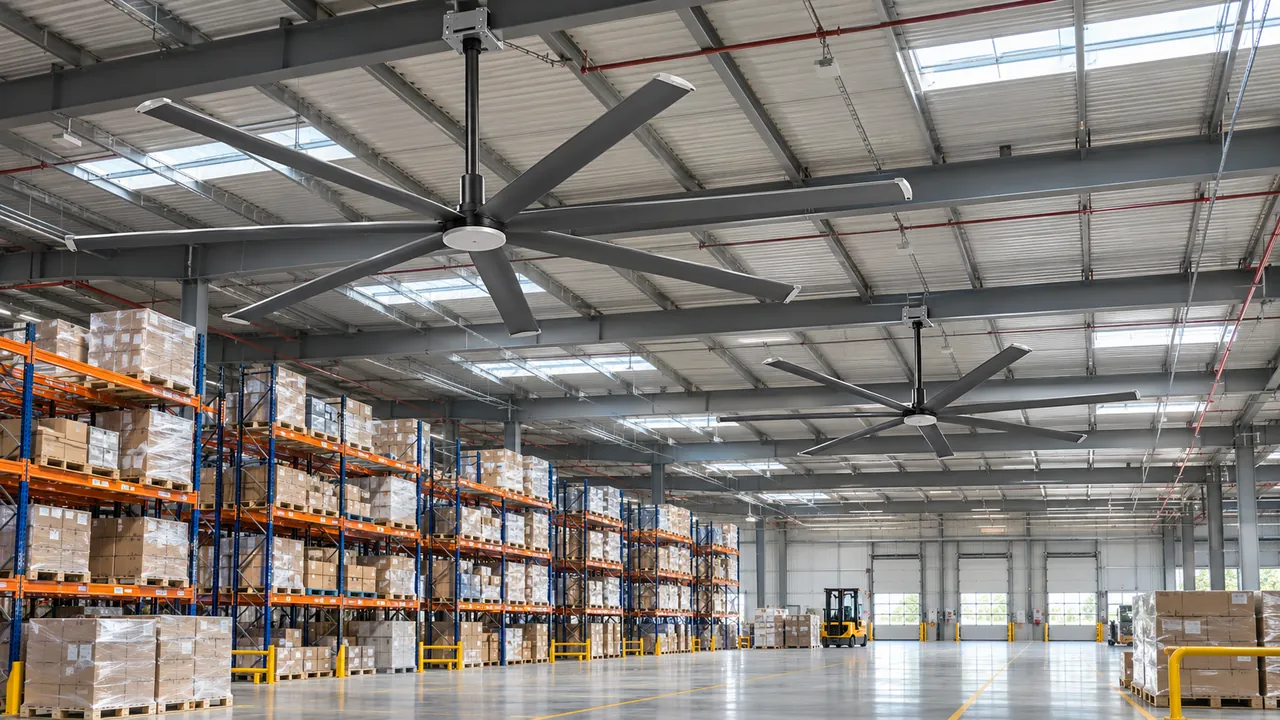
A distribution center is a hard place to keep comfortable. High ceilings, long aisles, tall racks, dock doors opening and closing all day, and people working across a floor the size of several football fields. A high-volume, low-speed (HVLS) fan is one of the few pieces of equipment that can move air across that whole space from a single mounting point. Two of the best-known American brands in this category are Big Ass Fans and Rite-Hite. Both sell large-diameter fans in the 8- to 24-foot range, both offer direct-drive and gearbox models, and both will quote a distribution-center project. The right choice depends on the models, the building, the installed price, and the support available in your market. This guide compares the two brands' current HVLS lines for distribution centers and gives a buy-one-or-the-other conclusion, not a claim that either brand is universally better.
A distribution center is a hard place to keep comfortable. High ceilings, long aisles, tall racks, dock doors opening and closing all day, and people working across a floor the size of several football fields. A high-volume, low-speed (HVLS) fan is one of the few pieces of equipment that can move air across that whole space from a single mounting point. Two of the best-known American brands in this category are Big Ass Fans and Rite-Hite. Both sell large-diameter fans in the 8- to 24-foot range, both offer direct-drive and gearbox models, and both will quote a distribution-center project. The right choice depends on the models, the building, the installed price, and the support available in your market. This guide compares the two brands' current HVLS lines for distribution centers and gives a buy-one-or-the-other conclusion, not a claim that either brand is universally better.
The Two Fans in Brief
Big Ass Fans started in 1999 in Lexington, Kentucky, and built its name on the Powerfoil line of industrial HVLS fans. The current range is built around the Powerfoil X4 flagship, the direct-drive Powerfoil D, and the Powerfoil 8, 6, and 5 models, in diameters from 8 to 24 feet. The flagship uses a sealed NitroSeal gearbox that needs no routine oil changes, and the X4 carries eight redundant safety features. Controls run from a touchscreen wall controller up to BAFCon, which adjusts fan speed from room temperature and ties into a building management system. For a neutral reference on how fans and controls fit into an efficient cooling strategy, see the U.S. Department of Energy's Energy Saver Guide.
Rite-Hite is an industrial equipment manufacturer with a 50-year track record, best known for loading dock equipment. Its HVLS line is the Revolution series. The Revolution 75 and 150 use direct-drive motors and cover up to 31,000 square feet, with air moving up to 100 feet in all directions from the center of the fan. The Revolution Classic uses a 1.5 HP industrial gear motor and a three-blade Tilt-Taper-Twist design covering up to 24,000 square feet. Diameters run from 8 to 24 feet. Warranty terms are 3-year parts and 3-year labor, a 10-year structural integrity warranty, a lifetime warranty on blade and arm workmanship, and a 12-month money-back guarantee. For the wider efficiency picture, the International Energy Agency's brief on space cooling sets out how fans fit alongside other cooling measures.
| Brand | Big Ass Fans Powerfoil | Rite-Hite Revolution |
|---|---|---|
| Background | Founded 1999, Lexington KY; HVLS pioneer | Industrial manufacturer; 50-year track record |
| Current HVLS lines | Powerfoil X4, D, 8, 6, 5 | Revolution 75/150 (direct drive); Classic (gear motor) |
| Diameters | 8 to 24 feet | 8 to 24 feet |
| Drive | Sealed NitroSeal gearbox (X4, 8, 6, 5); direct drive (D) | Direct drive (75/150); 1.5 HP gear motor (Classic) |
| Coverage claim | By model and layout | Up to 31,000 sq ft (75/150); 24,000 sq ft (Classic) |
| Warranty as stated | 15-year (X3.0); 7-year mechanical / 3-year electrical (8, 6, 5) | 3-year parts/labor; 10-year structural; lifetime blade/hub workmanship; 12-month money-back |
| Controls | Touchscreen controller; BAFCon smart controls | Touchscreen WiFi controls; 7-day schedule; building management via Ethernet |
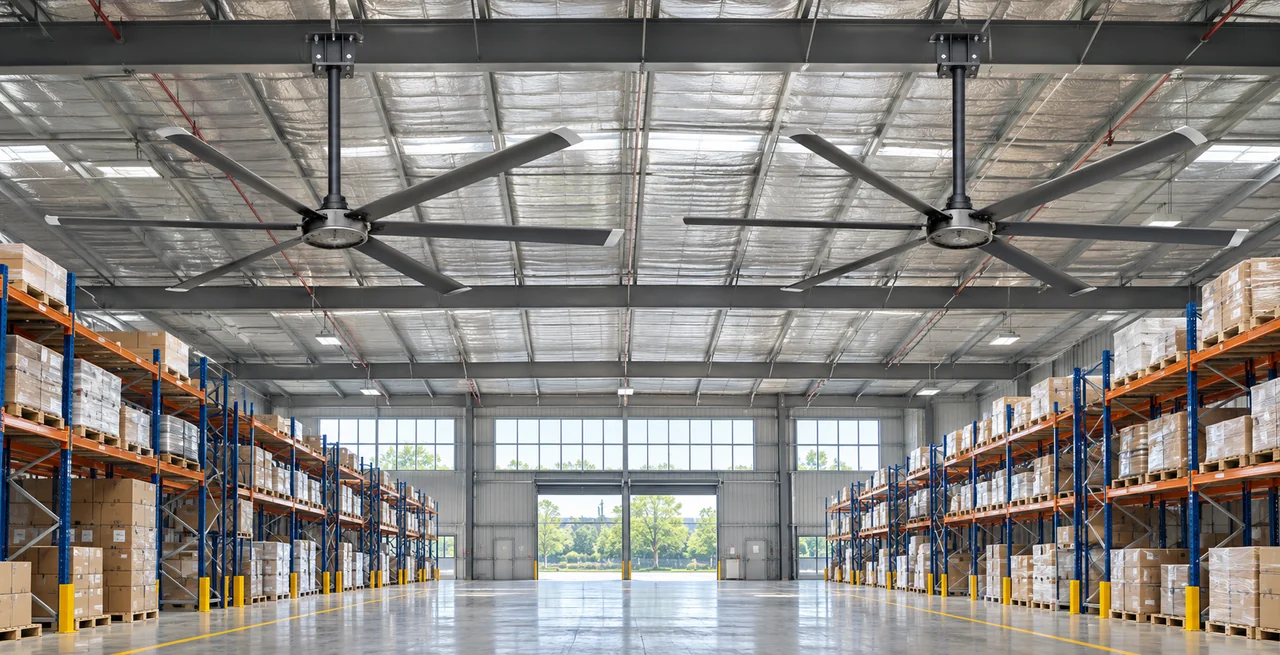
Neither brand publishes a single list price for a distribution-center installation. Both sell through quotations, and the installed price depends on the model, diameter, mounting, controls, and site. That is why this guide is built around comparing quotations, not brochure numbers. If you are new to the category, start with a plain explanation of what an HVLS fan is before you read the comparison sections.
Compare Specific Models, Not Just Brands
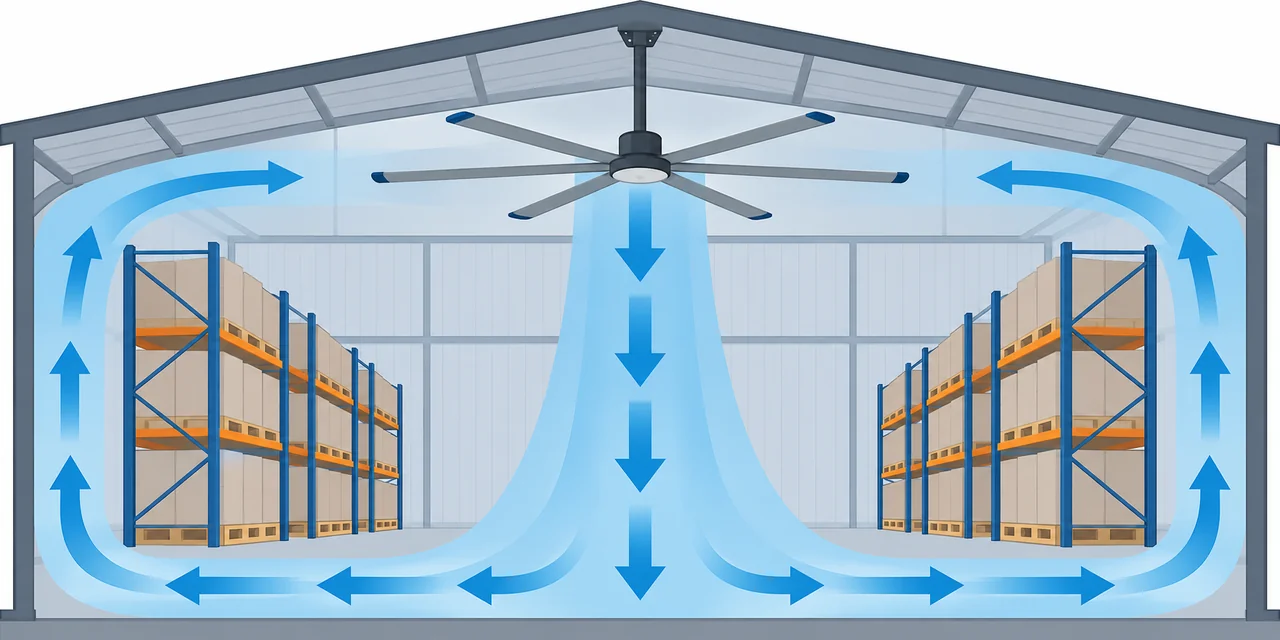
Before requesting quotations, identify where people work, building height, available mounting points, overhead obstructions, and existing heating or cooling equipment. A layout for an open center with clear aisles may differ from one for a facility with tall racks, cranes, ductwork, or mezzanines. Send the same building information to both suppliers so the proposals are comparable.
Review the proposed models against the same requirements:
| Comparison point | What to request from each supplier |
|---|---|
| Air movement | Airflow and air-speed data, test method, mounting height, proposed layout |
| Equipment | Fan diameter, motor and drive type, electrical requirements, controls, mounting hardware |
| Installation | Fan weight, structural loads, clearances, safety devices, installation instructions |
| Cost | Itemized equipment, freight, import charges, installation, commissioning, support |
| Ownership | Maintenance instructions, spare parts, warranty terms, local service |
| Documentation | Product certifications and documentation for the destination |
Diameter alone does not establish the useful coverage of a fan. Rite-Hite states up to 31,000 square feet for the Revolution 75 and 150, while Big Ass Fans describes coverage by model and layout rather than a single headline number. Compare the suppliers' data under equivalent conditions and ask how each proposed layout addresses the occupied areas, especially the aisles where pickers and forklift drivers work. A fan that covers a large empty floor is less useful than a layout that puts air where people are. For a wider look, see the guide to warehouse cooling and the earlier comparison of Big Ass Fans with RTFANS.
Motor and Drive: Direct Drive vs Gearbox
The drive is the most concrete technical difference between the two lines. Big Ass Fans builds most of its Powerfoil range around a sealed gearbox: the NitroSeal drive on the flagship is designed for a long life with no routine oil changes, and the Powerfoil 8, 6, and 5 use a sealed helical gearbox with an industrial-grade motor. The exception is the Powerfoil D, which uses direct drive with no gearbox at all. Rite-Hite splits its line the other way: the Revolution 75 and 150 are direct-drive fans, while the Classic uses a 1.5 HP industrial gear motor.
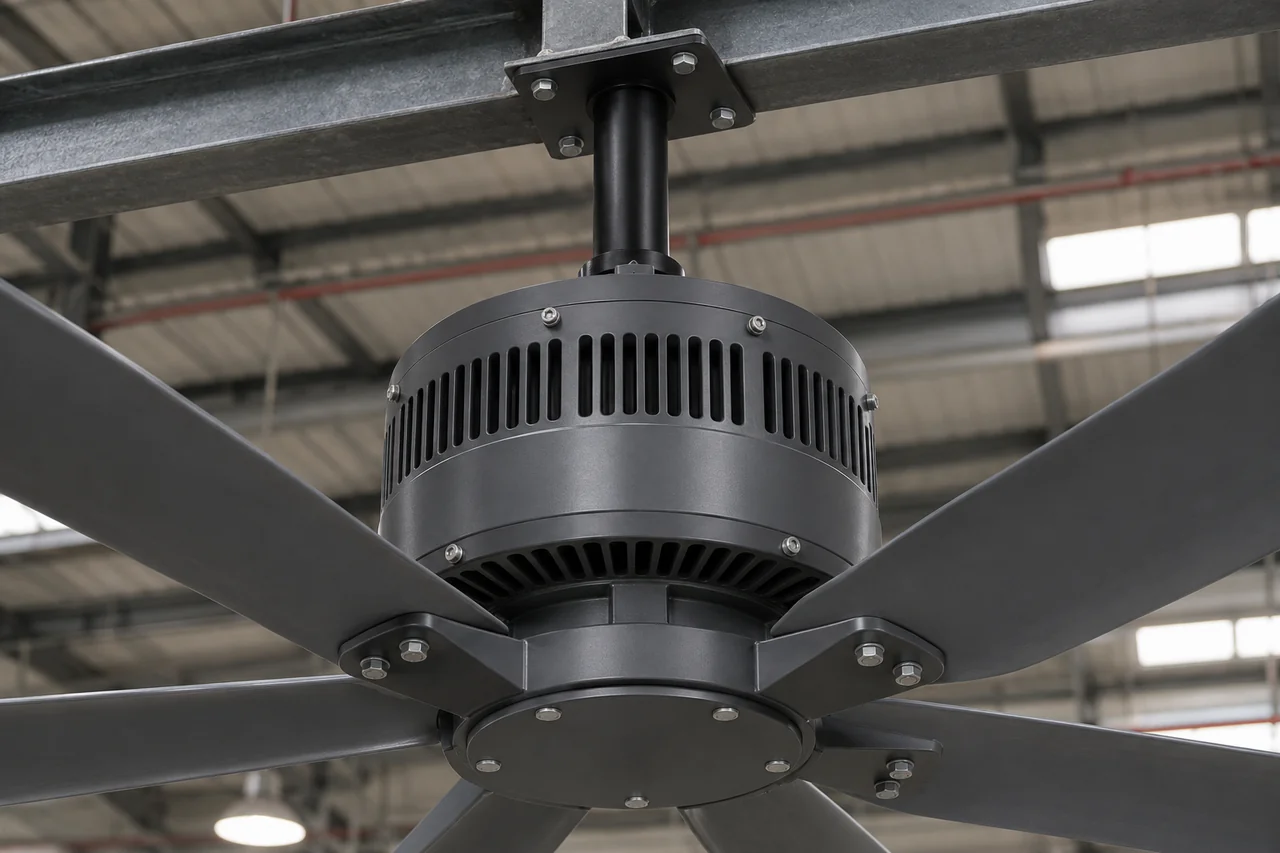
Removing the gearbox removes gearbox-specific service items, but direct-drive fans still need inspection and maintenance according to their manuals. Gearbox service requirements also vary by design; a sealed gearbox that needs no routine oil changes is a different ownership proposition from one that needs scheduled oil service. Ask each supplier for the maintenance schedule, expected spare parts, and service arrangements for the model quoted, and compare those documents side by side.
Do not assume a direct-drive model is quieter or consumes less power solely because of its drive type. Compare measured noise and electrical input at relevant operating settings, including the measurement methods and conditions. The number that matters is the one measured at the setting you will actually use.
Compare Installed Cost and Ownership Cost
An equipment-only quote is useful, but it is not the final cost of a working installation. Ask both suppliers to identify what is included in their quotations and calculate a comparable total:
- Fan, controller, mounting components, and options.
- Freight, insurance, duties, taxes, and customs costs.
- Structural assessment or reinforcement, electrical work, installation, commissioning.
- Scheduled maintenance, consumables, replacement parts, local service.
- Warranty coverage, exclusions, claim process, who pays for labor or shipping.
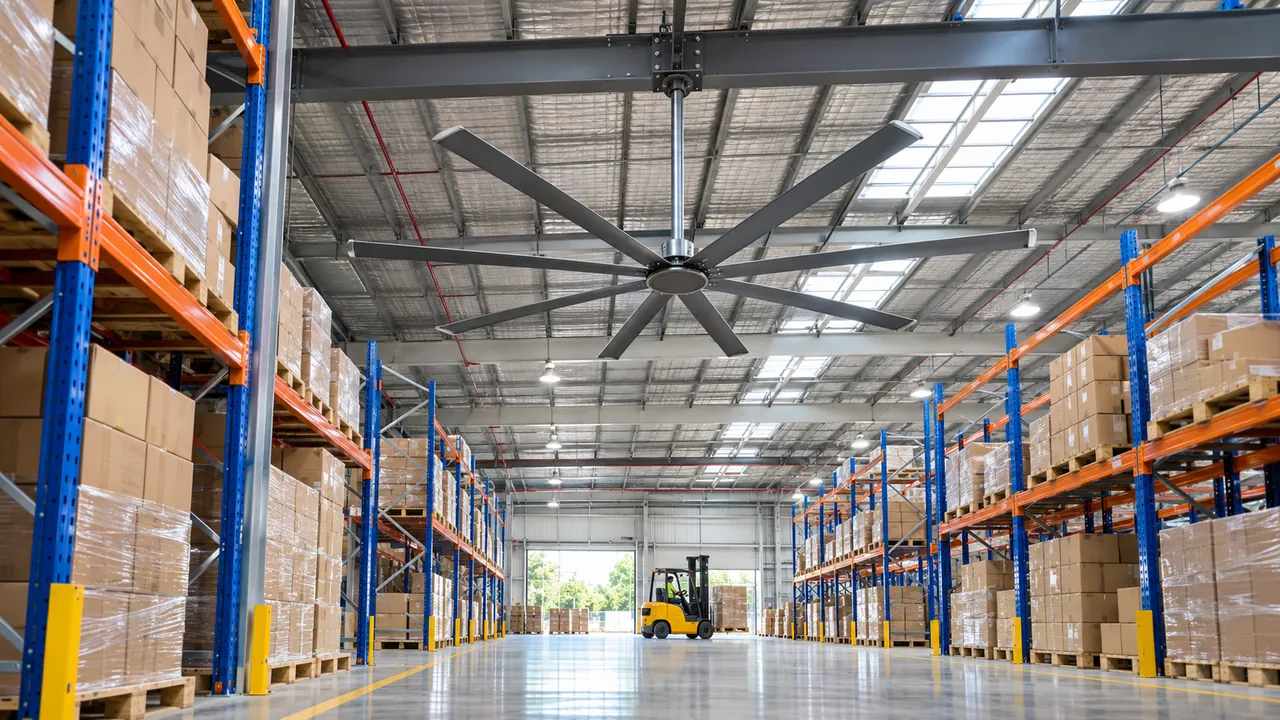
Use actual quotations and a stated operating period for your calculation. Prices, import costs, labor, and warranty support vary by configuration and destination. A lower equipment price does not by itself establish a lower installed or lifetime cost. A fan that needs structural reinforcement, a long drop tube, or a specialist installer can cost more installed than a more expensive fan that bolts straight onto an existing beam.
Warranty terms deserve the same itemized treatment. Big Ass Fans lists a 15-year warranty on the Powerfoil X3.0 specification sheet and 7-year mechanical and 3-year electrical coverage on the 8, 6, and 5. Rite-Hite lists 3-year parts and 3-year labor, a 10-year structural integrity warranty, a lifetime warranty on blade and arm workmanship, and a 12-month money-back guarantee. Those numbers cover different things, and a longer headline number does not always mean broader coverage. Read the exclusions, the claim process, and who pays for labor or shipping, and get the exact terms in writing for the model you are buying. To size the job before you request quotes, the ventilation and cooling calculator gives a starting point.
Energy Use and Operating Conditions
Fans create air movement that can help occupants feel cooler; they do not lower room air temperature by themselves. In a heated high-bay center, fans may also mix warmer air near the ceiling with air lower in the space. The result depends on the building, the controls, the occupancy, the climate, and the existing HVAC system.
Do not use a generic savings percentage or payback period as a purchase guarantee. If energy savings matter, ask the supplier or an independent engineer to document the baseline, operating hours, fan electricity use, proposed control changes, utility rates, and assumptions, and verify the outcome with measured energy use where practical. As a reference point, ENERGY STAR certified ceiling fans are up to 44 percent more efficient than conventional fans, but that is a category benchmark, not a promise about any specific industrial model in your building.
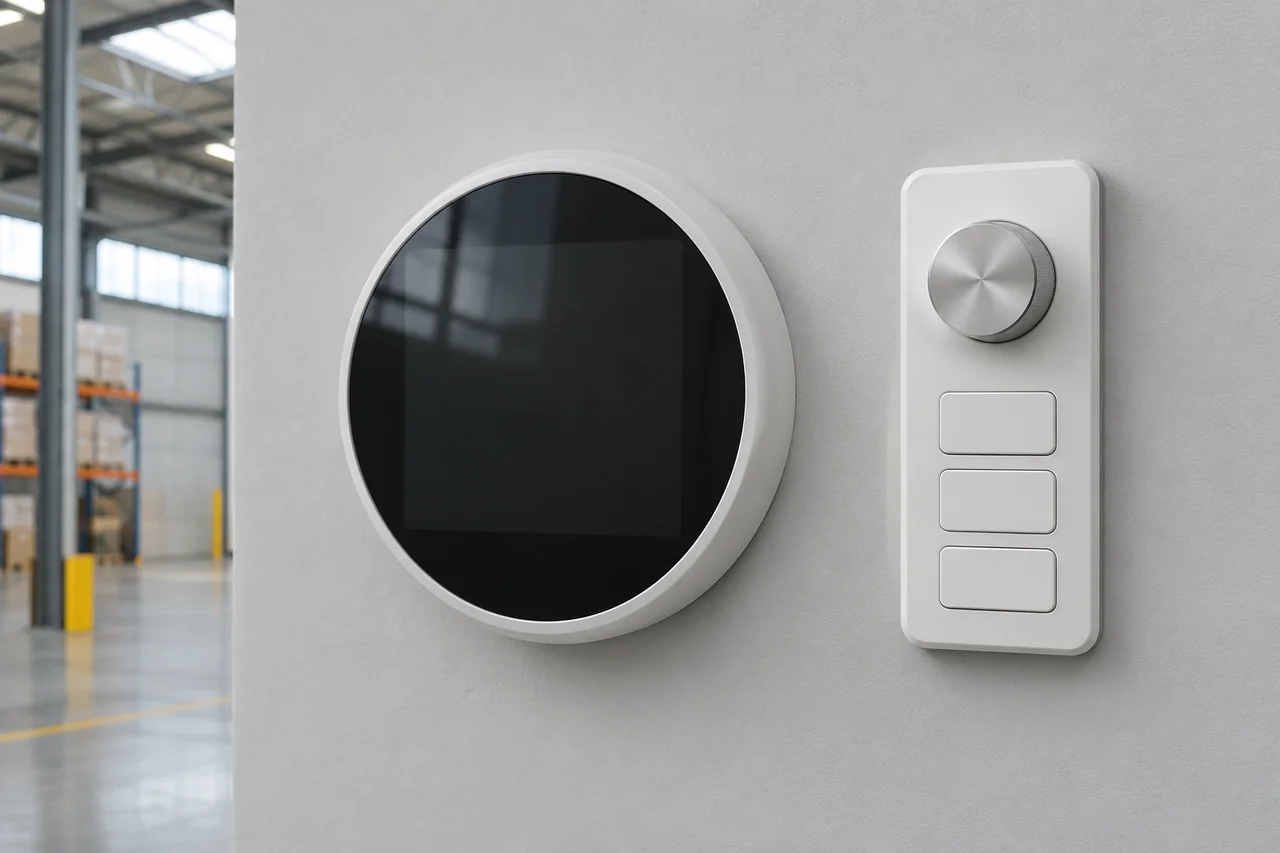
Where temperature reduction is required, evaluate the cooling system separately. Air circulation does not replace outdoor-air ventilation or process extraction when those are required. The controls matter as much as the fan: a fan tied to temperature sensors and a schedule runs only when needed, while a fan left on full speed around the clock uses more electricity for no extra comfort.
Installation and Maintenance Questions
Have a qualified installer review the manufacturer's instructions and site requirements before placing an order. Confirm the structural support and loads, blade-to-floor and obstruction clearances, electrical supply, safety retention, access for service, and coordination with sprinklers, racks, cranes, lighting, and other equipment. In a distribution center, the racking layout and the sprinkler design often decide where a fan can go more than the fan's own specifications do.
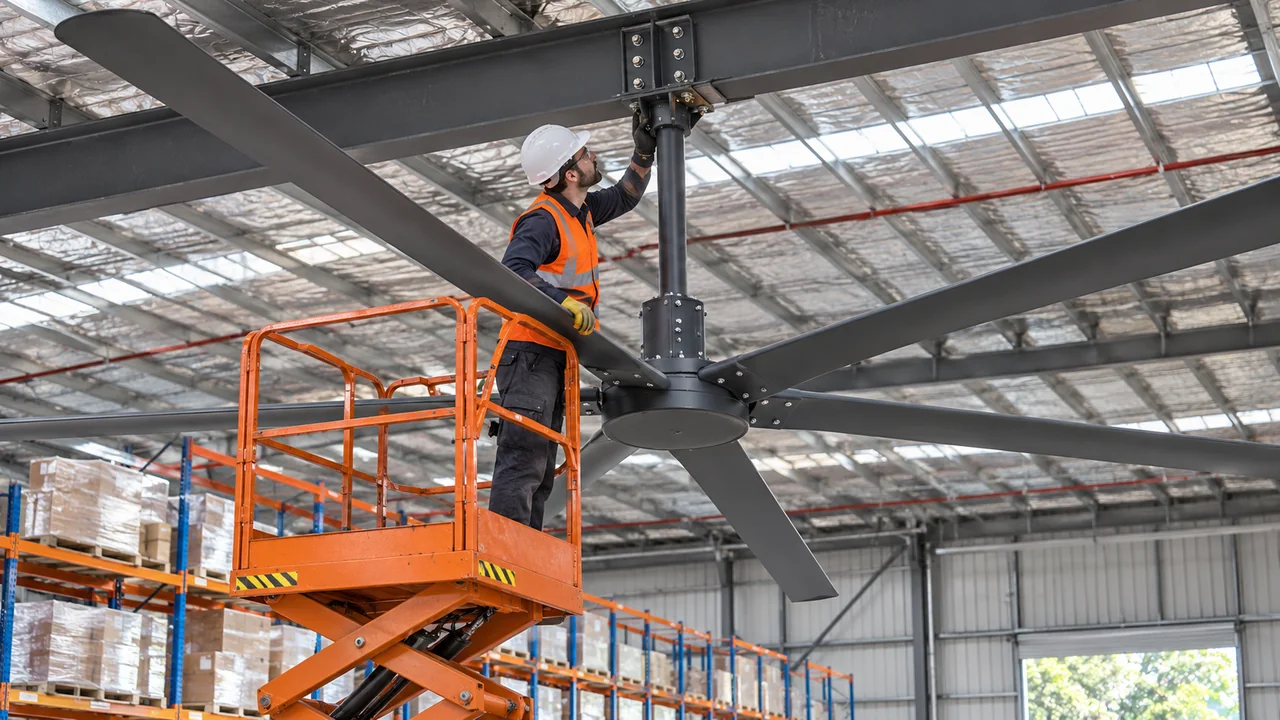
Rite-Hite emphasizes installation simplicity for the Revolution 75 and 150: the fans are pre-wired and factory configured, with standard wireless controls, so cooling begins almost immediately after mounting. Big Ass Fans emphasizes safety and mounting security: the Powerfoil X4 includes eight redundant safety features and a heavy-duty mounting system, and the NitroSeal gearbox is built for a long life with minimal maintenance. Both matter. A fan that installs quickly but is hard to service, or one that is built like a tank but needs a specialist to maintain, can both cost more over ten years than the quotation suggests.
For a useful layout review, provide a floor plan, ceiling and mounting heights, photos of the structure, obstruction locations, working zones, and details of existing HVAC or ventilation. Confirm who is responsible for structural approval, electrical work, installation, and final commissioning. If the building is tall, ask both suppliers how the drop tube length and mounting hardware change with height, and confirm the quoted mounting suits the beam or joist type in your building. Before you finalize the size, measure the ceiling and the mounting points.
Which Fan Should Your Distribution Center Choose?
Shortlist the models that fit the building first, then compare layout, performance, installed cost, service coverage, and warranty on the same assumptions. The verdict follows from the comparison, not from brand preference.
Choose Big Ass Fans Powerfoil if you want the broadest model range in one line: a sealed-gearbox flagship with a long stated warranty, a direct-drive option in the same family, and smart controls that tie into a building management system. The range also gives you more models for odd building shapes, from 8-foot sizes for low or tight spaces up to 24-foot sizes for open high bays. Give extra weight to Big Ass Fans if you already have a local dealer or installer; local service matters more over ten years than any brochure figure.
Choose Rite-Hite Revolution if you want direct drive across the line and a risk reducer in the terms: the Revolution 75 and 150 have no gearbox at all, the fans arrive pre-wired and factory configured, and the 12-month limited money-back guarantee lets you confirm the result in your own building before the purchase is final. Give extra weight to Rite-Hite if you already buy dock equipment from Rite-Hite and want one vendor, or if the stated coverage of up to 31,000 square feet fits your floor plan with fewer fans than the competing layout.
If the deciding factor is installed cost or local service, get both quotations itemized on the same basis and compare the totals, not the equipment lines. The cheaper fan on paper is not necessarily the cheaper installed fan, and the fan with the longer warranty headline is not necessarily the one with broader coverage. Where the two proposals are close, choose the supplier with the stronger local installer and the clearer service arrangement.
One more option is worth a single paragraph. RTFANS builds HVLS fans from 2.8 to 7.3 meters with coverage up to about 1,800 square meters in open space, and it supplies distributors and projects as a factory-direct manufacturer. If you want a third quotation from a manufacturer rather than a second brand-name quote, or if you are a distributor looking at OEM or private-label supply, ask RTFANS for a model-specific proposal with the same building details you sent to the other two brands. To discuss an RTFANS option, request a quote with your building details.
Frequently Asked Questions
Which fan covers more area in a distribution center?
It depends on the layout, not the headline number. Rite-Hite states up to 31,000 square feet for the Revolution 75 and 150 and up to 24,000 square feet for the Classic. Big Ass Fans describes coverage by model and layout rather than a single headline figure. Compare the proposed layouts for your floor plan, including mounting height.
Is direct drive better than a gearbox for a distribution center?
Direct drive removes gearbox-specific service items, but it is not automatically better. Big Ass Fans uses a sealed NitroSeal gearbox on most Powerfoil models and offers direct drive in the Powerfoil D; Rite-Hite uses direct drive in the Revolution 75 and 150 and a gear motor in the Classic. Compare the maintenance schedule, spare parts, and measured noise and power at the speed you use.
Which brand has the better warranty?
Compare what each warranty covers. Big Ass Fans lists a 15-year warranty on the Powerfoil X3.0 specification sheet and 7-year mechanical and 3-year electrical coverage on the Powerfoil 8, 6, and 5. Rite-Hite lists 3-year parts and 3-year labor, a 10-year structural integrity warranty, a lifetime warranty on blade and hub workmanship, and a 12-month money-back guarantee. Read the exclusions and the claim process before you decide.
Can I install either fan in a building with high racks and sprinklers?
Yes, with a layout review. Clearances, sprinkler coordination, and structural approval matter for both brands. Have a qualified installer review the manufacturer's instructions and confirm the mounting, drop tube length, and clearances before you order.
How do I compare two quotations fairly?
Ask both suppliers for an itemized quotation on the same basis: fan, controller, mounting, freight, installation, commissioning, maintenance, and warranty terms. Use a stated operating period and the same building information and assumptions for both. A lower equipment price does not by itself mean a lower installed or lifetime cost.
Related insights
Recommended Engineering & Ventilation Guides
PMSM vs BLDC Motors for HVLS Fans: Which Is Better?
When buyers compare large ceiling fans, the motor is usually the first technical question after size and coverage. Two motor types dominate the conversation: PMSM and BLDC. Both use permanent magnets and run without brushes. The difference matters most exactly where an HVLS fan works hardest: turning a very large, heavy set of blades at very low speed, all day. This article explains what each motor is, how they differ, and which one fits an HVLS fan — including the related question buyers keep asking: hub motor vs PMSM motor which is better? Short answer: PMSM direct drive fits a full-size HVLS fan best; BLDC fits smaller fans.
View article
Ceiling Fans vs. HVLS Fans: Which Is Right for Your Facility?
Standard ceiling fans work well in rooms up to about 400 sq ft with 8 to 10 ft ceilings, such as offices, break rooms, and retail counters. Past that point, or in spaces with ceilings above roughly 14 ft and wide open floors, HVLS fans can be a better fit, because one large, slow fan can cover what a dozen small ones can't. Floor area alone doesn't settle it. Ceiling height and structure, obstructions, occupancy, and how much heat the space carries all matter. When moving air isn't enough, evaporative cooling is the add-on. We're KOOLAIR, a manufacturer of HVLS fans and evaporative air coolers. We've been building since 2003 and export to more than 90 countries and regions. We make recommendations based on your facility's dimensions, ceiling structure, climate, and occupancy.
View article
How Do HVLS Fans Impact Energy Consumption and Overall Utility Costs?
Do HVLS fans raise or lower your energy bill? Both — and the balance depends on how you buy and run them. A high-volume, low-speed (HVLS) fan uses relatively little electricity itself — a big fan turning slowly, not a compressor. Its main effect is what it does to the rest of the building: in summer it makes people feel cooler without lowering the air temperature, so the air conditioning works less; in winter it pushes warm air down from the ceiling, so the heating system works less. Sized and controlled right, it usually pays for its own electricity over and over. This guide explains where the energy goes, how a fan changes heating and cooling load, and how to estimate the running cost — without promising a percentage saving, because the result depends on your building, your climate and how the fan is used.
View article