
Shop Evaporative Cooling Pad 5090 for Farm Cooling
Choose a 5090 evaporative cooling pad for farm ventilation by checking model configuration, dimensions, airflow, water distribution and equipment fit.
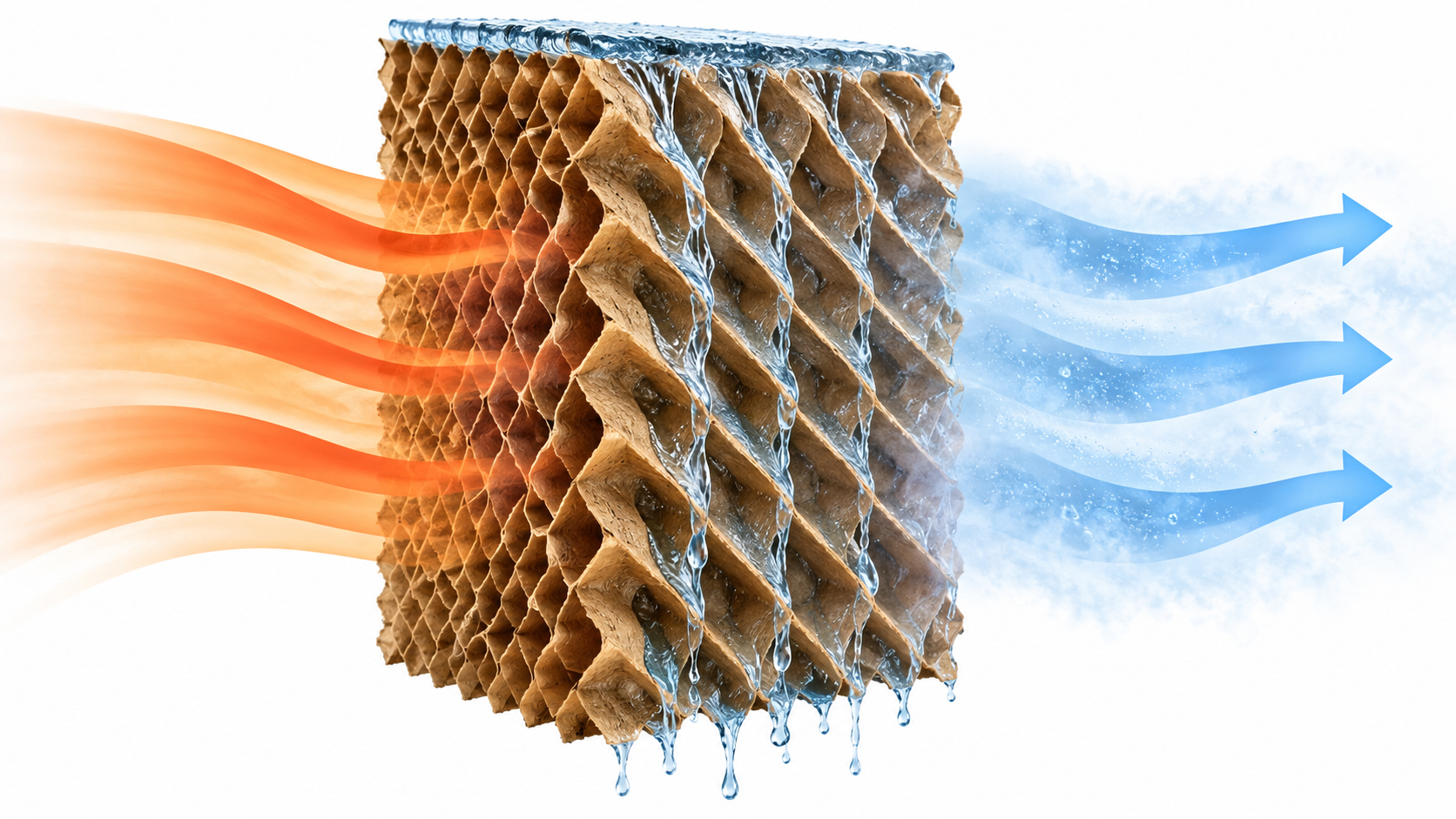
Farm cooling projects need an evaporative pad that matches the existing ventilation system, not just a familiar model number. A 5090 evaporative cooling pad can cool incoming air before fans move it through a poultry house, livestock building, or greenhouse, but the opening, pad depth, airflow and water distribution still have to match the installation.
The practical first step is to measure the equipment opening and identify the full model series. The number 5090 is not a universal size standard across manufacturers. Use it as a starting point, then confirm the finished height, width, depth, flute geometry and operating requirements with the supplier.
How does an evaporative cooling pad work on a farm?
A wetted pad cools incoming air through direct evaporation. Water moves over corrugated media while warm air passes through the channels. Some water changes into vapor and absorbs heat from the air, so the leaving air is cooler and more humid. The process depends on evaporation rather than refrigeration, and its result changes with the incoming dry-bulb temperature, wet-bulb temperature, humidity and airflow.
In a recirculating system, a pump sends water to the top of the media. Water travels down the corrugated surface, a gutter collects the unused water and the pump returns it to the distribution circuit. Even wetting and steady airflow help the pad provide consistent air-to-water contact. A pad is one part of a larger system, so it should be assessed together with the fan, cabinet, wall opening and water loop.
What does 5090 mean, and which specifications matter?
Two products marked 5090 can have different flute geometry, finished dimensions and depth options. For the RTFANS KA-5090, the product record lists a 5 mm flute height, 45°/45° flute angle, 50, 100 or 150 mm depths, and customizable dimensions. Those values describe that product configuration; they should not be treated as a universal specification for every 5090 pad.
Before ordering, compare the full model and suffix, flute height and angles, finished height and width, media depth, airflow path and the fan capacity available for the installation. If you are comparing the two media families, the 5090 vs 7090 cooling pad comparison explains why the labels alone are not enough to confirm interchangeability.
How do cellulose and honeycomb channels affect performance?
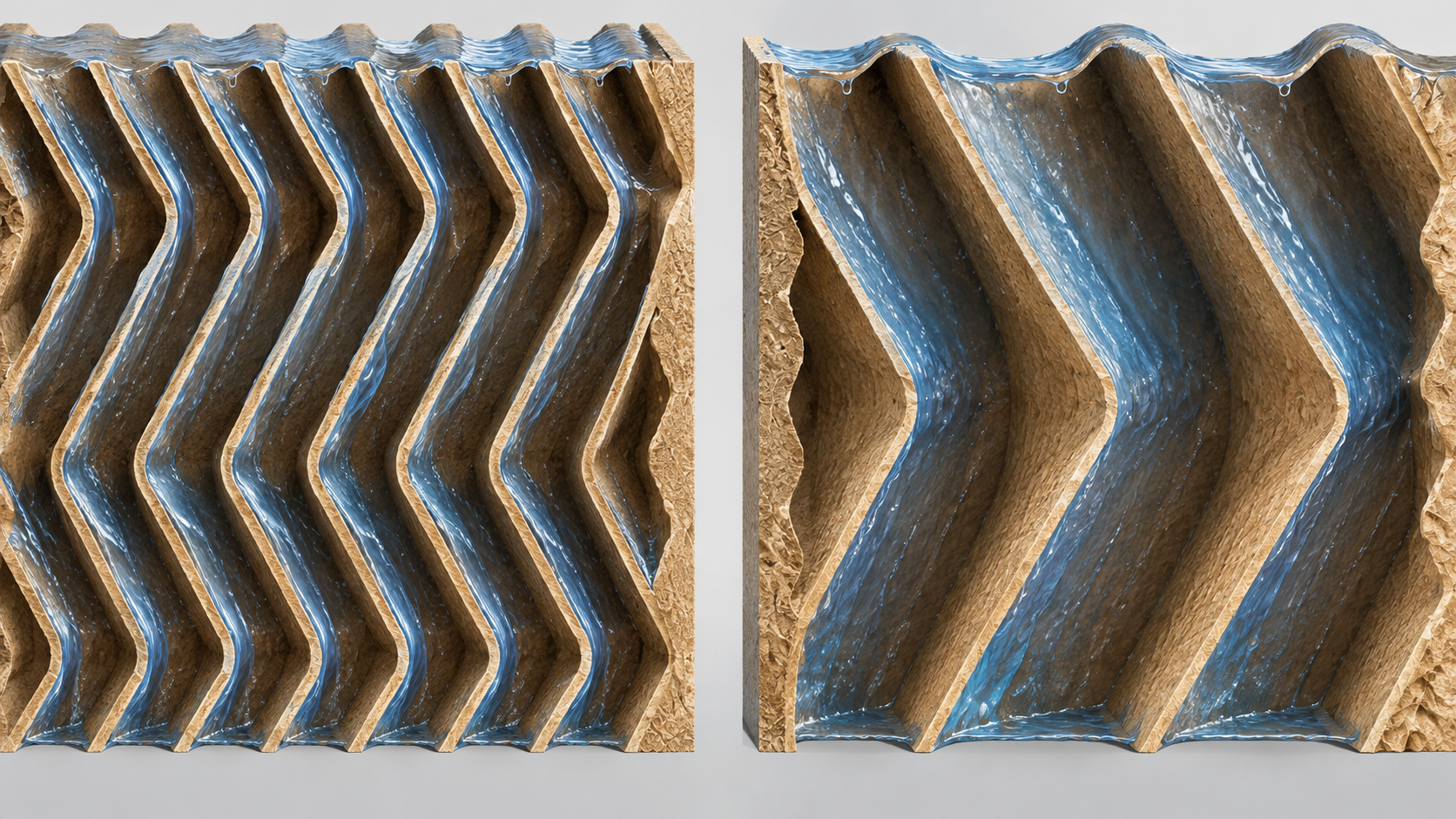
Corrugated cellulose creates a large contact surface where water and air can meet. Cross-fluted layers form honeycomb passages that support water distribution and airflow through the media. The pad still needs to be correctly supported and wetted: dry sections reduce the available contact area, while blocked or damaged channels can increase resistance to airflow.
Performance figures from one listing or test curve cannot be applied to every 5090 pad. Pressure drop depends on media depth, flute design, air velocity, wetting and the fan selected for the system. Ask the supplier to review the proposed pad with the fan and the operating conditions instead of relying on a single efficiency number.
Where can a 5090 pad be used?
A 5090 pad may be suitable for poultry housing, livestock buildings, greenhouses and compatible evaporative air coolers. The agricultural buildings application guide provides the broader planning context, while the agricultural ventilation case study shows how airflow planning and equipment selection must be considered together.
For a farm installation, check the pad area against the fan-and-pad layout, the wall or cabinet opening, the local climate and the route of the incoming air. A product listing can show possible applications, but it cannot confirm compatibility with a specific building or cooler without measurements.
How do you match the pad to a cooler or ventilation system?
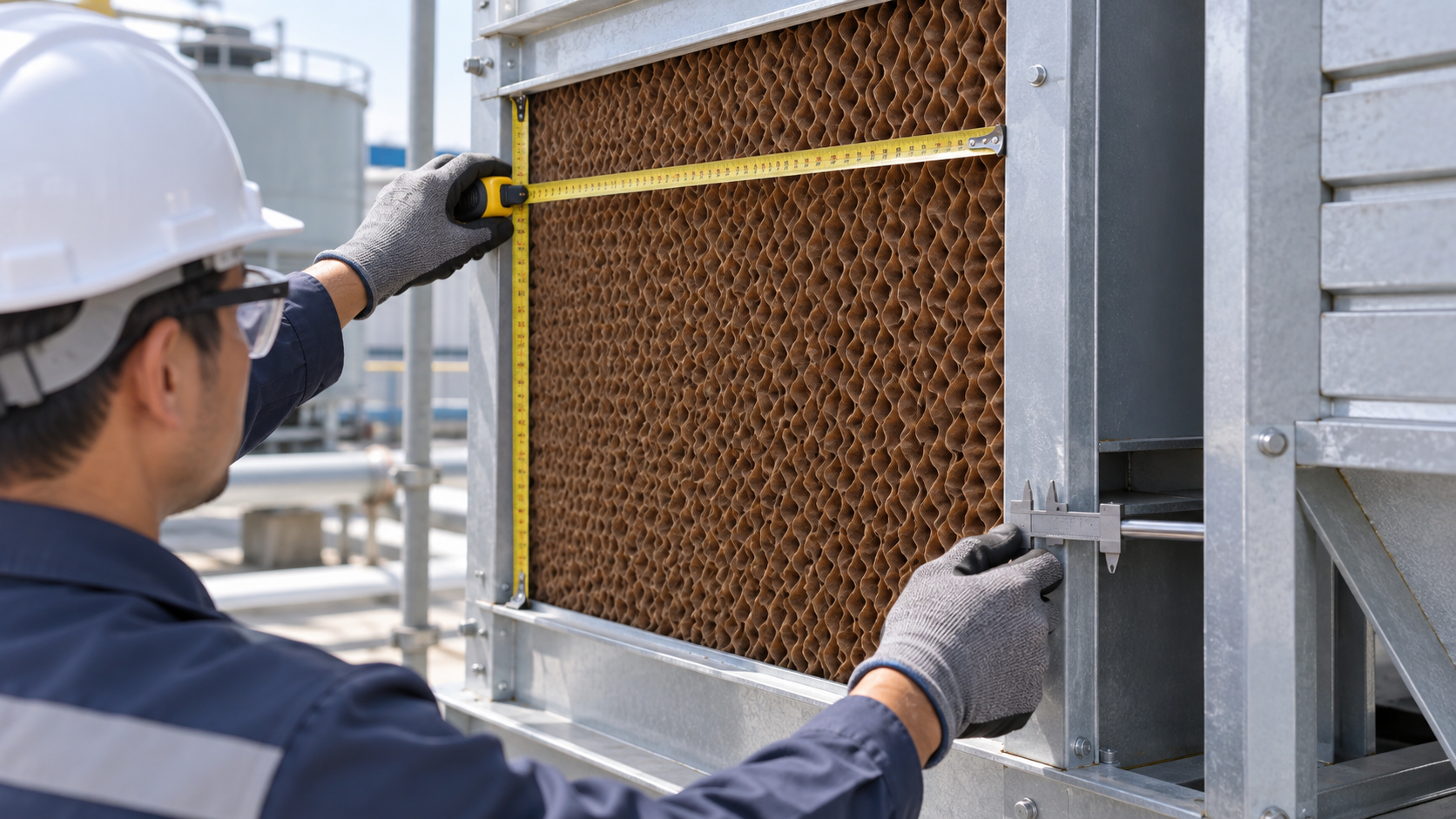
Measure the existing opening and pad directly. Record the height, width and depth in one unit, and note whether each measurement describes the clear opening, the frame or the finished pad. Also record the equipment model, fan capacity, number of pads, water distribution arrangement and the available installation space.
Depth is especially important. A deeper pad is not automatically better if the cabinet, fan or support frame was not designed for it. The fan must be able to move air through the selected media without creating an unsuitable pressure drop. Water must reach the full top edge and spread evenly across the surface during operation.
What should you check before ordering?
Ask for the exact configuration in writing. Include the full model, finished height, width, depth, quantity, application, equipment type and destination country. For OEM or replacement work, provide photos and the dimensions of the existing media so the supplier can review the fit before preparing a quotation.
- Confirm the manufacturer and complete model series.
- Compare flute geometry and media depth.
- Match the finished dimensions to the opening and frame.
- Review airflow, pressure drop and water distribution with the fan supplier.
- Request written price, delivery terms and warranty terms for the specific order.
When the configuration is clear, use the RTFANS quote request and include the measurements rather than sending only the phrase “5090 cooling pad.” That gives the engineering team enough information to review a compatible option.
How should you install and maintain the pad?
Follow the instructions for the selected pad and equipment. The frame must support the media without gaps that allow uncontrolled bypass air. A distribution pad or header above the media can help spread water across the top edge, but routine inspection is still needed.
During operation, check for dry areas, mineral scaling, blocked channels, damaged edges and uneven water flow. Keep the water circuit and gutter clean according to the equipment maker’s instructions. A self-cleaning or rot-resistant material description does not remove the need to inspect the water system and the pad surface.
Conclusion
The right 5090 cooling pad is the one confirmed for the farm’s opening, airflow, depth and water system. Model labels help narrow the search, but they do not establish fit on their own. Measure the installation, identify the full configuration and ask for a written compatibility review before placing the order.
FAQ
How much does a 5090 cooling pad cost?
There is no single comparable price because the model series, finished dimensions, depth, quantity and destination affect the quotation. Request a written quote that separates product and delivery terms.
Are 5090 and 7090 pads interchangeable?
Do not assume that they are interchangeable by name. Compare the exact dimensions, flute geometry, depth, airflow requirement and equipment design with the supplier.
How thick should a 5090 pad be?
Choose the depth that matches the cabinet or wall opening and the fan design. The KA-5090 product record lists 50, 100 and 150 mm options, but another product line may differ.
Can a 5090 pad be cut to fit?
Ask the manufacturer before cutting a finished pad. Cutting can change bonded edges, support and water flow. Request a custom size when the product line supports it.
Does evaporative cooling work in humid weather?
It can operate, but cooling potential generally falls as incoming air becomes more humid because the air has less capacity to accept additional water vapor. Review local dry-bulb and wet-bulb conditions with the equipment supplier.
Related insights
Recommended Engineering & Ventilation Guides
Why Choose Between a Fan and a Cooler? The Best Answer Might Be Both.
If you’ve been researching industrial cooling, you’ve probably seen the debate: evaporative air cooler vs. industrial fan. Which one is better? [...]
View article
Portable Air Cooler: Evaporative Cooling for Your Home | RTFANS
Portable Air Cooler: Evaporative Cooling for Your Home As the summer heat intensifies, finding an efficient and cost-effective cooling solution [...]
View article
Fresh Air First: The Overlooked Foundation of Indoor Comfort
We design for temperature. We debate setpoints, upgrade HVAC units, and chase the perfect thermostat reading. But what if our [...]
View article